Many students learning English often get confused between apologizes vs apologies. They look similar, but they are used in very different ways.
Using the wrong word can make your writing or speaking unclear. This guide explains the difference in simple words, with easy examples, mini exercises, and tips to remember.
Quick Answer: Difference Between Apologizes and Apologies
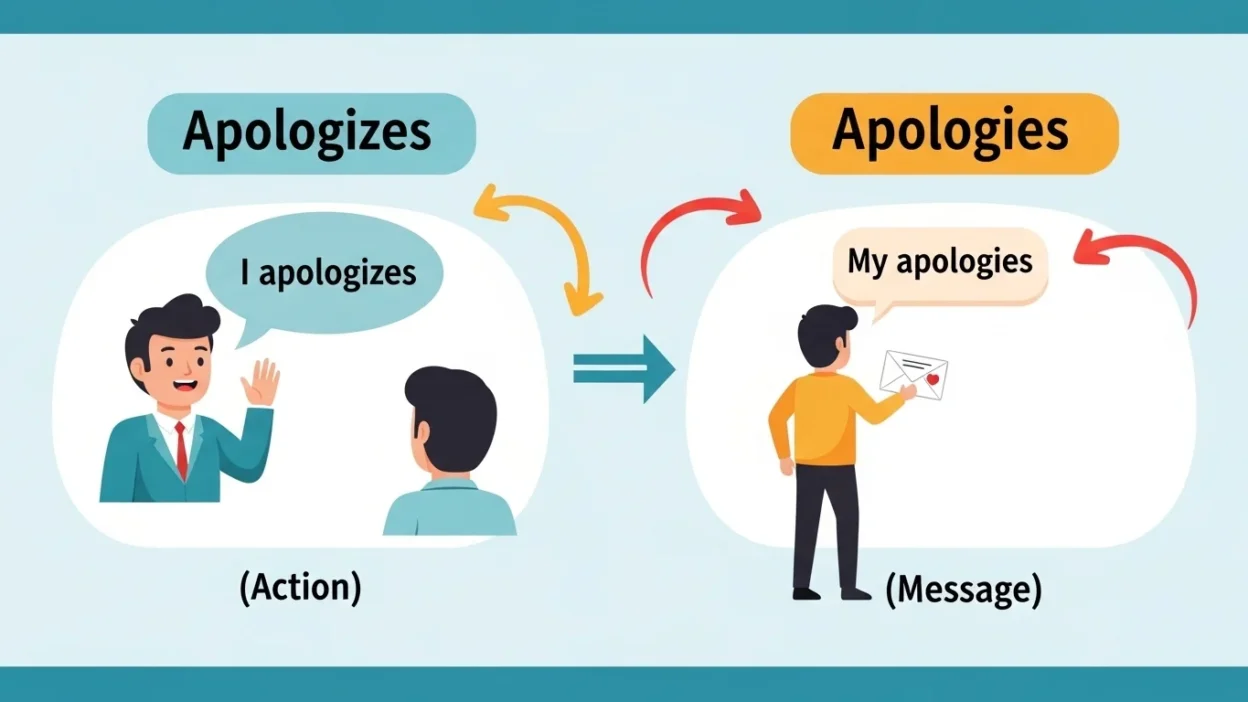
- Apologizes – Verb. The action of saying sorry.
- Example: She apologizes for being late every day.
- Example: She apologizes for being late every day.
- Apologies – Noun. The words, letters, or messages used to say sorry.
- Example: He sent his apologies for missing the meeting.
- Example: He sent his apologies for missing the meeting.
- Rule to remember: Action → apologizes, Words/Message → apologies
Understanding the Words: Apologizes Meaning and Apologies Meaning
The confusion happens because both words come from the verb apologize.
- Apologize = to say sorry (action).
- Apology = the thing that shows you are sorry (words, letter, message).
Adding “s” changes the meaning:
- Apologizes = action by he/she/it
- Apologies = plural or singular noun
Think of it like this:
- Apologizes = doing the act of saying sorry
- Apologies = the actual note, words, or message of saying sorry
Easy Comparison Table: Apologizes vs Apologies
| Feature | Apologizes | Apologies |
| Part of speech | Verb (present tense) | Noun |
| Meaning | The act of saying sorry | Words, letter, or message of saying sorry |
| Subject | He, she, it | Can be plural or singular |
| Example sentence | She apologizes for the mistake. | Please accept my apologies. |
| Usage | Action someone does | Actual note, letter, or words |
When to Use Apologizes
Use apologizes when someone does the action of saying sorry.
- Present tense, usually with he/she/it.
- Examples:
- He apologizes for being late every morning.
- She apologizes when she accidentally breaks something.
- It apologizes for any mistakes in the report.
- He apologizes for being late every morning.
Mini Exercise: Fill in the blank:
- He ______ for forgetting my birthday.
- She ______ if she says something wrong.
(Answer: apologizes, apologizes)
When to Use Apologies
Use apologies when referring to the words or messages of saying sorry.
- Can be singular (an apology) or plural (apologies).
- Examples:
- I send my apologies to my teacher.
- Their apologies were accepted by the manager.
- Please accept my apologies for the delay.
- I send my apologies to my teacher.
Mini Exercise: Choose the correct word:
- Please accept my ______ for being late.
- I sent my ______ yesterday.
(Answer: apologies, apologies)
Common Mistakes with Apologizes and Apologies
- Using apologizes as a noun
- ❌ Incorrect: I send my apologizes.
- ✅ Correct: I send my apologies.
- ❌ Incorrect: I send my apologizes.
- Using apologies as a verb
- ❌ Incorrect: She apologies for her mistake.
- ✅ Correct: She apologizes for her mistake.
- ❌ Incorrect: She apologies for her mistake.
- Wrong subject with apologizes
- ❌ Incorrect: I apologizes for the delay.
- ✅ Correct: I apologize for the delay.
- ❌ Incorrect: I apologizes for the delay.
Tip for Beginners: Remember the rule: Action = apologizes, Words = apologies
Real Life Examples of Apologizes vs Apologies
Emails
- Apologizes: John apologizes for missing your call.
- Apologies: Please accept my apologies for the delayed response.
Social Media
- Apologizes: She apologizes if her post hurt anyone.
- Apologies: He posted his apologies on Instagram.
Daily Conversation
- Apologizes: He apologizes every time he makes a mistake.
- Apologies: I offered my apologies after spilling coffee.
Short Dialogue Example
- A: “You forgot our meeting again.”
- B: “I apologize. I will not miss it next time.”
- A: “Thank you. I accept your apologies.”
Learning Tips for Beginners
- Visualize:
- Action → imagine someone bowing or speaking sorry → apologizes
- Words/message → imagine a letter or text → apologies
- Action → imagine someone bowing or speaking sorry → apologizes
- Short Sentences:
- She apologizes.
- My apologies.
- She apologizes.
- Speak aloud: This helps remember the correct word.
- Practice in Emails and Chat: Use both words in short messages.
Mini Exercise: Write two sentences: one using apologizes, one using apologies.
FAQs About Apologizes and Apologies
1. Can I say “I apologizes”?
- No. Use I apologize. “Apologizes” is only for he/she/it.
2. Is “apologies” always plural?
- Not always. One note = an apology, many notes = apologies.
3. Can I use “apologizes” in emails?
- Yes, when referring to the act. She apologizes for the inconvenience.
4. Can “apologies” be informal?
- Yes, you can say my apologies casually to friends.
5. How do I make “apologize” past tense?
- Past tense: apologized. He apologized yesterday.
6. Can “apologizes” be plural?
- No, only the noun is plural (apologies).
7. Which is correct: “send apologies” or “send apologizes”?
- Correct: send apologies.
8. Are there other forms I should know?
- Apologized (past), apologizing (present continuous), apology (singular noun).
Extra Tips to Remember the Difference
- Mnemonic:
- Apologizes = I do the action
- Apologies = the words I send
- Apologizes = I do the action
- Color Coding:
- Imagine blue for the action → apologizes
- Imagine green for the message → apologies
- Imagine blue for the action → apologizes
- Daily Practice:
- Check your emails or chats. Replace wrong words with the right one.
- Check your emails or chats. Replace wrong words with the right one.
Conclusion
Now you can confidently use apologizes vs apologies in any situation: emails, social media, or daily conversation.
- Apologizes = action of saying sorry
- Apologies = words, letters, or messages of saying sorry
Practice small sentences, read examples, and try mini exercises. Soon, using the correct word will feel natural.
With this guide, mistakes like “I apologizes” or “send apologizes” will become easy to avoid. Remember: action = apologizes, words = apologies.

Kaliyan Martan is a passionate dreamer and creative thinker who believes in turning ideas into meaningful action. With vision and dedication, he strives to make a lasting impact through innovation and authenticity.