Many students, learners, and beginners often get confused between boys, boy’s, and boys’.
These words look very similar, but each has a different meaning. Even people who speak English every day sometimes make mistakes with them.
This guide will explain everything step by step, using simple English, real life examples, and mini exercises.
By the end, you will confidently use these words in daily English, emails, social media, and school writing.
Quick Answer: Boys vs Boy’s vs Boys’
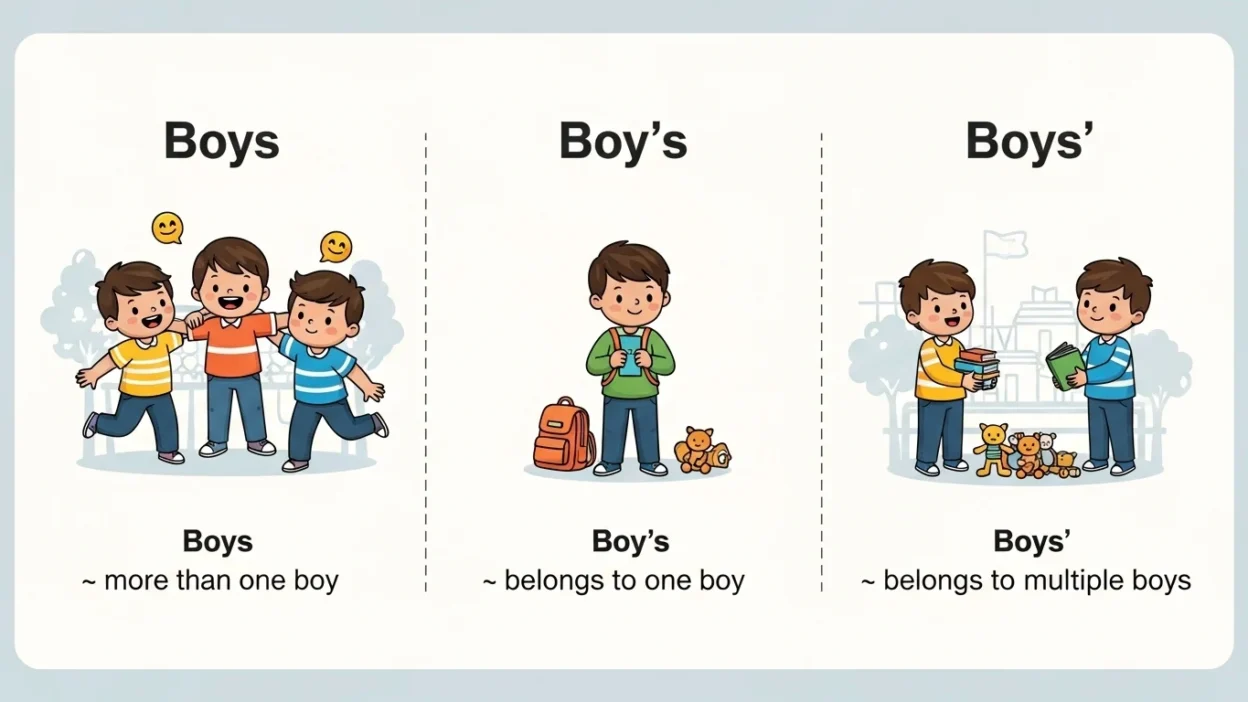
- Boys → plural noun. More than one boy.
- Example: “The boys are playing football.”
- Boy’s → possessive noun. Something belongs to one boy.
- Example: “This is the boy’s book.”
- Boys’ → plural possessive. Something belongs to more than one boy.
- Example: “The boys’ toys are in the box.”
Why People Get Confused
- Similar spelling and pronunciation – “boys” vs “boy’s” vs “boys’.”
- Plural vs possessive – beginners often forget apostrophes.
- Context matters – English uses the same base word but different rules for plural and possession.
Simple Grammar Background
- Plural nouns = more than one.
- Possessive nouns = show ownership.
- Plural possessive = more than one person owns something.
Examples:
- Plural: dog → dogs (two or more dogs)
- Singular possessive: dog → dog’s (the dog’s tail)
- Plural possessive: dogs → dogs’ (the dogs’ tails)
The same rules apply to boy → boys → boy’s → boys’.
Clear Explanation with Examples
1. Boys (Plural Noun)
- Use boys when talking about more than one boy.
- No apostrophe is needed.
Examples:
- “The boys are running in the park.”
- “All the boys in my class are friendly.”
- “Five boys like chocolate ice cream.”
Visual Tip: Imagine a group of boys standing together – no apostrophe needed for the group.
2. Boy’s (Singular Possessive)
- Use boy’s when something belongs to one boy.
- You need ’s to show ownership.
Examples:
- “The boy’s hat is blue.”
- “I borrowed the boy’s notebook.”
- “This is the boy’s favorite toy.”
Visual Tip: Picture one boy holding his own item – apostrophe shows it belongs to him.
3. Boys’ (Plural Possessive)
- Use boys’ when something belongs to more than one boy.
- The apostrophe goes after the s.
Examples:
- “The boys’ backpacks are on the floor.”
- “I like the boys’ drawings.”
- “The boys’ team won the game.”
Visual Tip: Think of a group of boys all owning something together.
Comparison Table: Boys vs Boy’s vs Boys’
| Word | Meaning | Use | Example Sentence |
| Boys | More than one boy | Plural noun | “Three boys are playing soccer.” |
| Boy’s | Belonging to one boy | Singular possessive noun | “The boy’s backpack is red.” |
| Boys’ | Belonging to more than one boy | Plural possessive noun | “The boys’ toys are in the box.” |
When to Use Each Word in Daily Life
Boys (Plural)
- Talking about two or more boys.
- Counting boys in a group.
- Writing general statements about boys.
Examples:
- Teacher: “All the boys, line up for the class.”
- Social Media: “The boys are having fun at the beach.”
- Email: “The boys will submit the project tomorrow.”
Boy’s (Singular Possessive)
- Something belongs to one boy.
Examples:
- Parent: “I like the boy’s drawing on the fridge.”
- Email: “I found the boy’s notebook you asked for.”
- Daily life: “The boy’s shoes are under the bed.”
Boys’ (Plural Possessive)
- Something belongs to more than one boy.
Examples:
- “The boys’ friends are waiting outside.”
- “I borrowed the boys’ footballs for the game.”
- “The boys’ backpacks are in the classroom.”
Common Mistakes
- Writing boy’s instead of boys for plural.
- ❌ Wrong: “The boy’s are happy.”
- ✅ Correct: “The boys are happy.”
- Forgetting apostrophes for possession.
- ❌ Wrong: “The boys toy is new.” (if it belongs to one boy)
- ✅ Correct: “The boy’s toy is new.”
- Using boy’s for multiple boys’ belongings.
- ❌ Wrong: “The boy’s toys are on the floor.” (if more than one boy)
- ✅ Correct: “The boys’ toys are on the floor.”
Mini Practice Exercises for Learners
Choose the correct word in each sentence:
- The ___ are playing football. (boys / boy’s / boys’)
- I like the ___ drawing. (boys / boy’s / boys’)
- The ___ backpacks are in the classroom. (boys / boy’s / boys’)
- The ___ toy is under the bed. (boys / boy’s / boys’)
Answers:
- boys
- boy’s
- boys’
- boy’s
Tips for Learners
- Ask yourself: “Am I talking about one or more boys?”
- Look for the apostrophe. If it has ’s, it usually shows possession.
- Read the sentence out loud to see if it sounds right.
- Practice with daily English examples from school, home, and social media.
FAQs About Boys, Boy’s, and Boys’
1. Can I use boy’s for more than one boy?
No. Use boys for plural and boys’ for plural possession.
2. How do I know if I need an apostrophe?
If something belongs to someone, use ’s for one person or s’ for more than one.
3. Is boys’ the same as boy’s?
No. Boy’s = one boy owns it. Boys’ = more than one boy owns it.
4. Can I use all three in one sentence?
Yes. Example: “The boys are visiting the boy’s house to borrow the boys’ books.”
5. Why do people confuse these words?
They look similar and sound alike. Apostrophes can be tricky for beginners.
6. Are there other words like boys and boy’s?
Yes, for example: girls / girl’s / girls’. The same rules apply.
Conclusion
Understanding boys vs boy’s vs boys’ is simple when you follow these rules:
- Boys = more than one boy (plural nouns)
- Boy’s = belongs to one boy (singular possessive)
- Boys’ = belongs to more than one boy (plural possessive)
Use daily English examples, emails, social media, and school situations to practice. Look for apostrophes and think about ownership. Soon, these words will feel natural, and you’ll avoid common grammar mistakes.

Robert Kalian is a passionate visionary dedicated to creativity, leadership, and meaningful innovation. He believes in turning ideas into action and inspiring others to achieve their highest potential.