Do commas and semicolons confuse you? You are not alone! Many beginners and learners struggle with comma vs semicolon because they look similar, but they have different rules.
This article will explain the difference between comma and semicolon, show you when to use each, give clear examples, and even include practice exercises. By the end, you’ll feel confident using both in your writing.
Quick Answer: Comma or Semicolon
Here’s a simple way to remember:
- Comma (,):
- Joins short ideas or items in a list.
- Connects two complete sentences with words like and, but, or so.
- Semicolon (;):
- Joins two full sentences without a connecting word.
- Separates items in a list when the items already have commas.
Think of a semicolon as a “soft period.” It separates strong ideas but keeps them connected.
Comma Rules for Beginners
Commas are everywhere in English writing. Beginners often overuse or underuse them. Here’s when to use a comma in lists or sentences:
- In lists:
- I bought apples, bananas, oranges, and grapes.
- Before connecting words:
- I wanted to go to the park, but it started raining.
- After introductory words or phrases:
- After dinner, we went for a walk.
- With extra information:
- My brother, who lives in Canada, is visiting next week.
- In dates, numbers, and addresses:
- On May 5, 2026, we will celebrate together.
Semicolon Rules for Beginners
Semicolons are less common but very useful. They help avoid confusion, especially in complex sentences.
- To join two full sentences:
- I enjoy reading; my sister prefers painting.
- In complex lists with commas:
- We visited Paris, France; Rome, Italy; and Madrid, Spain.
- Before words like “however” or “therefore”:
- She was tired; however, she finished her homework.
The Difference Between Comma and Semicolon
| Feature | Comma (,) | Semicolon (;) |
| Pause length | Short pause | Medium pause |
| Joining sentences | Needs a connector (and, but, so) | Joins complete sentences without a connector |
| Use in lists | Separates simple items | Separates items that already contain commas |
| Common mistake | Overusing or underusing | Using in place of a comma incorrectly |
| Example | I like coffee, tea, and juice. | I like coffee; my friend prefers tea. |
When to Use Comma vs Semicolon
Using a Comma
- In lists: I need eggs, bread, and milk.
- Before connectors: I like pizza, but my brother prefers burgers.
- After introductory phrases: After school, we went to the park.
- With extra information: My dog, who loves to run, is very fast.
Using a Semicolon
- To join complete sentences without a connector: I love movies; my sister loves books.
- In lists with commas: Our trip included Paris, France; Rome, Italy; and Madrid, Spain.
- Before words like “however” or “therefore”: He was nervous; therefore, he practiced a lot.
Common Mistakes Learners Make
| Mistake | Wrong Example | Correct Example |
| Comma splice | I love pizza, I hate pasta. | I love pizza; I hate pasta. |
| Semicolon + connector | I like coffee; and I like tea. | I like coffee; I like tea.or I like coffee, and I like tea. |
| Overusing commas | I went to the store, I bought milk, I saw my friend, and we talked. | I went to the store; I bought milk and saw my friend. |
Real Life Examples
Emails
- Comma: Hi John, I hope you are doing well.
- Semicolon: I finished the report; please review it when you can.
Social Media Posts
- Comma: Love this weather, feeling happy, ready for the weekend!
- Semicolon: Visited three countries this summer; each had its own charm.
Daily Life
- Comma: I need eggs, bread, and milk.
- Semicolon: I need eggs; my brother needs bread; my mother needs milk.
Advanced Examples for Practice
- Joining clauses with semicolons:
- I wanted to go for a run; it was raining too heavily.
- Lists with commas inside items:
- For the party, we invited Sarah, my neighbor; Tom, my cousin; and Mia, my classmate.
- Semicolon with conjunctive adverbs:
- I studied hard; therefore, I passed the exam easily.
Mini Practice Exercises
Fill in the blanks with a comma or semicolon:
- I like tea ___ my friend likes coffee.
- We traveled to London, England ___ Paris, France ___ Rome, Italy.
- I was tired ___ however, I finished my homework.
Answers:
- ;
- ; ;
- ;
Beginner Tips for Mastering Commas and Semicolons
- Remember the pause:
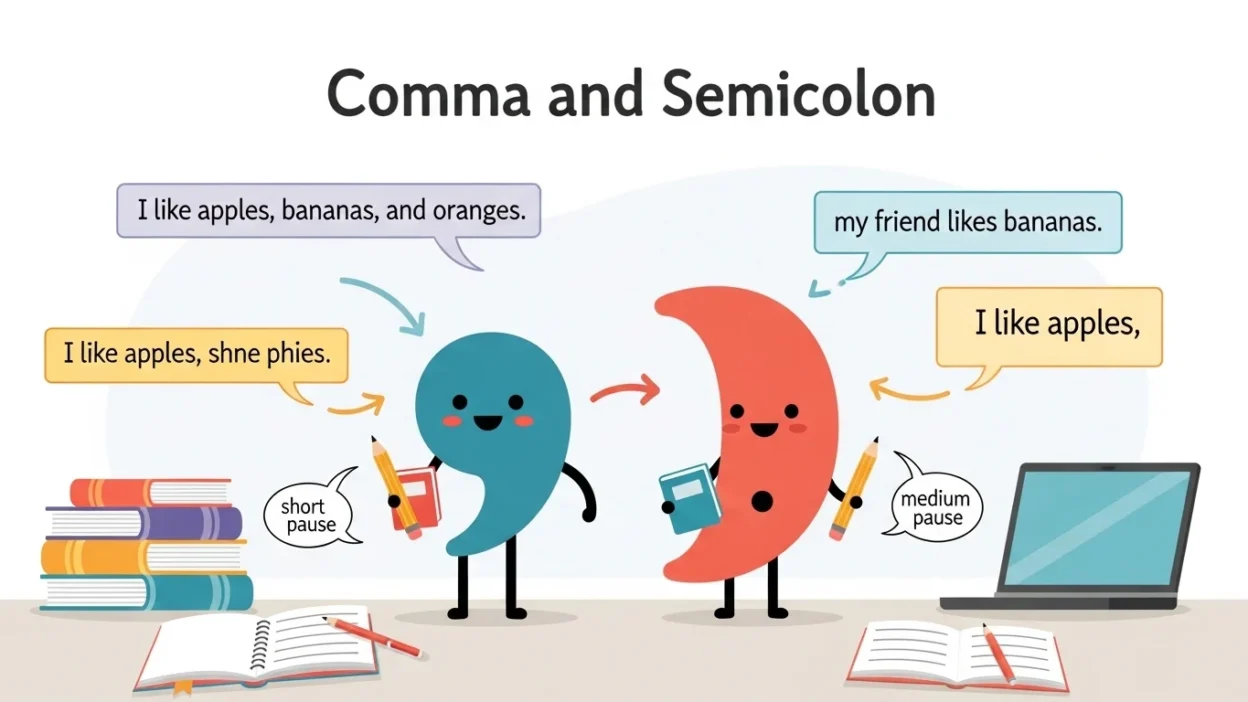
- Comma = short pause, semicolon = medium pause, period = full stop.
- Check sentence completeness:
- If both parts are full sentences, a semicolon can join them.
- Look at lists:
- If items already have commas, use semicolons to avoid confusion.
- Read aloud:
- If you naturally pause longer than a comma, a semicolon might be better.
- Practice daily:
- Write short sentences, then combine them using commas or semicolons.
FAQs About Comma and Semicolon
1. Can I always use a semicolon instead of a comma?
No. Commas are simpler and more common. Semicolons are only for specific cases.
2. Can a semicolon replace “and” or “but”?
Yes, but only when joining two full sentences.
3. Is a semicolon the same as a colon?
No. A colon introduces a list or explanation; a semicolon joins related sentences.
4. Do I need a semicolon in short sentences?
Usually not. Use a period or comma + connector instead.
5. Can I use a comma before “however”?
Yes, but a semicolon is stronger: I was tired; however, I kept working.
6. Why do lists with commas need semicolons?
Because items already have commas, semicolons prevent confusion.
7. Do native speakers always use semicolons correctly?
Not always, but learning the rule improves clarity.
8. Are semicolons important for beginners?
Yes. They make your writing clear in emails, essays, and professional texts.
Conclusion
Understanding comma vs semicolon is easier than it seems.
- Commas = short pause, use in lists or with connectors.
- Semicolons = medium pause, join complete sentences or complex lists.
Practice a few sentences every day, read aloud, and notice the pauses. Try the mini exercises above. Soon, you will use comma and semicolon correctly in all your writing.
Tip: Keep a small cheat sheet of rules and examples on your desk. It helps beginners and learners remember the differences quickly.

Mitcheel Satrac is a passionate visionary dedicated to creativity, innovation, and meaningful success. His work reflects authenticity, purpose, and a drive to make a real impact.