Many students and learners get confused with continually vs continuously. They look and sound similar, but their meanings are different. Using the wrong word can make your English unclear or awkward.
This guide will explain the difference between continually and continuously in a simple way. You will find clear examples, practical tips, exercises, and memory tricks to remember them easily.
Quick Answer: Continually vs Continuously Meaning
- Continually – happens again and again, with small breaks.
- Continuously – happens without stopping, nonstop.
Examples:
- Continually: She continually checks her phone. (She stops and starts multiple times.)
- Continuously: Water flows continuously in the river. (No breaks at all.)
Memory Tip:
- Continually = repeated
- Continuously = nonstop
Difference Between Continually and Continuously Explained
1. Continually – Repeated Actions
- Happens many times, but not all at once.
- Usually describes people or events.
Examples:
- He continually asks questions in class.
- My dog continually barks at strangers.
- She continually forgets her homework.
✅ Tip: If you can say “repeatedly” and it makes sense, use continually.
2. Continuously – Nonstop Actions
- Happens without stopping.
- Often describes natural processes, machines, or long activities.
Examples:
- The river flows continuously.
- The machine runs continuously at night.
- She studies continuously for three hours.
✅ Tip: If “without stopping” fits, use continuously.
Continually vs Continuously Comparison Table
| Feature | Continually | Continuously |
| Meaning | Again and again | Nonstop, without interruption |
| Breaks | Yes | No |
| Common Use | Actions by people or events | Machines, processes, natural events |
| Example | He continually calls his friend. | The engine runs continuously. |
| Works with “repeatedly”? | Yes | No |
| Works with “nonstop”? | No | Yes |
When to Use Continually and Continuously
Use continually when:
- Talking about repeated actions
- Action stops and starts
- Example: She continually emails her teacher for updates.
Use continuously when:
- Talking about something ongoing with no pause
- Action is natural, mechanical, or uninterrupted
- Example: The internet signal runs continuously all day.
Common Mistakes Learners Make
- Incorrect: The clock ticks continually.
Correct: The clock ticks continuously. - Incorrect: He continuously interrupts me.
Correct: He continually interrupts me. - Tip: Look for continually vs continuously examples to practice.
Real Life Examples You Can Relate To
Daily Life
- Continually: “The baby continually cries at night.”
- Continuously: “The sun shines continuously in summer in some countries.”
Social Media
- Continually: “She continually posts stories on Instagram.”
- Continuously: “The live stream runs continuously for 24 hours.”
School or Work
- Continually: “He continually asks questions in class.”
- Continuously: “The computer system checks data continuously.”
Fun Memory Tricks for Beginners
- Think of small breaks:
- Continually = actions with tiny pauses.
- Continuously = actions with no breaks.
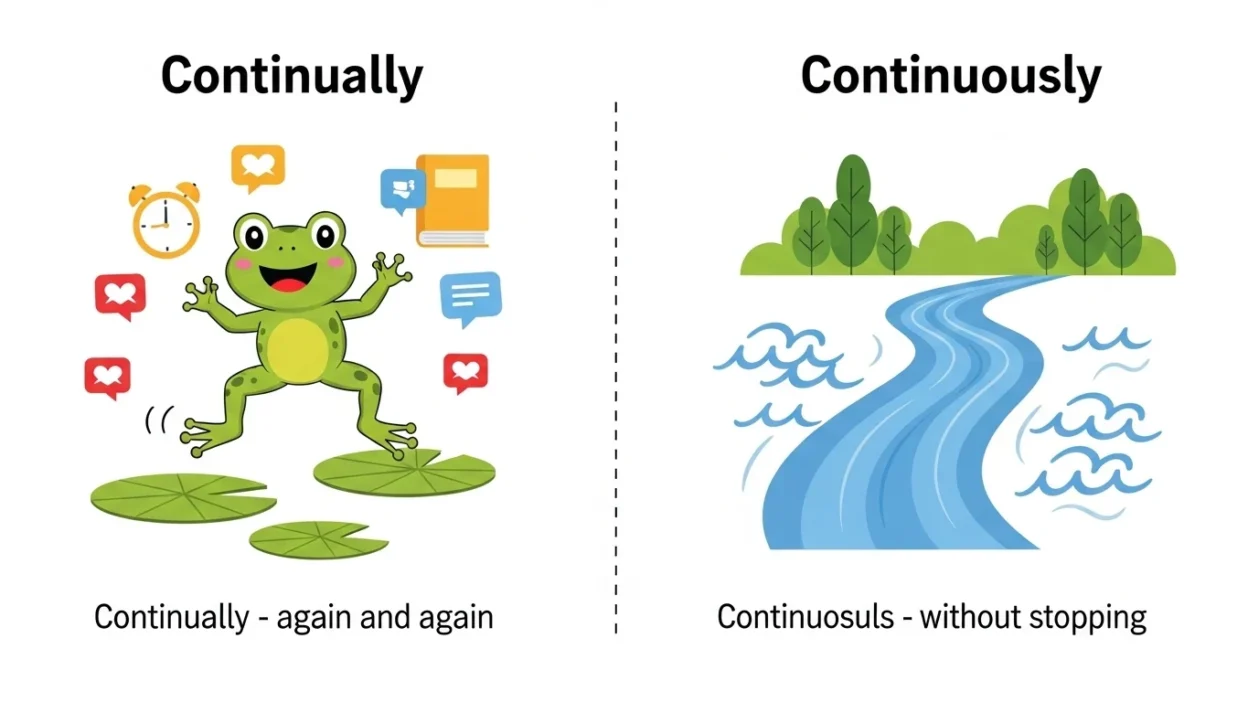
- Visual cue: Imagine:
- Continually = hopping frog (stop, start, stop)
- Continuously = flowing river (never stops)
- Practice sentences:
- Fill-in-the-blank: “She ______ (continually/continuously) practices piano every day.”
- Correct: continually
Mini Exercise: Test Yourself
Choose the correct word:
- The engine runs ______ during the night.
- He ______ forgets to do his homework.
- Water flows ______ in the fountain.
- She ______ sends me messages every hour.
Answers:
- continuously
- continually
- continuously
- continually
FAQs About Continually vs Continuously
1. Can I use them interchangeably?
No. Using the wrong word changes the meaning.
2. Which is more common in speech?
Continually, for repeated actions.
3. Which is more common in machines or science?
Continuously, for ongoing processes.
4. Can a person act continuously?
Yes, like running continuously for 30 minutes.
5. Can continually sound negative?
Sometimes, e.g., “He continually complains.”
6. How can I easily remember the difference?
Continually = again and again
Continuously = nonstop
7. Can animals act continually?
Yes, e.g., “The cat continually meows for food.”
8. What about machines?
Machines usually act continuously, e.g., “The generator runs continuously.”
Conclusion
Now you understand continually vs continuously clearly:
- Continually = repeated actions with breaks
- Continuously = nonstop actions without stopping
Practice with continually vs continuously examples, use memory tricks, and try the exercises. Soon, you will never confuse these words again.
Remember: continually = repeated, continuously = nonstop. Keep practicing, and English will feel much easier!

Mitcheel Satrac is a passionate visionary dedicated to creativity, innovation, and meaningful success. His work reflects authenticity, purpose, and a drive to make a real impact.