Many students and learners feel confused about despite or in spite. Both expressions appear in books, conversations, and school assignments.
They look different, but they often mean the same thing. Because of this, learners frequently ask about the difference between despite and in spite, how to use them correctly, and which one sounds better in a sentence.
The confusion usually happens because English sometimes expresses the same idea in multiple ways.
Quick Answer
Here is the simple explanation of despite or in spite:
- Despite and in spite of both mean “even though” or “regardless of something.”
- They are used to show contrast between two ideas.
- Despite is shorter and slightly more formal.
- In spite of is longer but very common in everyday conversation.
Examples:
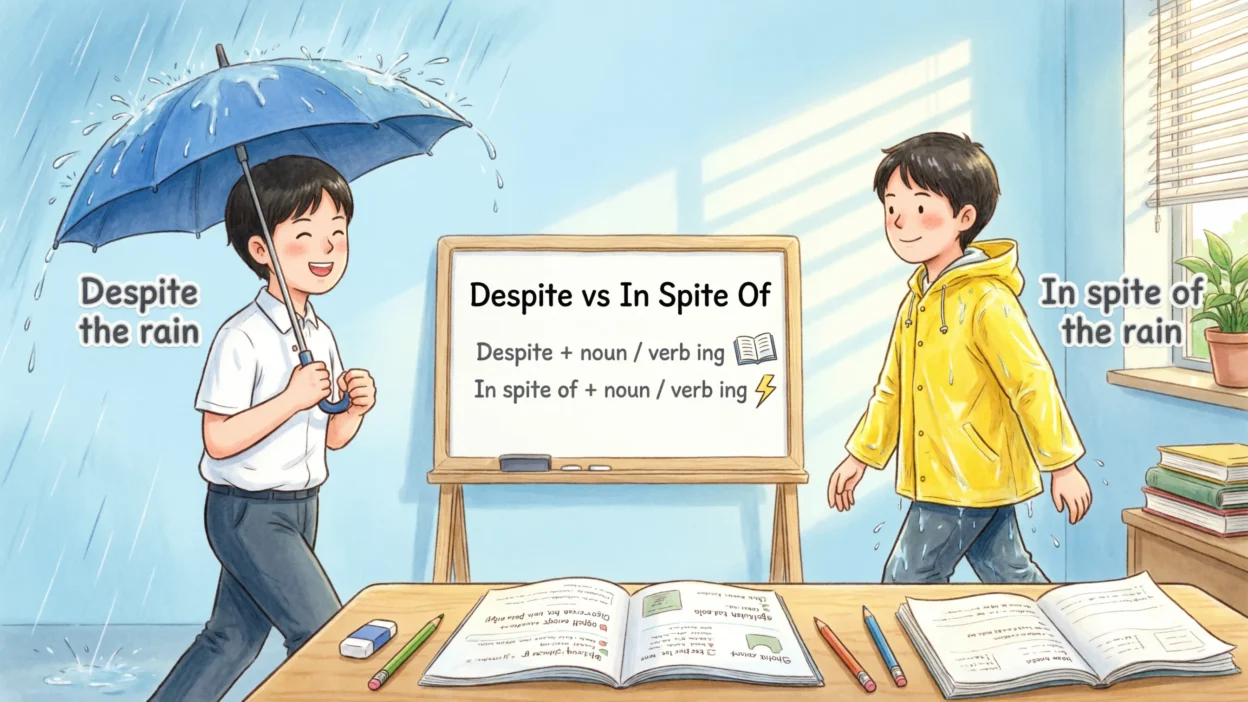
- Despite the rain, we went for a walk.
- In spite of the rain, we went for a walk.
Both sentences have the same meaning.
These sentences help explain the despite meaning with examples and the in spite of meaning with examples in everyday English.
Why These Expressions Exist
English often uses different expressions to communicate the same idea. Both despite and in spite of describe a situation where something happens even though there is a difficulty or obstacle.
For example:
- Despite the traffic, we arrived on time.
- In spite of the traffic, we arrived on time.
In both cases, the traffic did not stop the result. This is why learners often search for the difference between despite and in spite.
Sentence Structure (Easy Formula)
Understanding the sentence structure helps beginners learn faster.
Structure for Despite
Despite + noun
Despite + pronoun
Despite + verb ing
Examples of how to use despite in a sentence:
- Despite the noise, I finished my homework.
- Despite his fear, he tried the activity.
- Despite working late, she arrived early.
Structure for In Spite Of
In spite of + noun
In spite of + pronoun
In spite of + verb ing
Examples of how to use in spite of in a sentence:
- In spite of the rain, the match continued.
- In spite of her doubts, she accepted the challenge.
- In spite of feeling tired, he kept studying.
Quick Memory Tip
- Despite → never use “of”
- In spite → always use “of”
This is one of the most important despite and in spite grammar rules.
Difference Between Despite and In Spite
The despite vs in spite of difference is mainly about structure and style, not meaning.
| Feature | Despite | In Spite Of |
| Meaning | Shows contrast | Shows contrast |
| Structure | Despite + noun / verb ing | In spite of + noun / verb ing |
| Style | Slightly formal | Slightly conversational |
| Example | Despite the cold, we went out. | In spite of the cold, we went out. |
For most sentences, you can replace one with the other without changing the meaning.
When to Use Despite
Learning when to use despite is easy once you remember the structure.
Use despite when you want a short and direct sentence. It often appears in writing, reports, and academic language.
Examples:
- Despite the heavy rain, the event continued.
- Despite his busy schedule, he helped his friend.
- Despite the difficulty, the students solved the problem.
- Despite the distance, they stayed in contact.
- Despite losing the first game, the team won the series.
These sentences show practical examples of despite and in spite of used in everyday situations.
When to Use In Spite Of
Understanding when to use in spite of is also simple. It is often used in conversation and casual speech.
Examples:
- In spite of the long journey, we enjoyed the trip.
- In spite of her nervousness, she spoke confidently.
- In spite of the high price, many people bought the product.
- In spite of the delay, the meeting started successfully.
- In spite of the weather, people attended the festival.
These examples help learners understand the in spite of meaning with examples in daily communication.
Despite vs Although vs Even Though
Another common grammar question is the despite vs although difference or despite vs even though.
The main difference is sentence structure.
| Expression | Structure | Example |
| Despite | Despite + noun / verb ing | Despite the rain, we walked home. |
| In spite of | In spite of + noun / verb ing | In spite of the rain, we walked home. |
| Although | Although + full sentence | Although it rained, we walked home. |
| Even though | Even though + full sentence | Even though it rained, we walked home. |
Sentence Transformation Example
Although it was raining, we went outside.
Despite the rain, we went outside.
Even though he was tired, he finished the work.
Despite being tired, he finished the work.
This comparison helps learners understand the despite vs although difference clearly.
Common Mistakes
Many beginners make the same errors when learning despite or in spite.
Mistake 1: Using “despite of”
Incorrect
Despite of the rain, we continued walking.
Correct
Despite the rain, we continued walking.
Mistake 2: Forgetting “of” with in spite
Incorrect
In spite the noise, she studied.
Correct
In spite of the noise, she studied.
Mistake 3: Using a full sentence after despite
Incorrect
Despite he was tired, he finished the work.
Correct
Despite being tired, he finished the work.
These mistakes often appear when learners practice despite and in spite exercises.
Real Life Examples
Understanding grammar becomes easier when you see how it appears in daily communication.
School Situations
- Despite the difficult exam, the students stayed calm.
- In spite of the short preparation time, she performed well.
Workplace Examples
- Despite the tight deadline, the team completed the project.
- In spite of technical problems, the presentation continued.
Everyday Conversation
- Despite the cold weather, we went jogging.
- In spite of the late hour, the restaurant was busy.
Social Media Style
- Despite the long trip, the view was worth it.
- In spite of the cloudy sky, the sunset looked beautiful.
These examples show natural uses of despite vs in spite of in real life.
Practice Exercises
Try these simple despite and in spite exercises.
Fill in the blank with despite or in spite of.
- ______ the rain, the children played outside.
- ______ his fear, he tried the new activity.
- ______ the traffic, we reached on time.
- ______ feeling tired, she finished the project.
- ______ the difficult conditions, the team succeeded.
Possible answers:
- Despite / In spite of
- Despite / In spite of
- Despite / In spite of
- Despite / In spite of
- Despite / In spite of
Both answers work because the meaning is the same.
Beginner Learning Tips
If you are studying despite or in spite for ESL learners, these tips can help.
- Remember the meaning: both mean even though.
- Learn the structure carefully.
- Practice writing sentences every day.
- Read examples in books or conversations.
- Pay attention to common grammar mistakes.
Regular practice will make these expressions feel natural.
FAQs
What is the difference between despite and in spite?
There is almost no meaning difference. The main difference is grammar structure. Despite does not use “of,” while in spite of always includes it.
Can despite start a sentence?
Yes. It is very common.
Example:
Despite the rain, the match continued.
Can we say despite of?
No. This is incorrect grammar. Only despite should be used.
What comes after despite?
Usually a noun, pronoun, or verb ing form.
Example:
Despite the noise, I focused on my work.
Is despite formal or informal?
It is slightly more formal than in spite of, but both are widely used.
Can these expressions be used in everyday speech?
Yes. They appear in conversations, writing, social media, and academic language.
Can despite and in spite replace although?
Sometimes yes, but the sentence structure must change.
Are these expressions difficult to learn?
No. Once you understand the grammar rule and practice examples, they become easy to use.
Conclusion
Learning despite or in spite becomes simple once you understand their structure and meaning.
Both expressions show contrast and mean “even though.” The only real grammar difference is that despite is used without “of,” while in spite of always includes it.
By practicing sentences, studying examples, and remembering the key rule, students can quickly master despite vs in spite of.
With regular use in writing and conversation, these expressions will become a natural part of your English vocabulary.

Mitcheel Satrac is a passionate visionary dedicated to creativity, innovation, and meaningful success. His work reflects authenticity, purpose, and a drive to make a real impact.