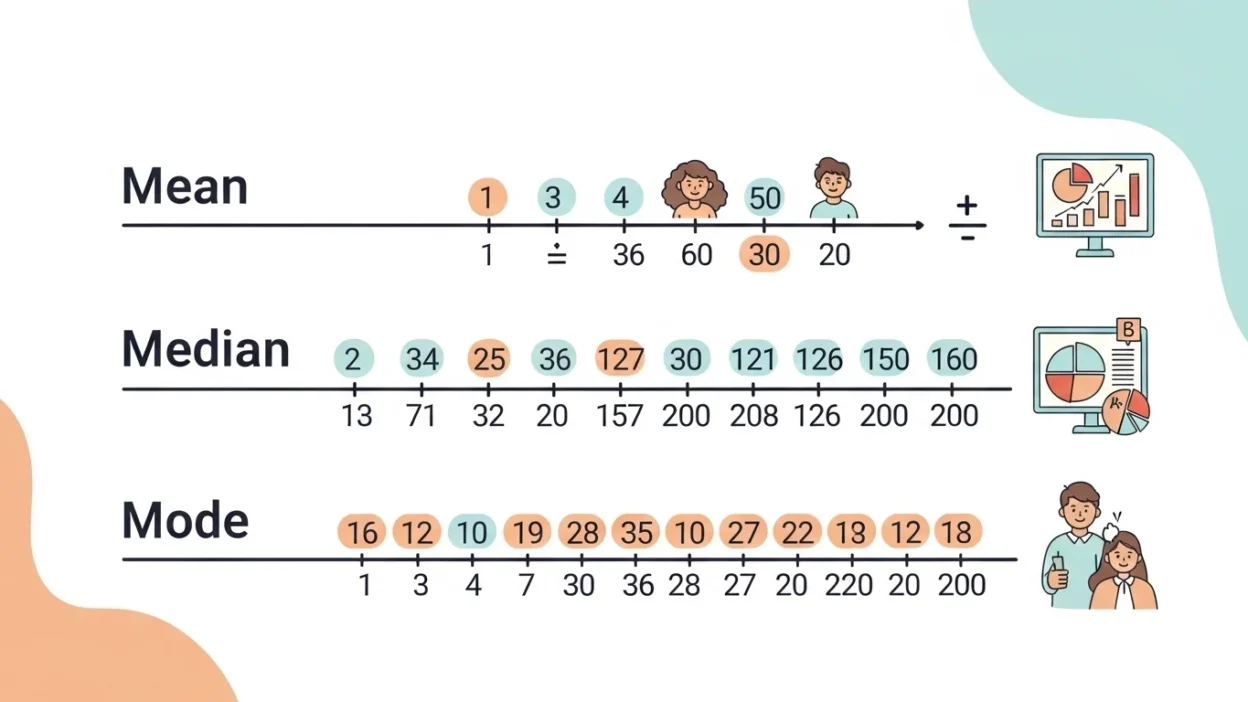
Many students and beginners get confused when they hear mean and median. Both are ways to describe the “average” of a group of numbers, but they work differently. Sometimes they give the same result, and sometimes they do not.
The confusion usually comes from:
- Both describe the center of data
- Both are called “averages” in everyday language
- Extreme numbers can affect them differently
This guide explains mean vs median for beginners and ESL learners. By the end, you will understand the difference, know how to calculate them, and see why each is useful in real life.
Quick Answer: Mean vs Median
- Mean = add all numbers, then divide by how many numbers there are
- Median = the middle number after sorting all numbers in order
- Key difference: mean uses all values; median focuses on the middle
Formulas
Mean Formula
Mean=Sum of all valuesNumber of values\text{Mean} = \frac{\text{Sum of all values}}{\text{Number of values}}Mean=Number of valuesSum of all values
Median Formula
- Sort the numbers from smallest to largest
- If odd count → middle number is median
- If even count → median = average of two middle numbers
Step by Step Calculation
Example 1: Mean
Numbers: 10, 15, 20, 25
- Add all numbers: 10 + 15 + 20 + 25 = 70
- Count numbers: 4
- Divide: 70 ÷ 4 = 17.5
Mean = 17.5
Example 2: Median
Numbers: 12, 5, 9, 20, 7
- Sort: 5, 7, 9, 12, 20
- Middle number = 9
Median = 9
Even number example:
Numbers: 4, 6, 8, 10
- Sort (already sorted)
- Two middle numbers: 6, 8
- Average: (6 + 8) ÷ 2 = 7
Median = 7
Mean vs Median: Key Difference
| Feature | Mean | Median |
| Definition | Average using all numbers | Middle value in sorted numbers |
| Formula | Sum ÷ Count | Middle number or average of two middles |
| Sensitive to outliers? | Yes | Usually no |
| Uses all numbers? | Yes | No |
| Best for | Balanced data | Data with extreme values |
| Example | Test scores | Income, house prices |
When to Use Mean
Use mean when numbers are similar and balanced:
- Test scores
- Daily temperatures
- Grades
Example:
Scores: 70, 75, 80, 85, 90
Mean = 80 (accurate summary of data)
When to Use Median
Use median when there are extreme numbers (outliers):
- Salaries
- House prices
- Survey responses
Example:
Salaries: 30,000, 32,000, 35,000, 38,000, 500,000
- Mean = 127,000 (too high because of 500,000)
- Median = 35,000 (better represents most people)
Outliers and Skewed Data
- Outliers: numbers much higher or lower than the rest
- Skewed data: when values are not evenly spread
Effect on Mean: Mean is pulled toward outliers.
Effect on Median: Median usually stays near the center.
Example:
Data: 1, 2, 3, 4, 100
- Mean = (1+2+3+4+100)/5 = 22
- Median = 3 (better represents typical value)
Mean vs Median vs Mode
Mode = the most frequently occurring number
Example: 2, 3, 3, 5, 7
- Mean = (2+3+3+5+7)/5 = 4
- Median = 3
- Mode = 3
Mode helps identify the most common value in a dataset.
Real Life Examples
- Classroom Test Scores
Scores: 60, 65, 70, 75, 80
- Mean = 70
- Median = 70
- Social Media Followers
500, 600, 650, 700, 20,000
- Mean = 4,430 (inflated)
- Median = 650 (represents typical creator)
- Monthly Spending
200, 220, 240, 260, 900
- Mean = 364
- Median = 240
- Email Response Times (minutes)
5, 7, 8, 10, 120
- Mean = 30
- Median = 8 (shows usual response time)
Beginner Friendly Practice Questions
- Find mean and median: 5, 8, 10, 12, 15
- Find mean and median: 3, 3, 4, 7, 20
- Find mean and median: 10, 20, 30, 40
- Identify the effect of outliers: 2, 3, 5, 100
Tip: Practice with small lists first and sort numbers carefully for median.
FAQs
1. Is mean the same as average?
Yes, usually in everyday language, average = mean.
2. Can median be different from mean?
Yes, especially if there are extreme numbers.
3. Which is better, mean or median?
Depends on the data:
- Use mean for balanced data
- Use median when there are outliers
4. Can median be higher than mean?
Yes, in skewed data with low outliers.
5. What is mode?
The number that appears most often. Mode is helpful with repeating values.
6. Why do economists use median income?
Median is less affected by very high incomes, so it better reflects typical earnings.
7. Do you always sort numbers for mean?
No. Sorting is only needed for median.
8. Can median be a number not in the list?
Yes, when averaging the two middle numbers in an even set.
Conclusion
The mean vs median difference is simple once you understand their calculation methods:
- Mean = sum ÷ count, affected by all numbers including extremes
- Median = middle value, less affected by outliers
Use mean for balanced data and median when data includes extreme numbers. Add mode if you want to know the most common value.
By practicing with small datasets, sorting numbers, and spotting outliers, you can easily understand mean vs median for beginners.
Once learned, these concepts make reading statistics, analyzing data, and understanding averages much easier.

Mitcheel Satrac is a passionate visionary dedicated to creativity, innovation, and meaningful success. His work reflects authenticity, purpose, and a drive to make a real impact.