Many students and English learners feel confused when they see words like dogs, dog’s, or students’. These words look almost the same, but their meanings are different. The confusion usually happens because both plural and possessive nouns often end with the letter s.
People often ask questions like:
- Is it dogs or dog’s?
- Should I write teachers or teacher’s?
- What are the plural vs possessive rules?
Understanding the difference between plural and possessive nouns is important because these forms appear in emails, homework, social media posts, and everyday conversations.
The good news is that this grammar rule is actually simple. Once you learn a few easy rules and practice with examples, you will quickly understand plural vs possessive grammar.
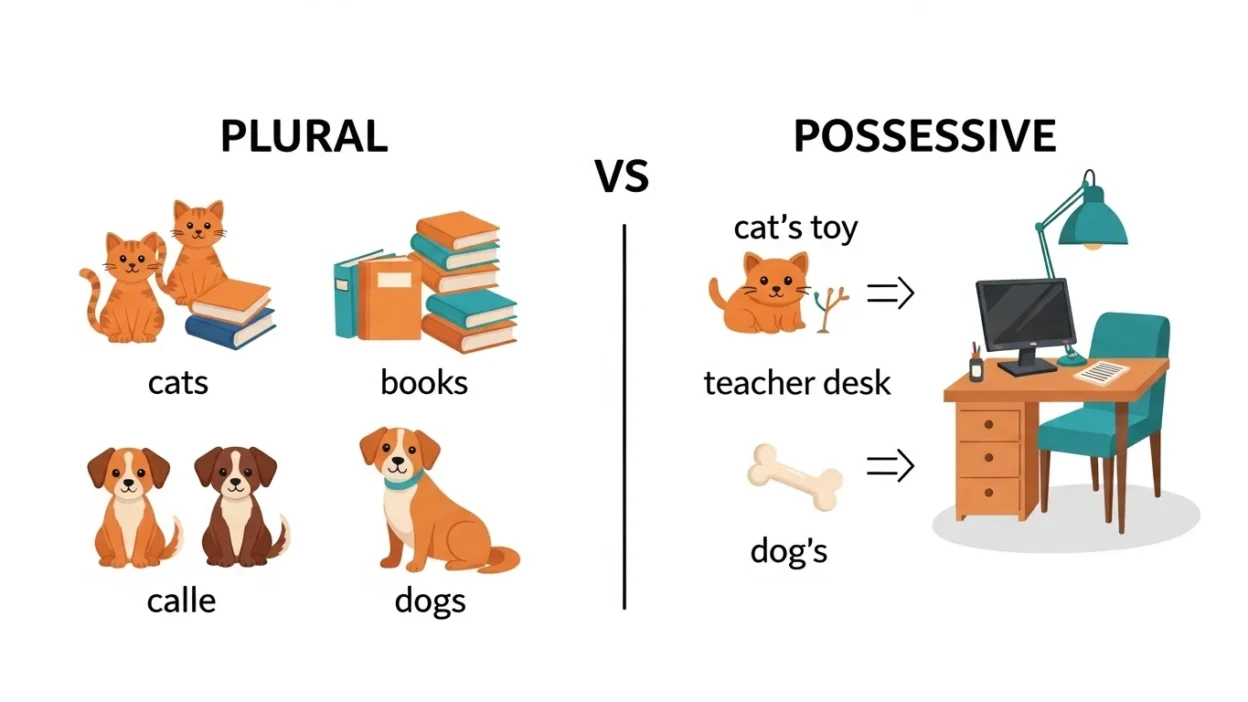
Quick Answer: Plural vs Possessive
Here is the simplest explanation.
Plural nouns
- Show more than one person, place, or thing
- Usually add s or es
- Do not use an apostrophe
Examples:
- cats
- books
- teachers
Example sentence:
- The dogs are barking.
Possessive nouns
- Show ownership or belonging
- Use an apostrophe (’)
Examples:
- cat’s toy
- teacher’s desk
- student’s notebook
Example sentence:
- The dog’s collar is blue.
These are basic plural or possessive examples that show the main difference.
Simple Background of Plural and Possessive Nouns
English grammar uses small changes at the end of words to change meaning. One common change is adding the letter s.
But the letter s can mean two different things:
- Plural – more than one
- Possessive – ownership
This is why learners sometimes struggle with plural vs possessive apostrophe rules.
Look at these two words:
- students
- student’s
They look similar but mean very different things.
Understanding the plural vs possessive difference will help you choose the correct word when writing.
The 3 Step Method to Choose Plural or Possessive
A simple method can help you decide quickly.
Step 1: Ask “Is there more than one?”
If yes → use plural
Example:
- Two cats
- Three cars
Step 2: Ask “Does something belong to someone?”
If yes → use possessive
Example:
- cat’s tail
- teacher’s book
Step 3: Check the Apostrophe
- No apostrophe → plural
- Apostrophe → possessive
This method makes plural vs possessive rules much easier to remember.
Comparison Table: Plural vs Possessive
| Feature | Plural | Possessive |
| Meaning | More than one | Shows ownership |
| Apostrophe | No | Yes |
| Example | dogs | dog’s |
| Sentence | The dogs are running. | The dog’s toy is red. |
| Key Idea | Quantity | Belonging |
This table clearly shows the difference between plural and possessive nouns.
When to Use Plural Words
Plural nouns are used when talking about more than one thing.
Talking About Groups
Examples:
- The students are studying.
- The birds are flying.
- The cars are parked outside.
Describing Multiple Items
Examples:
- I bought three books.
- The trees are tall.
- These phones are expensive.
General Statements
Examples:
- Dogs are loyal animals.
- Teachers help students learn.
- Computers are powerful tools.
These are common plural noun examples used in everyday English.
When to Use Possessive Words
Possessive nouns are used when something belongs to someone or something.
Showing Ownership
Examples:
- Emma’s backpack
- Ali’s bicycle
- The cat’s food
Showing Relationships
Examples:
- My brother’s friend
- The teacher’s advice
Showing Parts of Something
Examples:
- The car’s engine
- The house’s roof
These examples help learners understand plural vs possessive examples in sentences.
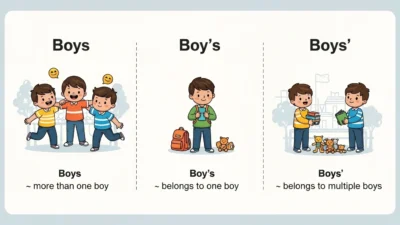
Singular Possessive vs Plural Possessive
Sometimes nouns can show both plural and possession.
Singular Possessive
One owner.
Example:
- student’s book
Meaning: the book belongs to one student.
Plural Possessive
Many owners.
Example:
- students’ books
Meaning: the books belong to many students.
Another example:
- teachers’ meeting
This means a meeting for many teachers.
This concept is important for understanding plural possessive nouns explained simply.
Common Plural vs Possessive Mistakes
Many learners make the same grammar mistakes.
Mistake 1: Using Apostrophes for Plurals
Incorrect:
- Apple’s for sale
- Car’s outside
Correct:
- Apples for sale
- Cars outside
Plural nouns do not use apostrophes.
Mistake 2: Forgetting the Apostrophe
Incorrect:
- The teachers desk is big.
Correct:
- The teacher’s desk is big.
The desk belongs to the teacher, so we need ’s.
Mistake 3: Mixing Singular and Plural Possessive
Example:
- Student’s homework → one student
- Students’ homework → many students
Understanding these mistakes helps learners master plural vs possessive grammar.
Real Life Examples
Example in an Email
Hello Anna,
I found your sister’s notebook in the classroom.
Example on Social Media
Plural:
- I love these photos from the trip.
Possessive:
- David’s photo is my favorite.
Example in Daily Conversation
Plural:
- The kids are playing outside.
Possessive:
- The kid’s ball rolled away.
Example at Work
Plural:
- The employees are in a meeting.
Possessive:
- The manager’s office is upstairs.
These situations show how plural or possessive nouns appear in daily communication.
Quick Cheat Sheet
Plural → more than one
Example: cats, cars, books
Possessive → ownership
Example: cat’s toy, teacher’s desk
Plural possessive → ownership by many
Example: cats’ toys
This quick summary helps students remember plural vs possessive rules easily.
Practice: Plural or Possessive?
Choose the correct word.
- The dog(s / dog’s) tail is wagging.
- The teacher(s / teacher’s) office is closed.
- The student(s / student’s) are studying.
- The cat(s / cat’s) food is on the floor.
Answers:
- dog’s
- teacher’s
- students
- cat’s
Practice helps learners understand plural and possessive nouns for students and beginners.
FAQs
1. What is the main difference between plural and possessive nouns?
Plural nouns show more than one thing, while possessive nouns show ownership.
2. What are simple plural vs possessive examples?
Examples include:
- cats (plural)
- cat’s toy (possessive)
3. Why do possessive nouns use apostrophes?
The apostrophe shows that something belongs to someone.
4. Can a noun be plural and possessive at the same time?
Yes. Example:
- Teachers’ lounge
This means the lounge belongs to many teachers.
5. Do all plural nouns end in “s”?
Most do, but some irregular nouns include:
- children
- men
- women
6. Why do learners confuse plural vs possessive?
Both forms often end with s, which makes them look similar.
7. How can beginners learn plural vs possessive rules?
Practice reading sentences, writing examples, and noticing apostrophes in everyday writing.
Conclusion
Understanding plural or possessive nouns becomes easy when you focus on meaning.
Remember the main ideas:
Plural nouns show more than one thing.
Examples:
- dogs
- books
- students
Possessive nouns show ownership or belonging.
Examples:
- dog’s toy
- teacher’s desk
- student’s notebook
The apostrophe is the key sign of possession.
With practice and attention, learners can easily understand the difference between plural and possessive nouns and use them confidently in writing, speaking, and everyday communication.

Kaliyan Martan is a passionate dreamer and creative thinker who believes in turning ideas into meaningful action. With vision and dedication, he strives to make a lasting impact through innovation and authenticity.