Do you often wonder whether to use relieve or relief? Many students and learners get confused because these words look similar and both deal with easing stress or problems.
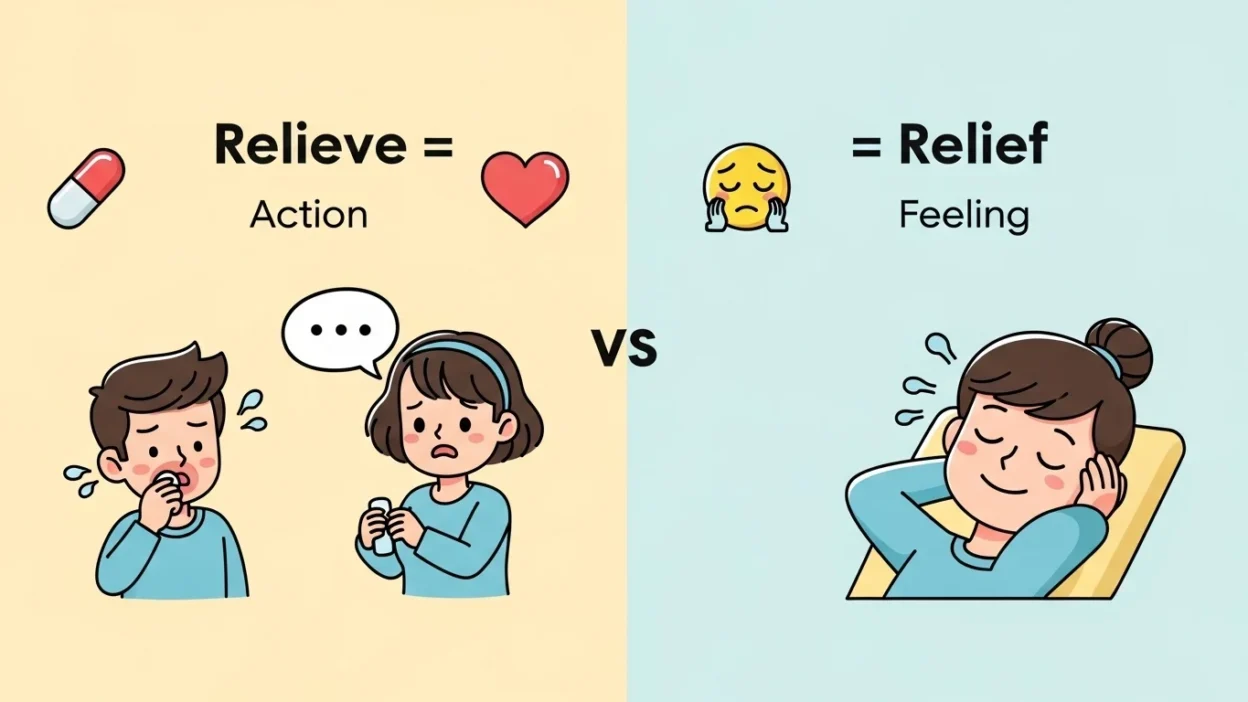
The difference is simple once you understand it: one is an action, and the other is a feeling.
This guide will explain everything clearly, with easy examples, daily conversation tips, emails, and common mistakes. By the end, you will never mix them up again.
Quick Summary: Relieve vs Relief
Here’s a fast answer before diving deeper:
- Relieve – verb. It means to do something to reduce stress, pain, or worry.
- Example: “A hot shower can relieve sore muscles.”
- Example: “A hot shower can relieve sore muscles.”
- Relief – noun. It means the feeling of comfort or freedom from stress, pain, or worry.
- Example: “I felt relief when my homework was done.”
- Example: “I felt relief when my homework was done.”
Tip: Think: Relieve = action → Relief = feeling.
What Is the Difference Between Relieve and Relief?
- Relieve is about taking action to make a problem smaller.
- Relief is the resulting feeling after the problem is eased.
Example in Daily Life:
- You relieve your headache by taking medicine.
- You feel relief after the medicine works.
Example in Social Media:
- “Meditation helps relieve anxiety.”
- “Finally submitted my project—what a relief!”
Comparison Table
| Feature | Relieve | Relief |
| Part of Speech | Verb | Noun |
| Meaning | To reduce stress, pain, or worry | Feeling of comfort or ease |
| Example | “This cream can relieve itching.” | “She felt relief after the test ended.” |
| Question Test | Can I do it? → Yes | Can I feel it? → Yes |
| Related Words | ease, reduce, help | comfort, calm, release |
When to Use Relieve
Use relieve when you are taking action to reduce stress, pain, or worry.
Examples:
- “A short walk can relieve tension after work.”
- “She gave him chocolate to relieve his sadness.”
- “Exercise helps relieve stress.”
- “Medicine can relieve a headache.”
Tip: If you can replace the word with “make better” or “reduce,” it’s usually relieve.
When to Use Relief
Use relief when you are talking about a feeling after a problem is solved.
Examples:
- “He felt relief when the exam ended.”
- “It was a relief to hear the good news.”
- “There’s a sense of relief when the storm passes.”
Tip: If you can replace the word with “comfort” or “calm,” it’s usually relief.
Common Mistakes
- Wrong: “I want to relief my headache.”
Correct: “I want to relieve my headache.” - Wrong: “He felt relieve after the exam.”
Correct: “He felt relief after the exam.” - Using relief as a verb.
- Forgetting that relieve is action → relief is feeling.
Real Life Examples
Emails
- “I hope this solution helps relieve your concerns.”
- “It’s a relief to know you received the report.”
Social Media Posts
- “Yoga helps relieve stress after a busy day.”
- “Finally passed my exam—what a relief!”
Daily Conversations
- Relieve: “This cream will relieve the itching.”
- Relief: “Ah, relief! The headache is gone.”
Workplace Example
- Relieve: “The manager relieved the team’s workload before the deadline.”
- Relief: “There was relief in the office once the deadline passed.”
Short Learning Section for Beginners
Step 1: Identify the type of word.
- Action (verb) → relieve
- Feeling (noun) → relief
Step 2: Fill in the blanks with the right word.
- “I want to ___ my friend’s stress.” → relieve
- “She felt ___ when the noise stopped.” → relief
Step 3: Use daily examples to practice.
- “This tea can relieve my headache.”
- “There is relief after finishing my homework.”
FAQs
1. Can I use relieve as a noun?
No. Use relief as the noun form.
2. Can relief be a verb?
No. Always use relieve for actions.
3. Are there similar confusing word pairs?
Yes. For example, “excite” (verb) vs “excitement” (noun).
4. Can relieve be used for objects?
Yes. “This cream can relieve itching.”
5. Can relief describe anything other than stress?
Yes. Relief can be for pain, fear, workload, or problems.
6. How can I remember the difference?
Think: Relieve = do something → Relief = feel something.
7. How do I use these words in emails?
- “I hope this solution relieves your concerns.”
- “It’s a relief to know everything is on track.”
8. Can I use these words on social media?
Yes. “Meditation relieves stress” or “Finally, relief!” are both natural.
Conclusion
Confusing relieve vs relief is common, but easy to fix. Remember: relieve is the action you take to make a problem smaller, and relief is the feeling afterward.
Practice using them in daily conversation, emails, social media, and writing. By understanding the difference and using real life examples, your English will sound natural, confident, and clear.

Robert Kalian is a passionate visionary dedicated to creativity, leadership, and meaningful innovation. He believes in turning ideas into action and inspiring others to achieve their highest potential.