English can be tricky. Some words confuse students, beginners, and learners even if they have been studying for years.
One of the most common problems is knowing when to use saw vs seen. Many people mix them up.
This guide explains everything in simple English, with easy examples, real-life sentences, and mini exercises. By the end, you will confidently know the difference between saw and seen.
Quick Answer: Saw or Seen
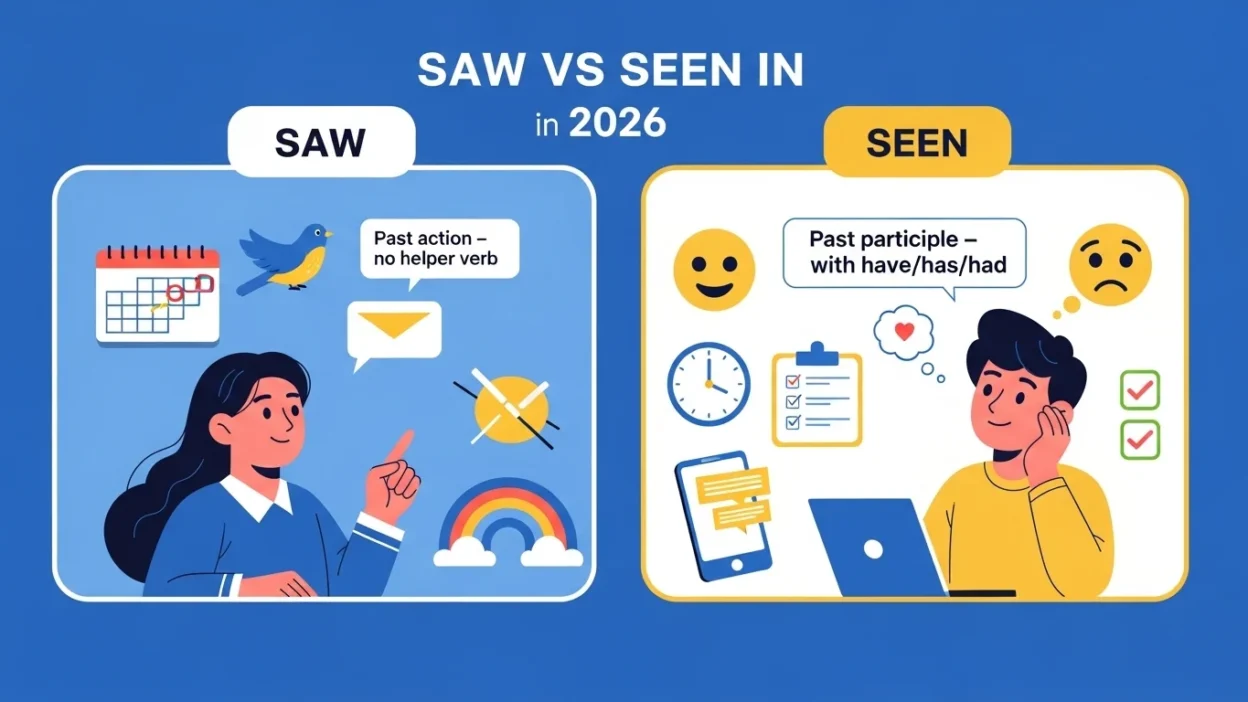
- Saw – the past tense of see. Use it for actions that happened at a specific time.
- Example: I saw a bird yesterday.
- Seen – the past participle of see. Always use it with have, has, or had.
- Example: I have seen that movie before.
Remember: Saw = past action, Seen = experience or past action with helper verb.
Why People Get Confused
Many learners struggle because both words talk about the past.
- Saw = simple past, works alone.
- Seen = past participle, needs have, has, or had.
Once you remember this rule, using them correctly is easy.
Forms of the Verb “See”
| Form | Use | Example |
| See | Present tense | I see a cat. |
| Saw | Past tense (simple past) | I saw a cat yesterday. |
| Seen | Past participle | I have seen that cat before. |
Think: see → saw → seen. Each step has a different job.
Saw vs Seen: Simple Rules
| Word | Form | Use without helper verb? | Example |
| Saw | Past tense of see | Yes | I saw a dog on the street. |
| Seen | Past participle of see | No, needs have/has/had | She has seen that show before. |
Tip: If you are talking about a specific past moment, use saw.
If you are talking about experience or past + present, use seen.
When to Use “Saw”
Use saw for actions that happened at a specific past time.
Examples:
- I saw my friend at school yesterday.
- We saw a rainbow after the rain.
- He saw the accident happen.
Mini Exercise: Fill in the blank with saw:
- Yesterday, I ___ a funny video online.
- She ___ a movie last night.
When to Use “Seen”
Use seen only with have, has, or had. It shows experience or a past action that connects to now.
Examples:
- I have seen that movie twice.
- She has seen her cousin this week.
- They had seen the new building before it opened.
❌ Wrong: I seen a movie yesterday.
✅ Correct: I saw a movie yesterday.
Mini Exercise: Choose the correct word (seen or saw) with a helper verb:
- I have ___ that show before.
- She has ___ the email already.
Common Saw vs Seen Mistakes
- Using seen alone:
- ❌ I seen him yesterday.
- ✅ I saw him yesterday.
- Forgetting the helper verb:
- ❌ She seen the email already.
- ✅ She has seen the email already.
- Confusing past tense and past participle:
- ❌ We have saw that play.
- ✅ We have seen that play.
Tip: If it sounds strange without have, has, or had, use saw instead of seen.
Real Life Examples
Daily Conversation
- “Did you see the news?”
- “Yes, I saw it this morning.”
- “I have seen that news before.”
Social Media
- “Just saw this funny video!”
- “I have seen this meme many times.”
Emails
- “I saw your message yesterday.”
- “I have seen the attached file and reviewed it.”
Storytelling
- “Yesterday, I saw a strange bird in the park.”
- “I have seen many birds, but that one was new to me.”
Beginner Friendly Tip
Think of it like this:
- Saw = “snapshot of the past” (a clear moment).
- Seen = “experience bridge” (needs have/has/had).
This mental picture makes it easier to remember.
Practice Section
Fill in the blanks with saw or seen:
- I ___ a rainbow yesterday.
- She has ___ that video before.
- We ___ our neighbors at the park last week.
- They have ___ this show many times.
Answers: 1) saw, 2) seen, 3) saw, 4) seen
FAQs
1. Can I use “seen” instead of “saw”?
No. “Seen” always needs have, has, or had.
2. Is “saw” only for yesterday?
No. “Saw” can be any time in the past.
3. Can I use “seen” in questions?
Yes. Example: “Have you seen this movie?”
4. Which is more common in speaking?
Both are common. Remember: saw alone, seen with have/has/had.
5. What about “I seen him yesterday”?
Incorrect. Say: “I saw him yesterday.”
6. Can “seen” be used in storytelling?
Yes, for experiences: “I have seen many sunsets.”
7. How can I remember the difference?
Think: Saw = simple past, Seen = past participle with a helper verb.
Conclusion
Confusion between saw vs seen is normal. The rules are simple:
- Saw = past tense of see, no helper verb.
- Seen = past participle of see, must use have, has, or had.
Practice short sentences every day, check if you need a helper verb, and use the mini exercises above. Soon, using saw and seen correctly will feel natural.

Kaliyan Martan is a passionate dreamer and creative thinker who believes in turning ideas into meaningful action. With vision and dedication, he strives to make a lasting impact through innovation and authenticity.