Many people get confused between sitting vs seating. They sound similar, but their meanings are very different. Even native speakers sometimes mix them up.
Understanding the difference between sitting and seating helps you speak, write, and read English more confidently.
This guide explains everything in simple English, with real life examples, exercises, and clear rules for beginners and learners.
Quick Answer: Sitting vs Seating
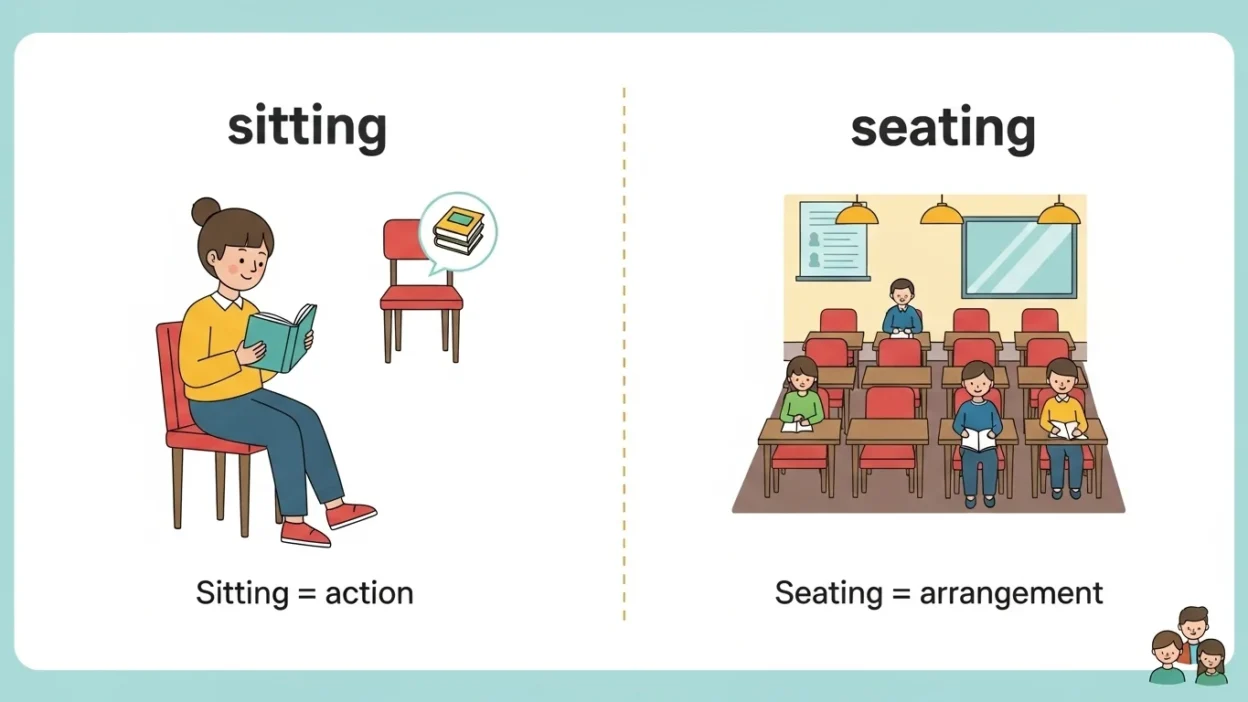
- Sitting – The action of resting your body on a chair, bench, or floor.
- Seating – The arrangement or capacity of seats.
- Tip: Talking about what someone is doing? Use sitting. Talking about chairs, arrangements, or space? Use seating.
Understanding the Words: Background for Beginners
English often has words that look similar but mean different things.
- Sitting meaning: Comes from the verb “sit”, describing the action.
- Seating meaning: Comes from the noun “seat”, describing arrangement or setup.
Simple memory trick:
- Sitting = action → what you do.
- Seating = setup → how many places there are or how they are arranged.
Detailed Explanation with Examples
1. Sitting
Sitting is all about the action of resting.
- Form: Verb (usually in continuous tense).
- Examples in daily life:
- “I am sitting on the bus in Karachi.”
- “She is sitting under a tree in the park.”
- “We were sitting quietly during class.”
- “I am sitting on the bus in Karachi.”
Tip for learners: If you can replace it with “resting on a seat,” it is sitting.
2. Seating
Seating is about space, arrangement, or number of seats.
- Form: Usually a noun.
- Examples in daily life:
- “The cinema has 300 seating spaces.”
- “The wedding hall has a special seating arrangement for families.”
- “This café offers outdoor seating.”
- “The cinema has 300 seating spaces.”
Tip for learners: If it describes chairs, plans, or capacity, use seating.
Comparison Table: Sitting vs Seating
| Feature | Sitting | Seating |
| Part of speech | Verb (action) | Noun (arrangement) |
| Meaning | Resting on a chair, bench, or floor | Arrangement or capacity of seats |
| Example 1 | “I am sitting on the sofa.” | “The theater has 200 seating spaces.” |
| Example 2 | “He is sitting quietly in class.” | “Check the seating arrangement for the party.” |
| Focus | What someone is doing | How seats are arranged or numbered |
| Common mistake | Using it to mean arrangement | Using it to describe action |
When to Use Sitting vs Seating
Use Sitting When:
- Describing an action someone is doing.
- Talking about yourself or others physically resting.
Examples:
- “I am sitting at my desk in school.”
- “The child is sitting on the bus.”
- “We enjoy sitting in the garden.”
Use Seating When:
- Talking about the number of seats.
- Explaining arrangements in restaurants, theaters, or events.
- Planning or describing space for people to sit.
Examples:
- “The stadium’s seating capacity is 50,000.”
- “Please follow the seating arrangement in the classroom.”
- “Outdoor seating is available at this café.”
Common Mistakes with Sitting vs Seating
- Wrong: “I like the seating on the bench.”
Correct: “I like sitting on the bench.” - Wrong: “The sitting in the hall is full.”
Correct: “The seating in the hall is full.” - Mixing action and arrangement:
- Confusing: “We are checking the seating by the window.”
- Correct: “We are checking the sitting by the window.”
- Confusing: “We are checking the seating by the window.”
Tip: Ask yourself: Am I talking about doing it (action) or the place (setup)?
Real Life Examples for Beginners
Emails
- Sitting: “I will be sitting in the meeting at 2 PM.”
- Seating: “Check the seating arrangement for tomorrow’s seminar.”
Social Media
- Sitting: “Just sitting in my room, enjoying the rain 🌧️.”
- Seating: “The new café has amazing outdoor seating ☕.”
Daily Life
- Sitting: “He is sitting on the bus in Lahore.”
- Seating: “The restaurant offers comfortable seating arrangement for families.”
Mini Exercises for Practice
- Fill in the blanks:
- “She is ___ on the sofa.” → sitting
- “The theater’s ___ is full.” → seating
- Choose the correct word:
- “We need more (sitting / seating) for the party.” → seating
- “I like (sitting / seating) under the tree.” → sitting
- True or False:
- “Seating is always the action someone is doing.” → False
- “Sitting describes resting on a chair.” → True
FAQs
- Can I say “seating on the chair”?
No. Use sitting on the chair. - Is sitting a noun?
Usually, it is a verb. Only in formal events like “a sitting of parliament” is it a noun. - Can I use seating for one person?
Usually not. Seating refers to arrangements or multiple seats. - Which is more common in daily conversation?
Sitting is more common. Seating is mainly in formal or event contexts. - Are there other forms of seating?
Yes: seating plan, seating arrangement, seating capacity. - Can I say “I am seating here”?
No, correct is “I am sitting here.” - Tip to remember:
Action = sitting, setup = seating. Imagine the “ing” in sitting as the action you are doing right now.
Quick Memory Tip / Cheat Sheet
| Word | Use | Example |
| Sitting | Action / What you do | “I am sitting on the bus.” |
| Seating | Arrangement / Setup | “The café has outdoor seating.” |
Conclusion
Sitting vs seating is simple once you remember:
- Sitting = action of resting on a seat
- Seating = arrangement or number of seats
Use the exercises, examples, and cheat sheet in this guide. With practice, you’ll use both words correctly and confidently.
Beginners and learners can now stop confusing sitting vs seating in daily life, emails, social media, or school.

Robert Kalian is a passionate visionary dedicated to creativity, leadership, and meaningful innovation. He believes in turning ideas into action and inspiring others to achieve their highest potential.