Have you ever stared at a set of numbers in a homework problem and wondered, “What does mean mean in math?” 😅 It might sound confusing at first, especially if you’ve only heard “mean” used as someone being unkind.
But in the world of math, mean is a simple, powerful concept that helps you summarize data quickly.
Whether you’re analyzing test scores, calculating averages for your sports stats, or just curious about mean in math meaning, understanding this concept is essential.
By the end of this guide, you’ll know exactly how to calculate mean, when to use it, and how it differs from median and mode.
Quick Answer:
In math, mean means the average of a set of numbers. It’s a neutral, friendly term used to describe the central value of a group of numbers.
🧠 What Does Mean Mean in Math?
In mathematics, the mean is another word for average. It shows the “central value” of a data set. This is different from median (middle number) or mode (most frequent number), but all three are ways to describe data.
How to calculate the mean:
- Add up all the numbers in the set.
- Divide the sum by the total number of numbers.
Example 1: Calculating a simple mean
You got quiz scores: 80, 90, 100.
Step 1: Add them together
80 + 90 + 100 = 270
Step 2: Divide by the number of scores
270 ÷ 3 = 90
✅ The mean = 90
Example 2: Mean with decimals
Your weekly study hours are: 2.5, 3, 4.5, 3.5.
Sum: 2.5 + 3 + 4.5 + 3.5 = 13.5
Divide by 4: 13.5 ÷ 4 = 3.375 hours
In short:
Mean = Average = Central value of a set of numbers
📊 Real Life Applications of Mean
Knowing the mean in math isn’t just for school it’s useful in everyday life:
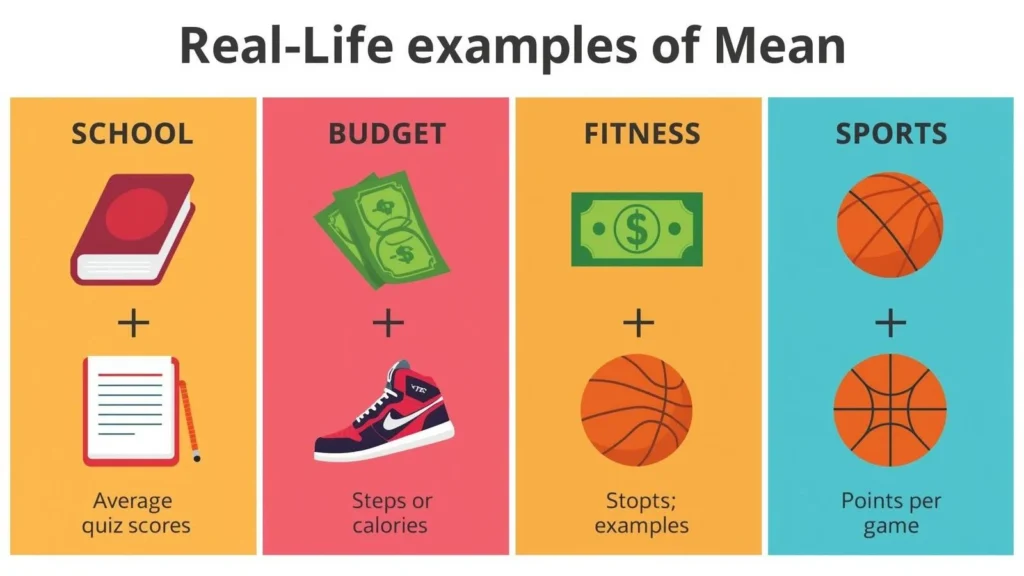
- School & Grades: Calculate average test scores or GPA.
- Budgeting: Average monthly spending to manage finances.
- Sports: Find average points scored per game.
- Health & Fitness: Average daily steps or calories.
- Weather: Calculate average temperature over a week or month.
Example: You walked 4000, 5000, 6000, 7000, 8000 steps in a week.
Sum = 4000+5000+6000+7000+8000 = 30,000
Divide by 5 days = 6,000 steps average
This helps you track progress and set goals.
📱 Step by Step Guide: How to Calculate Mean
Here’s a simple step by step approach for beginners:
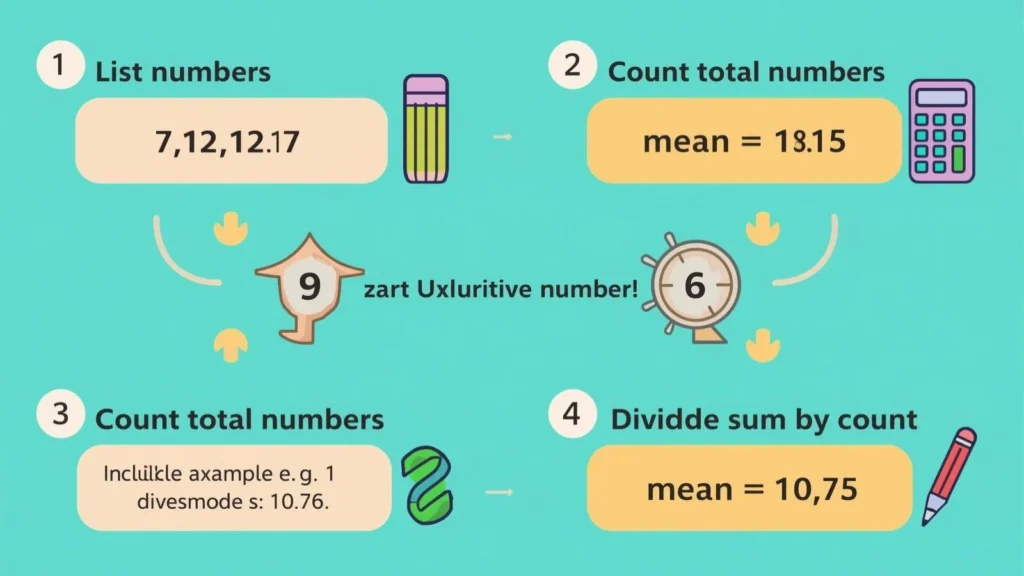
- List all numbers clearly
- Add them together → Use a calculator if needed
- Count the total numbers
- Divide the sum by the count
Example:
Numbers: 7, 9, 12, 15
Step 1: Add → 7 + 9 + 12 + 15 = 43
Step 2: Count numbers → 4
Step 3: Divide → 43 ÷ 4 = 10.75
✅ Mean = 10.75
Tip: If your dataset has a lot of numbers, organize them in a table for easier calculation.
🕓 When to Use Mean
✅ Best situations for using mean:
- Summarizing data sets like scores or measurements
- Comparing groups (e.g., average sales per month)
- Tracking progress over time (study hours, fitness stats)
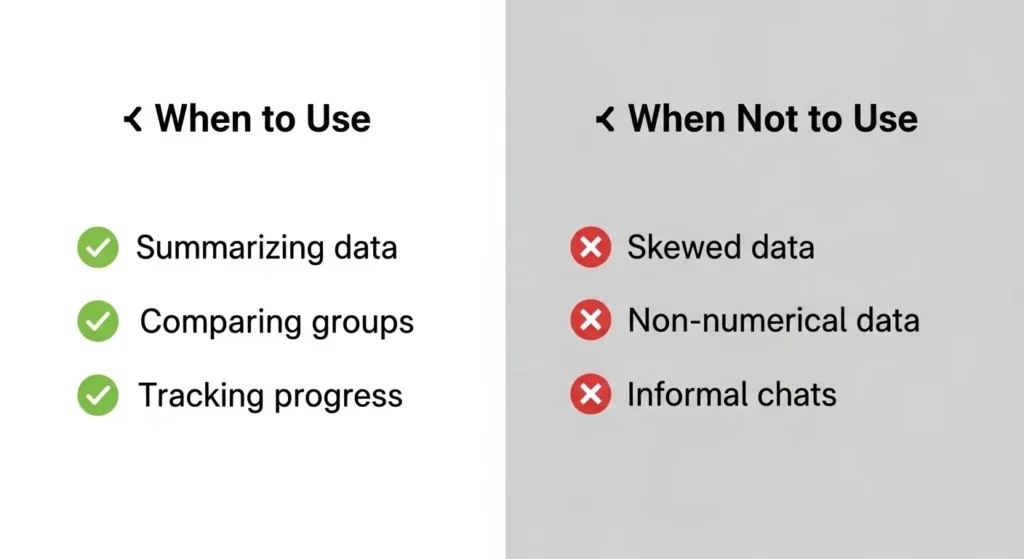
❌ When not to rely on mean:
- Datasets with extreme outliers (e.g., 1 person earns $10,000, 1 earns $1,000,000) — median may be better.
- Non-numerical data (e.g., colors, names).
- Informal conversation where numbers aren’t relevant.
Comparison Table:
| Context | Example Phrase | Why It Works |
| Classroom | “The mean score is 85” | Clear & academic |
| Office report | “The average monthly sales = $12,500” | Professional & precise |
| Daily life | “You walked an average of 6,000 steps this week” | Practical & relatable |
🔄 Mean vs Median vs Mode
Understanding mean in math is easier when you compare it to other measures of central tendency:
| Term | Meaning | When to Use |
| Mean | Average of all numbers | Standard summary of data sets |
| Median | Middle number | Data with outliers (skewed data) |
| Mode | Most frequent number | Identifying popular/recurring values |
Example: Numbers: 3, 5, 7, 7, 10
- Mean = (3+5+7+7+10)/5 = 32 ÷ 5 = 6.4
- Median = 7 (middle number)
- Mode = 7 (most frequent)
💬 Examples of Mean in Math Problems
Example 1:
Q: Find the mean of 10, 12, 14, 16
A: (10+12+14+16) ÷ 4 = 52 ÷ 4 = 13
Example 2:
Q: Weekly scores: 85, 90, 95, 80
A: Sum = 350, divide by 4 → Mean = 87.5
Example 3:
Q: Average test marks for 5 students: 70, 75, 80, 85, 90
A: Mean = (70+75+80+85+90)/5 = 80
Example 4: Real-life scenario:
Steps walked: 5000, 7000, 6000, 8000
Mean steps = (5000+7000+6000+8000)/4 = 6500 steps
❓ FAQs About Mean
Q1: Can mean be negative?
A: Yes! For numbers below zero, like temperatures, the mean can also be negative.
Q2: Can mean be a decimal?
A: Absolutely. Many datasets produce decimal averages.
Q3: How do I calculate mean for a large dataset?
A: Add all numbers carefully (spreadsheet helps) and divide by the total count.
Q4: Is mean always the best measure of central tendency?
A: Not always. For skewed data or outliers, median is more accurate.
Q5: Can I use mean for non-numerical data?
A: No. Mean only works for numbers.
Q6: Difference between mean and average?
A: They are the same — “mean” is the formal math term.
Q7: Where can I learn more about mean?
A: Check authoritative sites like Khan Academy or Math Is Fun.
✅ Conclusion
Understanding what does mean mean in math is simple once you know the steps. It’s the average, a neutral and practical way to summarize numbers in school, work, or daily life.
With a clear formula and a few examples, anyone can calculate the mean confidently.
Whether it’s for grades, fitness goals, or budgeting, mastering mean helps you make sense of numbers quickly.