Do you ever get confused between accept vs except? You are not alone. These words sound very similar but mean completely different things. Using the wrong one can make your sentence confusing.
Good news: After reading this, you will know exactly how to use accept and except. You’ll see examples, easy tips, pronunciation help, and real life usage. By the end, you’ll never mix them up again.
Quick Answer: Accept vs Except
Here’s a fast, easy way to remember:
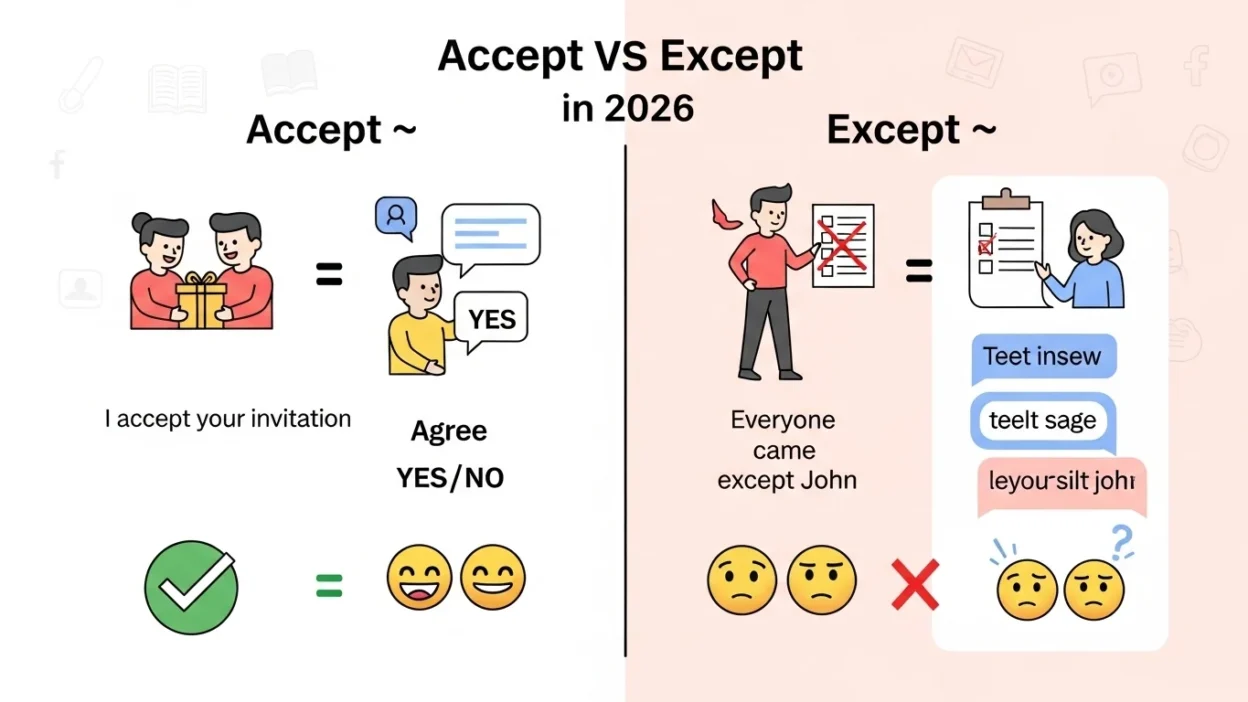
- Accept (verb) – to agree, take, or say yes ✅
- Example: I accept your invitation.
- Except (preposition) – to exclude or leave out ❌
- Example: Everyone came to the party except John.
Tip for ESL learners:
- Pronounce accept as /ək-ˈsept/ → think “agree or receive.”
- Pronounce except as /ik-ˈsept/ → think “exclude or leave out.”
Why People Confuse Accept vs Except
- They sound almost the same in spoken English.
- Some students use except when they mean accept.
- Others forget the difference when writing emails, social media posts, or essays.
The key is to link the word to its meaning:
- Accept = yes / take / agree
- Except = leave out / exclude
Difference Between Accept and Except
| Word | Type | Meaning | Example |
| Accept | Verb | To agree, receive, take | I accept your apology. |
| Except | Preposition | To exclude, leave out | I like all fruits except bananas. |
Remember: Think “A = Agree” and “Ex = Exclude”.
How to Use Accept
Accept is used when you agree or receive something:
- Agreeing: She accepted the job offer.
- Receiving: He accepted the gift happily.
- Approval: I accept your explanation.
Mini Exercise: Fill in the blank:
- I ___ your invitation to the party. → ✅ accept
How to Use Except
Except is used when you leave something out:
- Excluding people or things: Everyone passed the test except Sara.
- Highlighting an exception: I eat all vegetables except broccoli.
- In schedules or lists: We are open every day except Monday.
Mini Exercise: Fill in the blank:
- All students came ___ John. → ✅ except
Real Life Examples of Accept vs Except
Emails
- Accept: Dear Mr. Khan, I accept your invitation to the seminar.
- Except: All team members must attend the meeting, except those on leave.
Social Media / Chat
- Accept: I accept your friend request!
- Except: I follow all my classmates except the ones I don’t know.
Daily Life
- Accept: I accept your apology; it’s okay.
- Except: I like every ice cream flavor except strawberry.
Tip: Use colors or emojis when learning:
- ✅ Accept → 💚 (yes / receive)
- ❌ Except → ❌ (leave out / exclude)
Common Mistakes
- Mixing up accept and except:
❌ “I will except your offer.” → ✅ “I will accept your offer.” - Using accept to mean leave out:
❌ “All students accept John came late.” → ✅ “All students except John came late.” - Forgetting meaning in fast speech:
Always pause: Am I saying yes (accept) or leaving out (except)?
Beginner Friendly Learning Tips
- Memory trick: A = Agree, Ex = Exclude.
- Practice daily: Write short sentences using accept vs except.
- Use flashcards:
- Card 1: “Accept = ___” → Agree / Receive
- Card 2: “Except = ___” → Exclude / Leave out
Quick mini quiz:
- I ___ your apology. → ✅ accept
- Everyone came ___ Ali. → ✅ except
FAQs About Accept vs Except
1. Can accept and except be used interchangeably?
No. They have completely different meanings.
2. Is except only used in negative sentences?
No. It simply means “excluding,” even in positive sentences.
3. Can accept be a noun?
No, accept is always a verb. The noun form is acceptance.
4. Can except start a sentence?
Yes: Except for Tom, everyone arrived on time.
5. Are there common phrases with except?
Yes: except for, with the exception of, everyone/something except.
6. How can I practice accept vs except?
Read examples, write sentences, and check meaning: Am I agreeing or excluding?
7. Can I use except in casual speech?
Yes, for example: Everyone’s ready except me.
8. Pronunciation tips for learners:
- Accept = /ək-ˈsept/ → think “agree”
- Except = /ik-ˈsept/ → think “exclude”
Conclusion
Accept vs except may sound tricky, but with these simple tips, real-life examples, and mini exercises, you will always know the difference.
- Accept = agree, take, receive ✅
- Except = exclude, leave out ❌
Use the table, practice in emails, chat, and daily conversations.
Remember the memory trick: A = Agree, Ex = Exclude. Soon, using accept vs except correctly will become automatic.

Robert Kalian is a passionate visionary dedicated to creativity, leadership, and meaningful innovation. He believes in turning ideas into action and inspiring others to achieve their highest potential.