English has many words that sound the same but mean different things. These words often confuse students, beginners, and learners. A very common example is cue vs que vs queue.
Many people hear the sound “kyoo” and are not sure which spelling is correct. Some write cue, others write que, and sometimes the correct word should actually be queue.
Because these three words look similar and sound the same, learners often ask questions like:
- What is the difference between cue and queue?
- Is que correct in English?
- When should I use cue vs queue vs que?
This guide explains everything in very simple English. By the end, you will clearly understand the cue meaning in English, the queue meaning, the que definition, and how to use each word correctly in everyday sentences.
Quick Answer: Cue vs Que vs Queue
If you want a fast explanation, here it is:
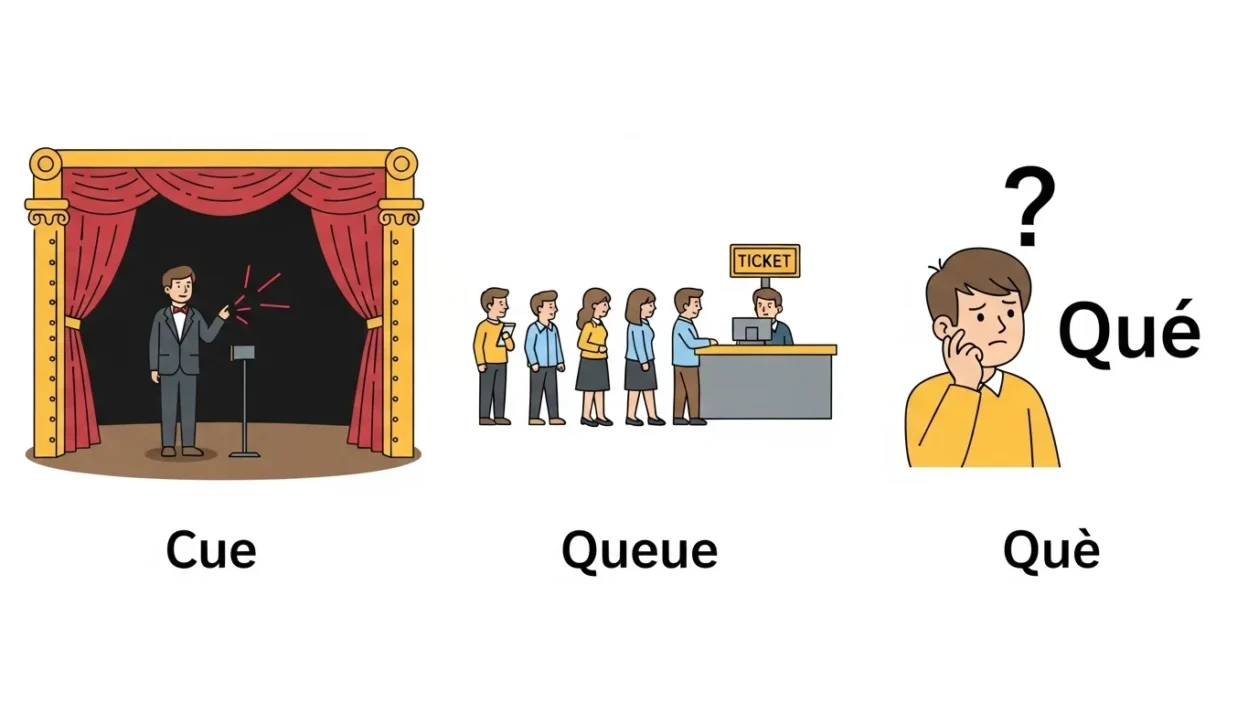
- Cue – a signal, hint, or prompt telling someone to do something
- Queue – a line of people or things waiting for their turn
- Que – usually a misspelling of “queue” or a word from another language like Spanish
Most of the time, people writing “que” actually mean “queue.”
Why People Confuse Cue, Queue, and Que
There are three main reasons why learners mix up cue vs queue vs que.
First, all three words sound almost the same when spoken. They are pronounced like “kyoo.”
Second, English spelling is not always logical. The word queue has five letters but only one main sound.
Third, beginners often see que online and assume it is a normal English word. In reality, it is usually a spelling mistake or a foreign word.
Understanding these differences makes the cue vs queue spelling problem much easier to solve.
Cue Meaning in English
The cue meaning in English is a signal, prompt, or hint that tells someone when to do something.
A cue helps people know what action to take next.
Cue in Daily Life
Example:
“The bell was my cue to leave the classroom.”
Here, the bell gives a signal.
Cue in Performances
Actors and musicians often wait for cues.
Example:
“The actor waited for his cue before walking onto the stage.”
Cue as a Hint
Sometimes cues are small clues.
Example:
“Her smile was my cue to start speaking.”
Cue in Sports
In billiards or pool, a cue is the stick used to hit the ball.
Example:
“He picked up his cue before taking the shot.”
These examples help beginners understand cue definition and examples clearly.
Queue Meaning in English
The queue meaning in English is a line of people or things waiting for their turn.
This meaning is very common in everyday situations.
Queue in Real Life
Example:
“We stood in a long queue to buy movie tickets.”
Queue in Technology
The word is also used in computers and apps.
Example:
“The songs are waiting in your Spotify queue.”
Another example:
“The printer has a long queue of documents.”
Understanding these examples helps learners see the difference between cue vs queue usage.
Que Meaning in English
The que meaning in English is different from cue and queue.
In most English writing, que is not a standard word.
Que as a Misspelling
Many people accidentally write que instead of queue.
Example mistake:
“I waited in the que for coffee.”
Correct version:
“I waited in the queue for coffee.”
Que in Foreign Languages
The word que is very common in Spanish, French, and Portuguese.
Example in Spanish:
“¿Qué haces?” (What are you doing?)
Example in French:
“Je pense que oui.” (I think yes.)
So in English writing, que is usually a spelling mistake or a foreign word.
Cue vs Queue vs Que Comparison Table
This simple table explains the difference between cue and queue and how que fits in.
| Word | Meaning | Common Use | Example |
| Cue | Signal or hint | Theatre, daily life | The music was my cue to start dancing |
| Queue | Line waiting for turn | Tickets, stores, technology | We joined the queue for coffee |
| Que | Usually misspelling of queue or foreign word | Spanish or French | ¿Qué hora es? |
This table makes cue vs queue vs que explained much clearer.
When to Use Cue
Use cue when talking about signals or hints.
Common situations include:
- theatre performances
- conversations
- instructions
- signals to act
Examples:
“The teacher’s nod was my cue to answer.”
“The music gave everyone the cue to dance.”
“The director gave the actor a cue to enter the stage.”
When to Use Queue
Use queue when talking about waiting in line.
Examples include:
- lines at stores
- ticket counters
- airports
- computer processes
Examples:
“We joined the queue at the airport.”
“There is a long queue outside the restaurant.”
“Your video is in the upload queue.”
These examples show queue definition and usage clearly.
When to Use Que
You usually should not use “que” in English sentences unless:
- you are writing Spanish or French
- you are using a name that contains the word
Otherwise, the correct spelling is usually queue.
Cue vs Queue Examples in Real Life
Here are practical cue vs queue examples you might see every day.
Email Example
Cue:
“I will send you a message as a cue to join the meeting.”
Queue:
“Your request is in the support queue.”
Social Media Example
Cue:
“That song was my cue to start dancing.”
Queue:
“Add the song to your music queue.”
Everyday Conversation
Cue:
“The green light was our cue to cross the street.”
Queue:
“We waited in a long queue for the bus.”
Common Cue vs Queue vs Que Mistakes
Here are some mistakes learners often make.
Incorrect:
“I stood in the cue for tickets.”
Correct:
“I stood in the queue for tickets.”
Incorrect:
“The actor missed his que.”
Correct:
“The actor missed his cue.”
Incorrect:
“There is a long que at the store.”
Correct:
“There is a long queue at the store.”
Learning these examples helps avoid cue vs queue spelling mistakes.
Easy Learning Tips for Beginners
If you are learning English, these tricks help remember cue vs queue vs que.
Tip 1: Think of a Signal
Cue = signal to act.
Tip 2: Think of a Line
Queue = people waiting in line.
Tip 3: Remember the Mistake
Que = usually a spelling error.
Tip 4: Practice Simple Sentences
“The bell is my cue.”
“We waited in the queue.”
Practice makes these words easier to remember.
How to Pronounce Cue, Queue, and Que
These words sound very similar.
| Word | Pronunciation |
| Cue | kyoo |
| Queue | kyoo |
| Que | keh (Spanish) or kyoo when mistaken |
This similarity is why many learners confuse cue vs queue pronunciation.
Quick Practice Quiz
Try this quick test.
- I waited in the ___ for coffee.
- The music was my ___ to start dancing.
- Many people spell queue as ___ by mistake.
Answers:
- queue
- cue
- que
Frequently Asked Questions
1. What is the difference between cue and queue?
Cue means a signal or prompt. Queue means a line of people waiting.
2. Is “que” correct English?
Usually no. It is often a misspelling of queue or a word from another language.
3. Why do cue and queue sound the same?
English has many words called homophones, which sound the same but have different meanings.
4. Is queue used in American English?
Yes. Americans use “line” more often, but queue is still correct.
5. What does cue mean in theatre?
A cue tells actors when to speak, move, or perform an action.
6. What is a queue in technology?
It is a list of tasks waiting to be processed by a computer system.
7. Is cue used in sports?
Yes. In billiards or pool, a cue is the stick used to hit the ball.
8. How can beginners remember cue vs queue?
Think:
Cue = signal
Queue = line
Conclusion
Understanding cue vs que vs queue becomes easy when you remember their meanings.
- Cue means a signal or hint telling someone when to act.
- Queue means a line of people or tasks waiting for their turn.
- Que is usually a misspelling of queue or a word from another language.
Because these words sound the same, confusion is common.
But by practicing examples and remembering their meanings, students and learners can quickly master the difference between cue and queue and avoid mistakes.