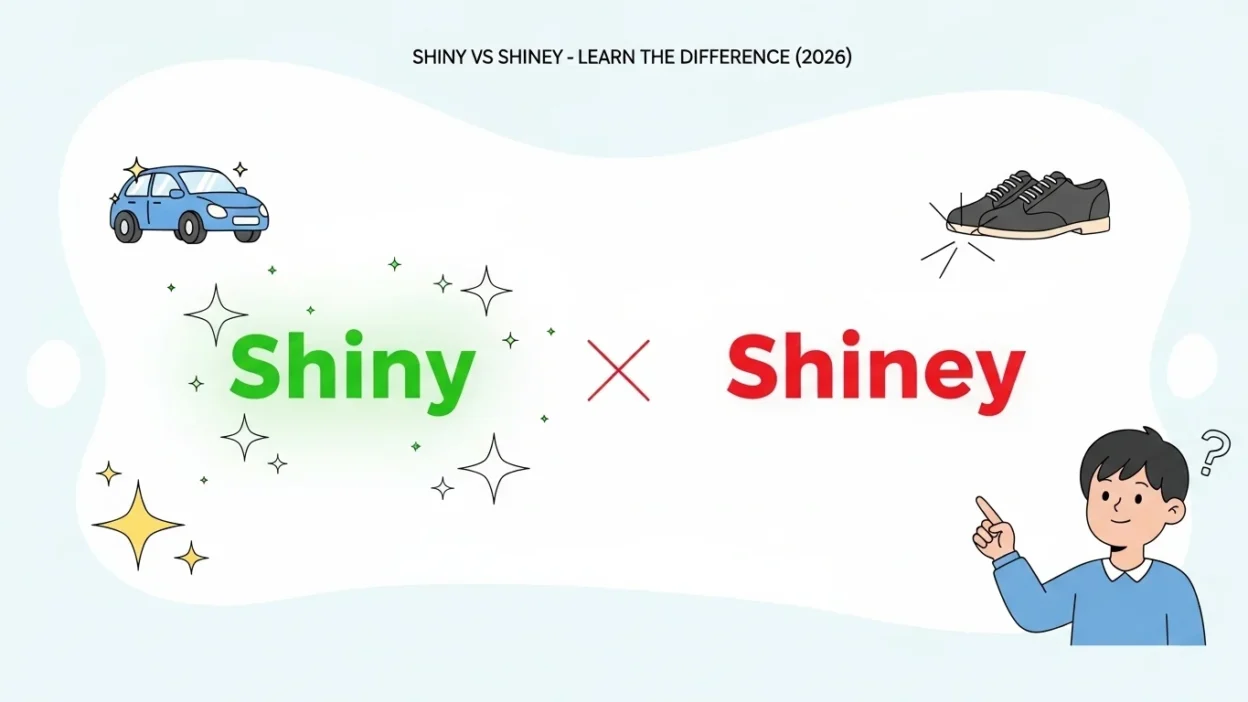
Have you ever typed “shiney” and then paused for a second, wondering if it looks right? You’re not alone. Many students and English learners face this exact confusion.
The words “shiny” and “shiney” look almost the same. They come from the same base word, “shine.” Because of this, it’s easy to guess the wrong spelling especially when typing fast.
This guide will clear everything up in a simple and friendly way. By the end, you won’t just know the correct answer you’ll remember it without thinking twice.
Why this confusion happens
Let’s start with a real moment.
You’re writing a sentence:
“I bought a new phone. It looks so shiney.”
You stop. Something feels off. But why?
This confusion happens because:
- Both spellings look natural
- They come from the word “shine”
- English spelling rules are not always obvious
- Many people online use the wrong form
- Your brain tries to follow patterns that don’t always work
This is one of those small but tricky spelling problems in English.
Quick answer
Here’s the clear truth:
- ✅ Shiny is correct
- ❌ Shiney is incorrect
- “Shiny” means something bright or reflective
- “Shiney” is just a spelling mistake
If you remember one thing, remember this:
👉 Always use shiny
A simple story to remember it
Imagine you clean your shoes. After polishing them, they look bright and smooth.
You say:
“My shoes shine.”
Now you want to describe them:
“My shoes are shiny.”
That’s it.
You don’t say “shiney.” You simply change “shine” into “shiny.”
Understanding the rule (easy version)
Here’s a helpful pattern in English:
When a word ends in “e” and you want to add “y,” you often drop the “e.”
Examples:
- Shine → shiny
- Ice → icy
- Smoke → smoky
This is why “shiney” is wrong. The extra “e” is not needed.
Shiny vs Shiney: Clear difference
Let’s make it very simple.
Shiny
- Correct spelling
- Used in everyday English
- Describes something bright or smooth
- Found in dictionaries
Shiney
- Incorrect spelling
- Not used in correct English
- A common typing or learning mistake
- Should be avoided
Quick comparison
| Feature | Shiny (Correct) | Shiney (Incorrect) |
| Spelling | Correct | Wrong |
| Meaning | Bright, smooth | No real meaning |
| Usage | Common | Mistake |
| Acceptable | Yes | No |
| Example | Shiny car | Shiney car ❌ |
When to use “shiny”
Use “shiny” when something reflects light or looks clean and polished.
Real examples:
- I bought a shiny new laptop
- The floor looks shiny after cleaning
- Her hair looks smooth and shiny
- The coins are old but still shiny
- The stars look small and shiny in the sky
When NOT to use “shiney”
You should avoid “shiney” in all situations, including:
- School assignments
- Exams
- Emails
- Job applications
- Social media (if you want correct English)
Even if you see others using it, it is still incorrect.
Why learners often make this mistake
Let’s go deeper for a moment.
Your brain likes patterns. You may think:
- “If I add ‘ ey,’ it looks complete”
- “Other words look similar”
But English spelling does not always follow simple patterns.
Here are similar correct forms:
- Sunny (not sunney)
- Funny (not funney)
- Happy (not happye)
So, “shiney” follows a false pattern. That’s why it feels right but isn’t.
Common mistakes to watch for
Here are typical errors learners make:
- Writing “shiney” while typing quickly
- Copying incorrect spelling from others
- Thinking both forms are acceptable
- Adding extra letters unnecessarily
The good news? This mistake is easy to fix once you notice it.
Real Life Usage Examples
Let’s look at how this appears in daily life.
Social media
Correct:
- “Just got a shiny new bike!”
Wrong:
- “Just got a shiney new bike!”
Chat message
Correct:
- “Your shoes look so shiny!”
Wrong:
- “Your shoes look so shiney!”
Correct:
- “We are launching a shiny new product.”
Wrong:
- “We are launching a shiney new product.”
Small spelling differences can change how professional your writing looks.
Practice section (try it yourself)
1. Choose the correct word:
- The car looks very (shiny / shiney)
- She has a (shiny / shiney) dress
- The floor is clean and (shiny / shiney)
2. Find the mistake:
- “I like your shiney shoes.”
- “This is a shiney surface.”
3. Fix the sentences:
- “The shiney table looks new.”
- “He bought a shiney watch.”
Answers:
- shiny, shiny, shiny
- shiney → shiny
- shiney → shiny
Quick memory tips
Here are simple ways to remember:
- Think: Shine → Shiny
- Drop the “e,” add “y”
- If it looks like “shiney,” it’s wrong
You can also say this to yourself:
👉 “If it shines, it’s shiny.”
Frequently Asked Questions
1. Is “shiney” ever correct?
No, it is always incorrect in standard English.
2. Why do people still use “shiney”?
Mostly because of fast typing or misunderstanding spelling patterns.
3. What does “shiny” mean?
It describes something bright, smooth, or reflective.
4. Is “shiny” used in formal writing?
Yes, it is perfectly correct in both formal and informal English.
5. How can I avoid this mistake?
Practice writing “shiny” and remember the rule: drop the “e.”
6. Are there other similar mistakes?
Yes. For example:
- sunney ❌ → sunny ✅
- funney ❌ → funny ✅
7. Is “shiny” an adjective?
Yes, it describes how something looks.
8. Can spelling mistakes affect my writing?
Yes. Small mistakes can make your writing look less clear or less professional.
Final thoughts
The difference between “shiny” and “shiney” is simple once you see it clearly.
- “Shiny” is the correct word
- “Shiney” is a common mistake
By remembering the small rule drop the “e” and add “y” you can avoid this error easily.
With a bit of practice, you’ll never stop to question it again. You’ll just write “shiny” with confidence every time.

Mitcheel Satrac is a passionate visionary dedicated to creativity, innovation, and meaningful success. His work reflects authenticity, purpose, and a drive to make a real impact.