Many English learners feel confused when they see the words either and neither. At first, they look almost the same. They also appear in similar sentence patterns. Because of this, students often mix them up.
Another reason for confusion is that both words usually talk about two choices. You often see them in the phrases either…or and neither…nor. These structures are common in English conversations, school writing, and everyday communication.
If you are learning English as a second language, understanding the difference between either and neither can feel tricky at first. But once you learn the simple rule and see clear examples, the meaning becomes easy.
This guide explains either vs neither in very simple language. You will learn the grammar rules, sentence structures, common mistakes, and real life examples. There is also a short practice section to help you test your understanding.
Quick Answer
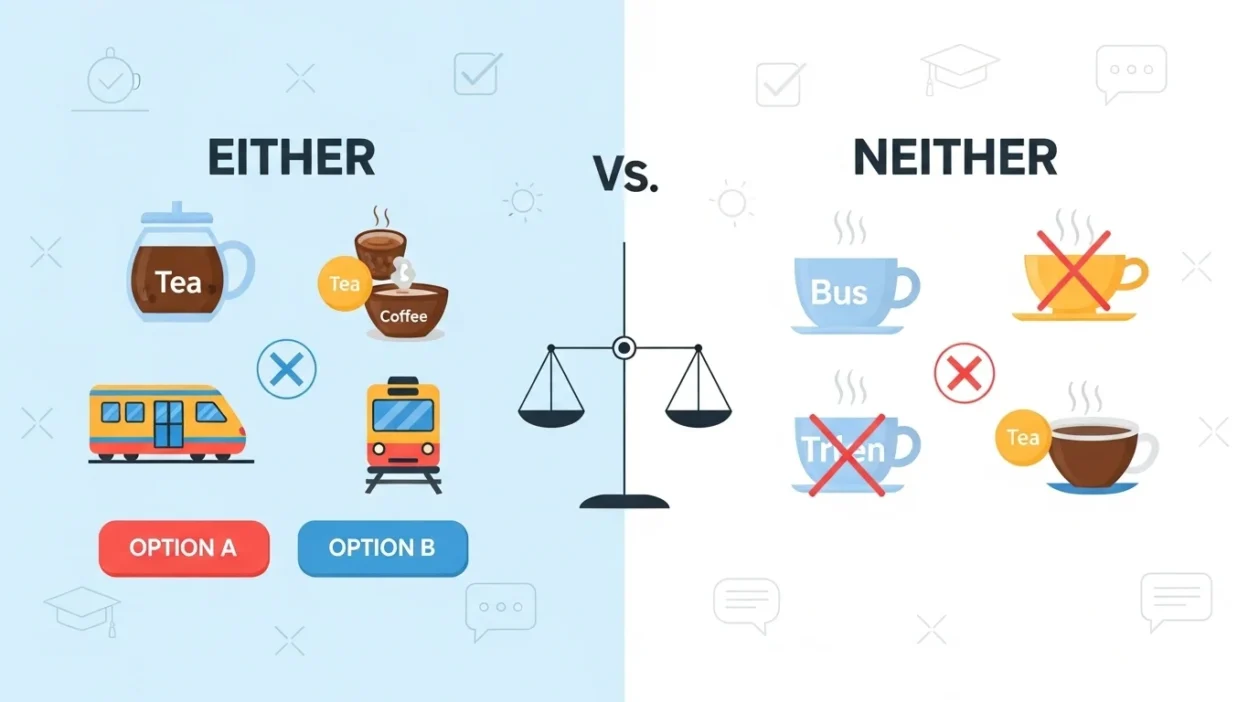
Here is the simple difference between either vs neither:
- Either means one of two choices.
- Neither means not one and not the other.
- Either is used when one option is possible.
- Neither is used when both options are rejected.
Examples:
- You can choose either tea or coffee.
- Neither tea nor coffee is available.
Easy memory tip:
- Either = one option
- Neither = zero options
Understanding this basic rule will make either and neither grammar much easier.
A Simple Background
The words either and neither have been part of English for a long time. They developed from older forms of the language used to describe choices between two things.
Today, these words are common in everyday English. You will see them in:
- conversations
- emails
- school assignments
- social media posts
Many learners first notice these words in the expressions:
- either…or
- neither…nor
These phrases help connect two options or ideas. Learning these patterns is an important part of understanding either vs neither in English grammar.
The Core Difference Between Either and Neither
The main difference between either and neither is about choice.
Either means that one of two options is possible.
Example:
- You can take either bus to reach the station.
Both buses are possible choices.
Neither means not one and not the other.
Example:
- Neither bus goes to the airport.
Here are more either vs neither examples.
Examples with either:
- You may sit in either chair.
- She will study either math or science.
Examples with neither:
- Neither chair is comfortable.
- Neither answer is correct.
Simple idea:
- Either → one option works
- Neither → no option works
Comparison
| Feature | Either | Neither |
| Meaning | One of two choices | Not one and not the other |
| Type | Positive choice | Negative meaning |
| Common pattern | either…or | neither…nor |
| Example | Either option works | Neither option works |
| Number of choices | Two | Two |
Grammar Roles of Either and Neither
In English grammar, either and neither can act in different ways.
They can function as:
- pronouns
- determiners
- conjunctions
- adverbs
1. As Determiners
They come before a noun.
Examples:
- Either student can answer the question.
- Neither road leads to the village.
2. As Pronouns
They replace the noun.
Examples:
- I like both jackets. Either is fine.
- I looked at both options, but neither worked.
3. As Conjunctions
They connect two ideas.
Examples:
- We will travel either by train or by bus.
- Neither the teacher nor the students were ready.
Learning these patterns helps understand either vs neither grammar rules.
Important Grammar Rule: Verb Agreement
A common grammar rule appears when using either…or and neither…nor.
The verb usually agrees with the noun closest to it.
Example:
- Either the teacher or the students are coming.
- Either the students or the teacher is coming.
Examples with neither:
- Neither the manager nor the employees were available.
- Neither the employees nor the manager was available.
This rule is important in either and neither in English grammar.
When to Use Either
Understanding when to use either helps you describe choices clearly.
1. Offering Two Choices
Example:
- You may choose either path to reach the park.
Both paths are possible.
Another example:
- You can start the assignment either today or tomorrow.
2. Using Either…Or
The phrase either…or connects two choices.
Structure:
either + option 1 + or + option 2
Examples:
- We will travel either by train or by car.
- She will study either history or biology.
This explains the either or meaning in English.
3. Using Either in Negative Agreement
“Either” can appear at the end of a negative sentence.
Example:
- I don’t like loud music.
- My friend doesn’t like it either.
Another example:
- I didn’t watch the game.
- She didn’t watch it either.
When to Use Neither
Understanding when to use neither helps you describe situations where both choices are not true.
1. Rejecting Two Options
Example:
- Neither dress fits me.
This means both dresses are not suitable.
Another example:
- Neither restaurant is open tonight.
2. Using Neither…Nor
The phrase neither…nor connects two negative ideas.
Structure:
neither + option 1 + nor + option 2
Examples:
- Neither Sara nor Ali finished the project.
- Neither the red shirt nor the blue shirt looks good.
This explains the neither nor meaning in English.
3. Responding to Negative Statements
Example:
- I don’t understand this problem.
- Neither do I.
Another example:
- I didn’t attend the meeting.
- Neither did she.
Pronunciation Tip for Learners
The pronunciation of either and neither can change depending on the accent.
Common pronunciations:
Either
- EE ther
- EYE ther
Neither
- NEE ther
- NYE ther
Both pronunciations are correct in English.
Common Mistakes Learners Make
Students learning either vs neither for beginners often make these mistakes.
Mistake 1: Double Negatives
Incorrect:
- I don’t want neither option.
Correct:
- I don’t want either option.
or - I want neither option.
Mistake 2: Mixing Or and Nor
Incorrect:
- Either tea nor coffee is available.
Correct:
- Either tea or coffee is available.
Or:
- Neither tea nor coffee is available.
Mistake 3: Using Them With More Than Two Choices
These words usually describe two options.
Incorrect:
- Neither apples, oranges, and bananas are fresh.
Better:
- None of the fruits are fresh.
Real Life Examples
Seeing either vs neither examples in daily life helps learners understand the meaning.
Everyday Conversation
- You can choose either movie tonight.
- Neither plan works for me.
Emails
Example email:
Hello Sara,
We can schedule the meeting either Monday or Tuesday. Please let me know which day works better.
Another example:
Hi,
I checked the documents, but neither file contains the final version.
Social Media
- I visited two cafés today, but neither was good.
- I might watch either comedy or action tonight.
School or Work
- Students can submit the assignment either online or in class.
- Neither answer explains the question clearly.
Practice Exercises
Try these exercises to practice either vs neither in sentences.
Exercise 1: Fill in the Blank
Choose either or neither.
- ______ option seems correct.
- You can choose ______ dress.
- ______ answer is right.
- She likes ______ tea nor coffee.
Answers:
- Neither
- Either
- Neither
- Neither
Exercise 2: Choose the Correct Sentence
Which sentence is correct?
- Either tea nor coffee is available.
- Either tea or coffee is available.
Correct answer:
Sentence 2.
Exercise 3: Make Your Own Sentences
Write:
- 2 sentences using either…or
- 2 sentences using neither…nor
Practice helps you remember the either vs neither grammar rules.
Frequently Asked Questions
1. What is the difference between either and neither?
The difference between either and neither is simple.
Either means one of two choices.
Neither means not one and not the other.
2. What does either or mean in English?
The phrase either or meaning in English refers to choosing between two options.
Example:
- You can choose either tea or coffee.
3. What does neither nor mean?
The phrase neither nor meaning in English shows that both options are not true.
Example:
- Neither rain nor wind stopped the match.
4. Can either and neither refer to more than two things?
Usually they refer to two choices. For more choices, English uses any or none.
5. Can either start a sentence?
Yes.
Example:
- Either solution will solve the problem.
6. Is neither always negative?
Yes. The word already carries a negative meaning.
7. Is “me either” correct?
In informal conversation, some people say “me either,” but the standard form is:
- Neither do I
8. Are either and neither common in everyday English?
Yes. They are used often in conversations, emails, and writing.
Conclusion
Understanding either vs neither becomes easy when you remember the basic idea.
Either means one of two choices is possible.
Neither means both choices are rejected.
You will often see them in the structures:
- either…or
- neither…nor
By learning the either vs neither grammar rules, practicing examples, and avoiding common mistakes, you can use these words confidently.
A helpful learning tip is to practice writing your own sentences. Try creating a few examples using either…or and neither…nor in daily situations.
With practice, using either and neither in English grammar will soon feel natural in your conversations and writing.

Mitcheel Satrac is a passionate visionary dedicated to creativity, innovation, and meaningful success. His work reflects authenticity, purpose, and a drive to make a real impact.