Many English learners write sentences like:
- Everyone of the students passed the test.
This sentence looks correct, but it actually contains a grammar mistake. The correct sentence is:
- Every one of the students passed the test.
This confusion happens because everyone and every one look almost the same. However, they have different meanings and different grammar rules.
If you understand one simple idea, the difference between everyone and every one becomes very easy.
Simple rule:
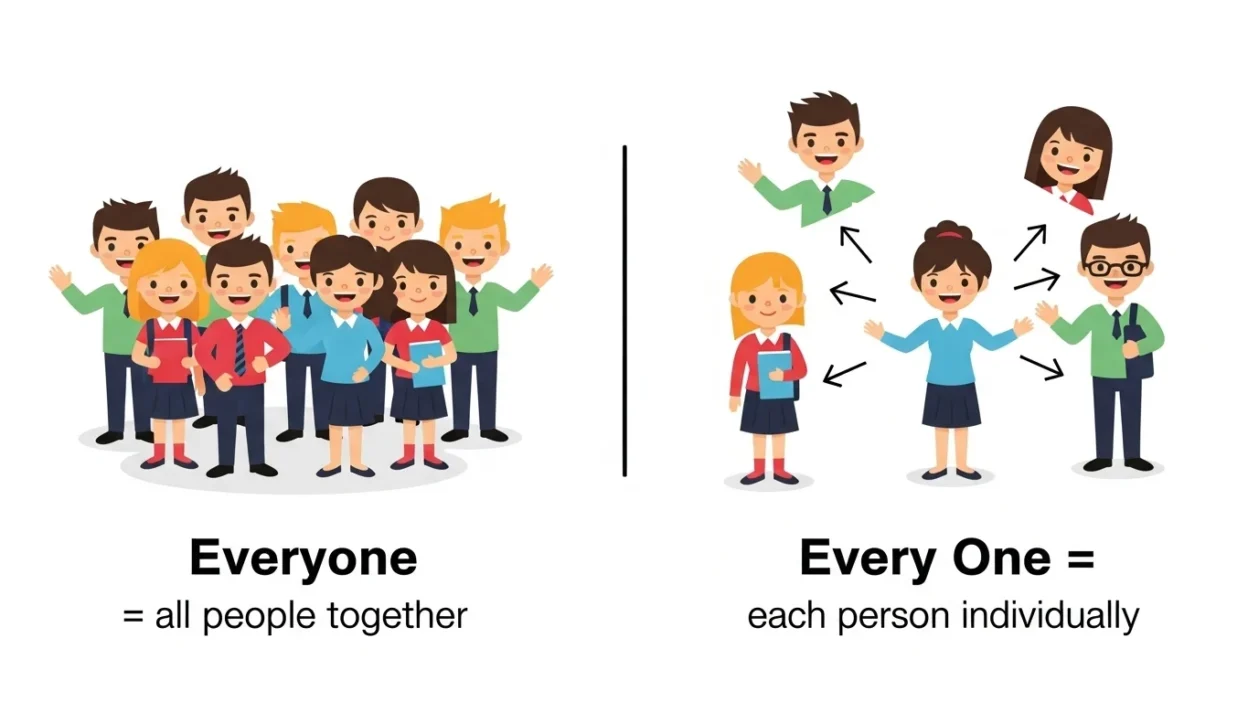
- Everyone = all people together
- Every one = each individual person or thing
In this guide, you will learn the everyone vs every one meaning, see many sentence examples, understand grammar rules, and practice with exercises so the confusion disappears completely.
Quick Answer: Everyone vs Every One
Here is the fastest way to understand the difference.
Everyone
- One word
- Refers to all people in a group
- Used only for people
Example:
Everyone enjoyed the party.
Every one
- Two words
- Refers to each person or thing in a group
- Can be used for people or objects
Example:
Every one of the students passed the test.
This simple rule explains the everyone vs every one grammar difference.
Why People Confuse Everyone and Every One
The confusion happens because the words look almost identical. Many learners assume they mean the same thing.
However, English uses them for two different purposes:
- Sometimes we talk about a whole group of people
- Sometimes we talk about each member inside the group
So English created two forms:
- Everyone for the whole group
- Every one for individuals inside the group
Understanding this idea is the key to mastering everyone vs every one grammar rules.
Difference Between Everyone and Every One
Let’s clearly explain the difference between everyone and every one.
Everyone (One Word)
“Everyone” refers to all people in a group together.
It treats the group as a single unit.
Examples:
- Everyone is excited about the holiday.
- Everyone in the class understood the lesson.
- I invited everyone to my birthday party.
In these everyone vs every one examples, the focus is on the group as a whole.
Important rule:
“Everyone” is only used for people, never for objects.
Every One (Two Words)
“Every one” refers to each individual member of a group.
It focuses on one by one instead of the whole group.
Examples:
- Every one of the players practiced today.
- Every one of the cookies was delicious.
- I checked every one of the answers.
These everyone vs every one sentence examples show that we are talking about individual items or people.
Often, “every one” can be replaced with each one.
Everyone vs Every One Comparison
| Feature | Everyone | Every One |
| Word form | One word | Two words |
| Meaning | All people together | Each individual person or thing |
| Usage | Only for people | People or objects |
| Focus | Whole group | Individual members |
| Example | Everyone is ready | Every one of the players is ready |
This table makes the difference between everyone and every one very clear.
When to Use Everyone
Use everyone when you are talking about all people as a group.
Common situations include:
- Talking to a group
- Describing a shared action
- Referring to people in general
Examples:
- Everyone loves a good story.
- Everyone is waiting for the bus.
- Everyone in the office attended the meeting.
In these examples, the speaker is not focusing on individuals. The focus is the entire group together.
This explains how to use everyone and every one correctly.
When to Use Every One
Use every one when you want to focus on each member separately.
It is often followed by “of”.
Examples:
- Every one of the students finished the exam.
- Every one of the books is interesting.
- I read every one of your messages.
This structure appears frequently in everyone vs every one grammar examples.
Remember:
“Every one” can often be replaced with each one.
Example:
Every one of the answers is correct.
Each one of the answers is correct.
Common Mistakes Learners Make
Many students make the same mistakes when learning everyone vs every one grammar.
Mistake 1: Using Everyone with Objects
Incorrect:
Everyone of the apples is fresh.
Correct:
Every one of the apples is fresh.
Reason:
“Everyone” is only used for people, not objects.
Mistake 2: Forgetting the Space
Incorrect:
Everyone of the players practiced.
Correct:
Every one of the players practiced.
If you mean individuals, you must write two words.
Mistake 3: Writing a Nonexistent Word
Incorrect:
Everyone enjoyed the movie.
Correct:
Everyone enjoyed the movie.
Always remember: the correct forms are everyone and every one.
Real Life Everyone vs Every One Examples
Understanding everyone vs every one examples becomes easier when we look at real life situations.
Classroom
Teacher speaking to the class:
Everyone must submit homework today.
Teacher checking assignments:
Every one of the students submitted homework.
Social Media
Everyone loved the new video.
Every one of my followers left a comment.
Email Example
Hello everyone, the meeting starts at 9 AM.
I reviewed every one of your reports carefully.
Daily Conversation
Everyone is excited about the festival.
Every one of the tickets has a seat number.
These examples help learners understand how to use everyone and every one in real life.
Easy Memory Trick for Beginners
Here is a simple trick for remembering everyone vs every one for beginners.
Memory Rule
Everyone = all together
Example:
Everyone is smiling.
Every one = one by one
Example:
Every one of the students is smiling.
Another easy trick:
If the sentence contains “of the”, it is usually every one.
Example:
Every one of the players scored a goal.
This trick helps avoid everyone vs every one common mistakes.
Practice Exercise
Try these questions to test your understanding.
Choose the correct word.
- _____ enjoyed the concert.
- _____ of the cookies was eaten.
- _____ in the class passed the exam.
- I checked _____ of the answers carefully.
Answers
- Everyone
- Every one
- Everyone
- Every one
Practicing with examples helps you remember the everyone vs every one grammar rules more easily.
Mini Quiz
Which sentence is correct?
A. Everyone of the students finished the test.
B. Every one of the students finished the test.
Correct answer:
B
Reason: When we say “of the students”, we must use every one.
Everyone vs Every One in Exams
Many grammar exams test this difference.
Example question:
Choose the correct sentence:
A. Everyone of the answers is correct.
B. Every one of the answers is correct.
Correct answer:
B
Because we are talking about each answer individually, we use every one.
Understanding this rule helps students avoid mistakes in English exams and ESL tests.
FAQs About Everyone vs Every One
1. What is the main difference between everyone and every one?
The difference between everyone and every one is simple. “Everyone” refers to all people together, while “every one” refers to each person or thing individually.
2. Is everyone singular or plural?
“Everyone” is grammatically singular, even though it refers to many people.
Example:
Everyone is happy.
3. Can everyone refer to objects?
No. “Everyone” is only used for people.
4. Can every one refer to objects?
Yes. “Every one” can refer to both people and things.
5. Is every one the same as each one?
In many cases, yes. They often have the same meaning.
6. Which form is more common in daily English?
“Everyone” is more common in everyday conversation.
7. Why do learners confuse these two words?
Because they look very similar but follow different grammar rules.
8. How can I remember the difference easily?
Think of this rule:
Everyone = group
Every one = individuals
Final Summary
The everyone vs every one confusion disappears once you understand the basic rule.
- Everyone refers to all people together in a group.
- Every one refers to each person or thing individually.
Remember this simple idea:
Everyone = all together
Every one = one by one
With practice and examples, you will quickly learn when to use everyone and every one, and this common grammar mistake will no longer cause confusion.

Kaliyan Martan is a passionate dreamer and creative thinker who believes in turning ideas into meaningful action. With vision and dedication, he strives to make a lasting impact through innovation and authenticity.