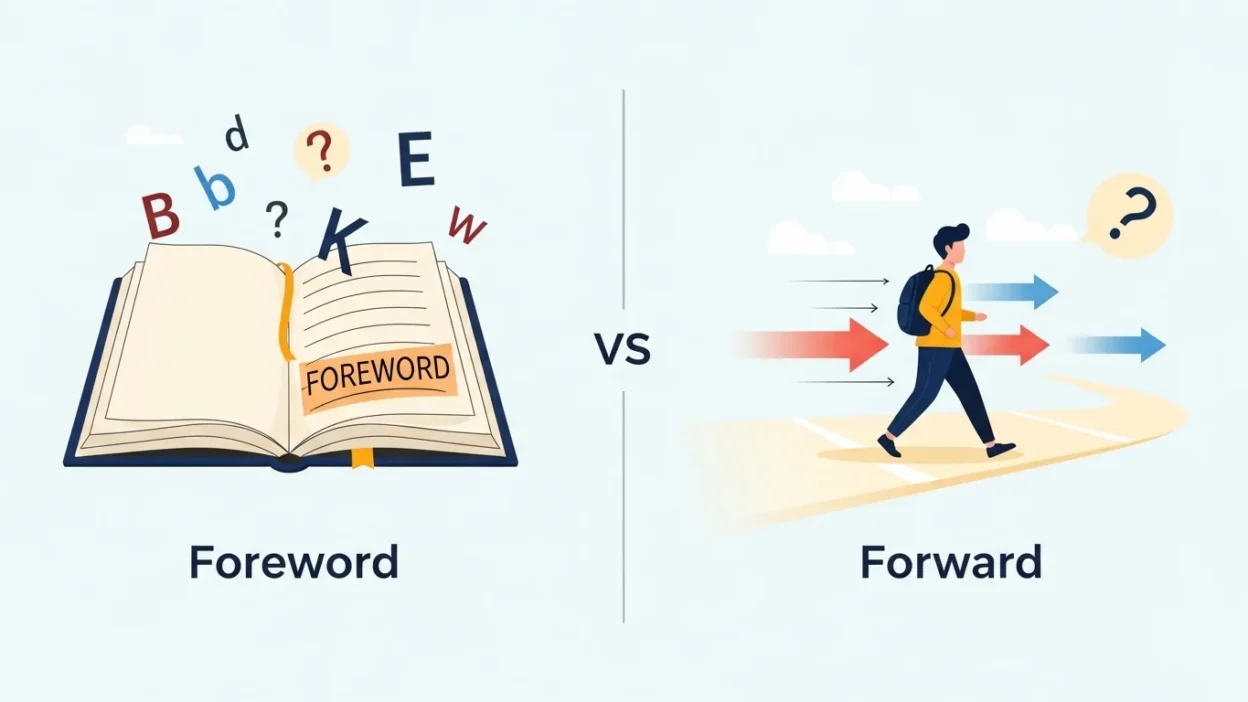
Many English learners get stuck on one small but tricky problem: foreword vs forward. These two words look almost the same, and they even sound similar.
Because of this, students often use the wrong word in writing, exams, emails, and daily English.
The real problem is not the words themselves. The problem is that learners do not clearly separate their meanings in their mind. Once you understand the difference in a very simple way, you will never confuse them again.
This guide will make everything clear using simple English, real examples, and strong memory tricks.
Quick Answer
- Foreword → A short introduction written in a book (before the main content)
- Forward → Moving ahead, sending something ahead, or direction toward the front
Super simple rule:
- Book introduction = foreword
- Movement or action = forward
Why These Words Confuse Students
Students mix these words because:
- They look almost identical
- Only one letter changes the meaning
- Both are used in English writing
- They appear in reading passages and exams
But here is the truth:
These words belong to completely different worlds.
- Foreword → Book world
- Forward → Real life action world
Foreword Meaning
A foreword is a short introduction written at the beginning of a book.
It is not written by the main author. It is usually written by:
- A teacher
- An expert
- A famous writer
- A respected person
Purpose of a foreword:
- To introduce the book
- To explain why the book matters
- To give trust or support to the author
Simple idea:
A foreword is like a friendly “welcome message” before the story begins.
Examples:
- The foreword of this book explains the author’s journey.
- A professor wrote the foreword for this science book.
- I always read the foreword before starting a novel.
Forward Meaning (Very Simple)
Forward means moving ahead or sending something ahead.
It is used in many daily situations like direction, communication, and progress.
1. Movement
- Step forward slowly.
- He moved forward in the queue.
2. Progress in life
- She is moving forward after hard times.
- Let’s move forward with the plan.
3. Sending messages
- Please forward this email to your teacher.
- He forwarded the file to his friend.
4. Sports
- He plays as a forward in football.
Simple idea:
Forward means anything that goes “ahead.”
The Strong Difference (No Confusion Method)
To fully understand foreword vs forward, use this rule:
If it is inside a book → FOREWORD
If it involves action or movement → FORWARD
Even simpler:
- Foreword = before the book begins
- Forward = going ahead in real life
Side by Side Comparison
| Feature | Foreword | Forward |
| Meaning | Book introduction | Moving ahead |
| Where used | Only in books | Daily English |
| Type | Noun | Verb, noun, adjective |
| Action or not | No action | Yes, action word |
| Example | Foreword of a novel | Move forward in life |
Pronunciation Tip (Helps Memory)
- Foreword → sounds like “FOR word” (book introduction idea)
- Forward → sounds like “FOR ward” (move ahead idea)
Even though they sound similar, context makes them different.
Easy Memory Tricks (Very Important)
Trick 1: FORE = Before
- Foreword = before the main book content
Trick 2: FORWARD = Forward motion
- Imagine walking forward → moving ahead
Trick 3: Word clue
- ForeWORD → written words before the story
- Forward → action word in real life
Common Mistakes Students Make
Mistake 1 (Book confusion)
❌ I read the forward of the book.
✔ I read the foreword of the book.
Mistake 2 (Message error)
❌ Please foreword this email.
✔ Please forward this email.
Mistake 3 (Meaning mix up)
❌ The foreword is moving ahead in life.
✔ The person is moving forward in life.
Real Life Usage Examples
In Books
- The foreword explains why the book was written.
- A famous author wrote the foreword.
In Emails
- Please forward this message to the manager.
In Daily Life
- I want to move forward in my career.
- Don’t look back, just move forward.
In School
- The teacher explained the foreword before reading the chapter.
Exam Trick Section (Very Important for Students)
In exams, these traps are common:
- “The forward of the book is interesting.” ❌ (wrong)
- “The foreword of the book is interesting.” ✔ (correct)
👉 If the sentence mentions a book, ALWAYS think foreword.
👉 If the sentence shows action or movement, ALWAYS think forward.
Zero Confusion Rule (Final Learning Lock)
Remember this:
If you can replace the word with “ahead,” use FORWARD.
If it introduces a book, use FOREWORD.
That’s it. No exceptions.
FAQs
1. What is the main difference between foreword and forward?
Foreword is a book introduction, while forward means moving ahead.
2. Is foreword used in daily English?
No, it is only used in books.
3. Can forward be used in emails?
Yes, you can forward messages or emails.
4. Why do students confuse these words?
Because they look and sound very similar.
5. Is foreword a verb?
No, foreword is a noun only.
6. Can forward be a noun?
Yes, especially in sports (football forward).
7. What is the easiest way to remember them?
Foreword = book introduction
Forward = moving ahead
8. Which one is more common?
Forward is more common in daily English.
Conclusion
The confusion between foreword vs forward is very common, but it is also very easy to fix.
Once you remember the simple rule:
- Foreword = book introduction
- Forward = movement or progress
You will never make this mistake again in writing, exams, or daily English.
The key is not memorizing hard definitions, but understanding the context. When context is clear, the words become easy forever.

Kaliyan Martan is a passionate dreamer and creative thinker who believes in turning ideas into meaningful action. With vision and dedication, he strives to make a lasting impact through innovation and authenticity.