Many English learners get stuck on one small problem: “discrete vs discreet.” These two words look almost identical.
They also sound very similar when spoken. Because of this, even good students mix them up in writing.
But the truth is simple. These words have completely different meanings. One talks about separation. The other talks about careful behavior.
In this guide, you will learn the difference in a very clear and natural way. No stress. No confusing grammar. Just simple understanding that stays in your memory.
Quick Answer
If you only remember one thing, remember this:
- Discrete = separate, individual parts
- Discreet = careful, quiet, and private behavior
Simple rule:
- If something is split into parts → discrete
- If someone is careful or silent → discreet
Why People Confuse These Two Words
This confusion happens for three simple reasons:
- The spelling is almost the same
- The pronunciation sounds very close
- Both words are not used in the same situation
So learners often guess instead of understanding.
But once you connect meaning to real life thinking, the confusion disappears.
Discrete Meaning (Simple and Clear)
Let’s understand discrete meaning in simple English.
What “discrete” really means
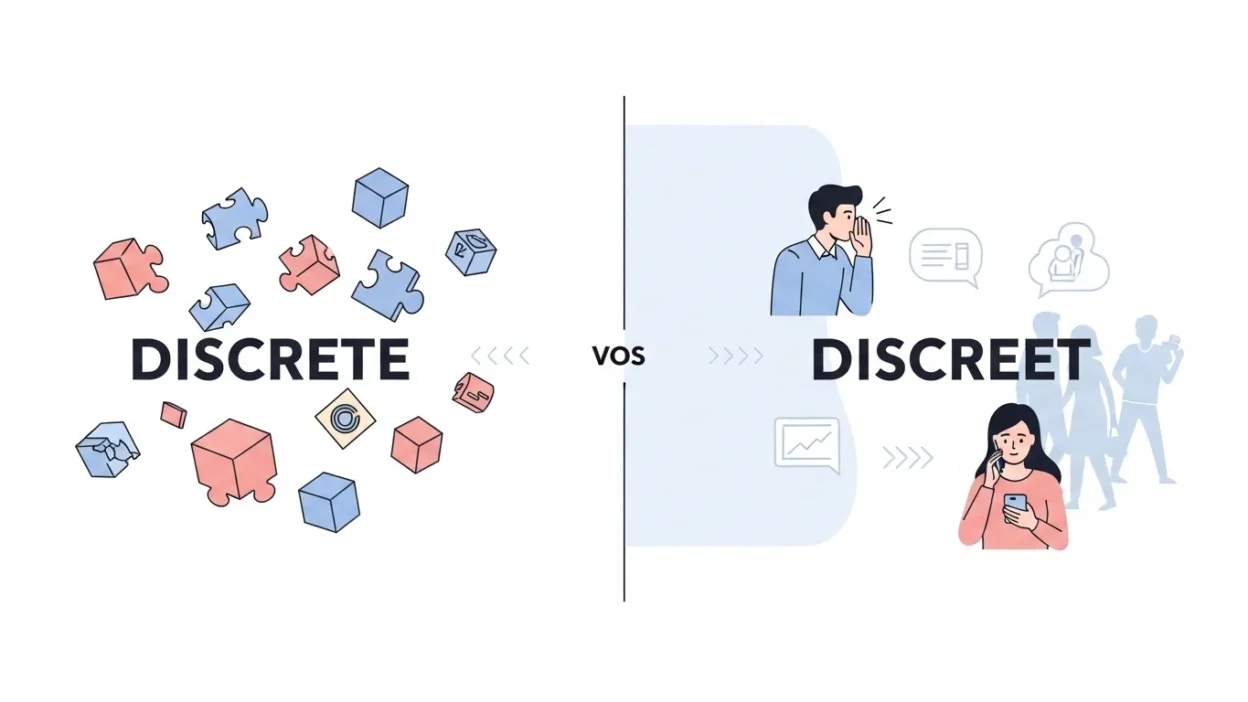
Discrete means things that are separate and not connected.
Think of objects or ideas that exist individually.
Easy idea:
- Separate pieces
- Independent parts
- Not joined together
Real life picture in your mind:
Imagine a box filled with LEGO blocks. Each block is separate. That is discrete.
When We Use “Discrete”
We usually use discrete in study, science, and structured systems.
Examples:
- The lesson is divided into discrete units.
- The system works in discrete steps.
- Data is stored in discrete values.
Simple understanding:
If you can count or separate something, it is discrete.
Discreet Meaning (Simple and Clear)
Now let’s understand discreet meaning in simple English.
What “discreet” really means
Discreet means careful, quiet, and not drawing attention.
It is about behavior, not objects.
Easy idea:
- Quiet actions
- Private behavior
- Careful communication
Real life picture in your mind:
Imagine someone whispering a secret so nobody hears it. That is discreet behavior.
When We Use “Discreet”
We use discreet in daily life situations involving people.
Examples:
- She gave a discreet smile.
- He made a discreet phone call during the meeting.
- Please be discreet about this matter.
Simple understanding:
If someone is acting quietly or carefully, it is discreet.
Discrete vs Discreet Difference (Very Clear View)
Let’s make the discrete vs discreet difference extremely simple:
| Feature | Discrete | Discreet |
| Meaning | Separate parts | Careful behavior |
| Focus | Things or structure | People or actions |
| Idea | Not connected | Not noticeable |
| Use | Science, systems, data | Daily life, communication |
Strong Memory Trick (Easy to Remember Forever)
Here is a simple trick that actually works:
🔹 Discrete = “T” for Two pieces
Think: Discrete = Two separate things
🔹 Discreet = “E” for Extra careful
Think: Discreet = Extra quiet behavior
Or even simpler:
- Discrete = “split”
- Discreet = “silent”
Discrete vs Discreet Examples (Real Life Situations)
Let’s understand with real situations so it feels natural.
1. School Example
- The course is divided into discrete lessons.
- The student gave a discreet answer quietly.
2. Workplace Example
- The system has discrete departments.
- The manager handled the issue in a discreet way.
3. Social Situation
- The app shows discrete sections of data.
- He sent a discreet message to avoid attention.
4. Everyday Life Example
- The recipe has discrete steps.
- She acted discreet while discussing a private issue.
Pronunciation Tip
Many learners confuse these words because they sound similar.
- Discrete → /dɪˈskriːt/
- Discreet → /dɪˈskriːt/
Yes, they sound the same.
That’s why meaning is the only way to choose correctly.
Common Mistakes Students Make
❌ Mistake 1: Using “discrete” for behavior
Wrong: He is very discrete about secrets
Correct: He is very discreet about secrets
❌ Mistake 2: Using “discreet” for objects
Wrong: The system has discreet parts
Correct: The system has discrete parts
❌ Mistake 3: Guessing spelling instead of meaning
Learners often rely on spelling. Always focus on meaning first.
Quick Learning Practice
Fill in the blanks:
- The system has ______ parts.
- She was very ______ during the conversation.
- The lesson is divided into ______ steps.
- He gave a ______ reply in the meeting.
Answers:
- discrete
- discreet
- discrete
- discreet
FAQs: Discrete vs Discreet
1. What is the main difference?
Discrete means separate parts. Discreet means careful behavior.
2. Why do they confuse learners?
Because they look and sound almost the same.
3. Can discrete be used for people?
No, it is not used for behavior or personality.
4. Can discreet be used for objects?
No, it is only used for actions or behavior.
5. What is discrete in simple words?
It means things that are separate and not connected.
6. What is discreet in simple words?
It means being quiet, careful, and not attracting attention.
7. Which word is used more in daily life?
Discreet is more common in daily communication.
8. What is the easiest way to remember both?
Discrete = separate things
Discreet = silent behavior
Conclusion
The confusion between discrete vs discreet is very common, but it is also very easy to fix.
Just remember one simple idea:
- Discrete = separate pieces or parts
- Discreet = careful and quiet behavior
If you connect meaning with real life examples, you will never mix them again. With a little practice, choosing the correct word becomes automatic and natural.

Robert Kalian is a passionate visionary dedicated to creativity, leadership, and meaningful innovation. He believes in turning ideas into action and inspiring others to achieve their highest potential.