The confusion between laying vs lying is very common for English learners. The words look similar, but they follow different grammar rules.
Many students also get stuck with related forms like laid, lain, and lying down, which makes everything even more confusing.
Most people search this topic because they want a quick answer like:
- “Is this sentence correct?”
- “Should I say laying on bed or lying on bed?”
The problem is that many explanations are too complex. This guide will fix that using very simple English and clear rules so you never mix them again.
Quick Snippet Answer (Very Important)
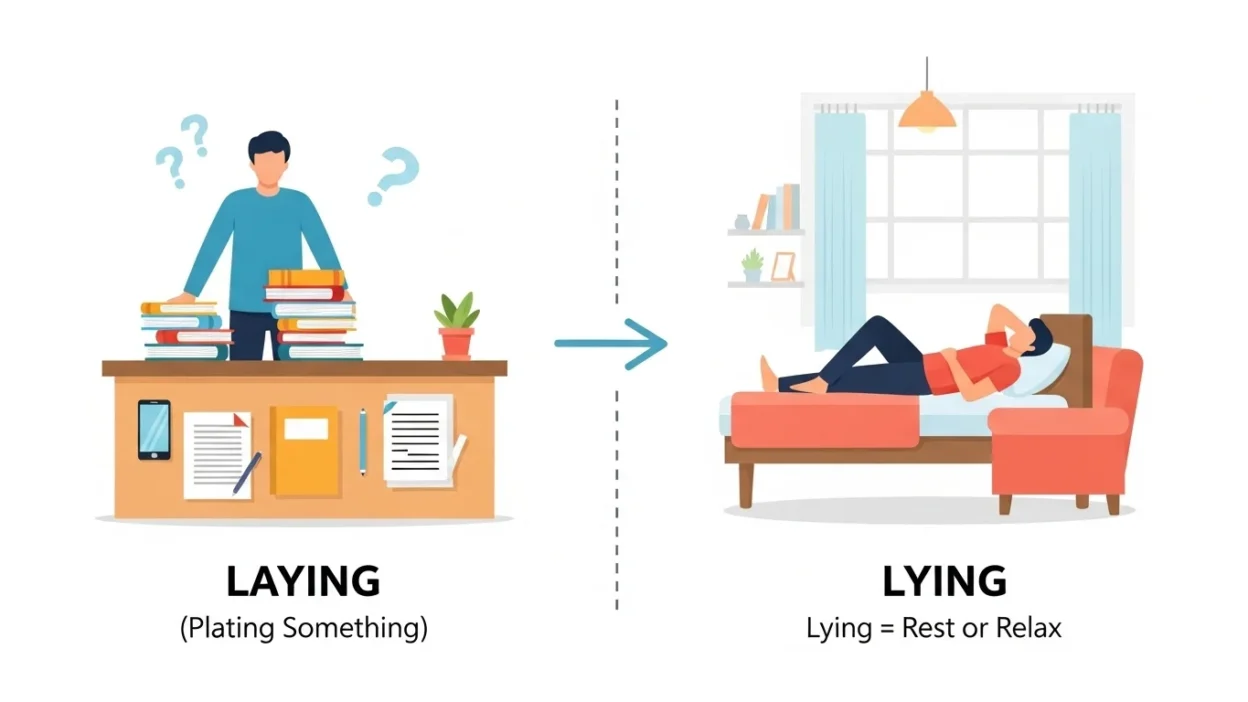
- Lay / Laying = to put something down (needs an object)
- Lie / Lying = to rest or to not tell the truth (no object)
Extra important:
- Lay → Laid → Laid
- Lie (rest) → Lay → Lain
- Lie (falsehood) → Lied → Lied
The Core Rule (Most Important Thing to Remember)
If you understand this rule, you will never confuse these words again:
✔ Rule 1: Lay always needs an object
Something must be placed.
- She is laying the book on the table.
- He is laying the baby in the crib.
👉 Ask: “What is being placed?”
If the answer exists → use laying
✔ Rule 2: Lie does NOT need an object
It means resting or being in position.
- She is lying on the bed.
- The cat is lying in the sun.
👉 No object is involved → use lying
Lay vs Lie Family (Full Verb Breakdown)
This is where most learners get confused. Let’s simplify:
1. LAY (placing something)
- Present: lay
- Past: laid
- Continuous: laying
Example:
- I lay the phone on the table.
- I laid the phone on the table yesterday.
- I am laying the phone on the table now.
2. LIE (resting on surface)
- Present: lie
- Past: lay
- Past participle: lain
- Continuous: lying
Example:
- I lie on the bed.
- I lay on the bed yesterday.
- I have lain on the bed for hours.
- I am lying on the bed now.
3. LIE (not telling truth)
- Present: lie
- Past: lied
- Continuous: lying
Example:
- He lies to his parents.
- He lied yesterday.
- He is lying again.
Laying Meaning in English (Simple Explanation)
Laying means:
👉 to place or put something carefully somewhere
Examples:
- She is laying clothes on the bed.
- He is laying papers on the desk.
- They are laying bricks for the wall.
✔ Always remember: something is being moved or placed.
Lying Meaning in English (Simple Explanation)
Lying has two meanings:
1. Resting meaning
- I am lying on the sofa.
- The dog is lying near the door.
- She is lying on the grass.
2. False statement meaning
- He is lying about his age.
- She is lying to the teacher.
- They are lying to avoid punishment.
Common Real Life Confusions (Fixed Clearly)
❌ Wrong: I am laying on the bed
✔ Correct: I am lying on the bed
👉 Because YOU are not placing anything
❌ Wrong: She is lying the book on the table
✔ Correct: She is laying the book on the table
👉 Because an object (book) is being placed
❌ Wrong: He has lied on the sofa (rest meaning)
✔ Correct: He has lain on the sofa
👉 “lain” is past participle of lie (rest)
Simple Comparison (Easy Memory Tool)
| Situation | Correct Word | Example |
| Putting something down | Laying | She is laying plates on the table |
| Resting on surface | Lying | He is lying on the bed |
| Past of lie (rest) | Lay | He lay on the bed yesterday |
| Past of lie (truth) | Lied | He lied about homework |
| Past participle (rest) | Lain | She has lain here for hours |
Real Life Usage Examples
At Home
- Mom is laying food on the table.
- Dad is lying on the couch watching TV.
At School
- The teacher is laying worksheets on desks.
- The student is lying on the bench during break.
Social Media Style
- “I am lying on my bed and relaxing 😄”
- “She is laying out her outfit for tomorrow.”
Email Style
- I am laying the documents on your desk for review.
- I am lying down due to illness today.
Common Mistakes Students Make
Mistake 1: Using “laying” for resting
❌ I am laying on the bed
✔ I am lying on the bed
Mistake 2: Mixing lay and lie past forms
❌ I lied on the bed yesterday (rest meaning)
✔ I lay on the bed yesterday
Mistake 3: Forgetting object rule
❌ She is laying on the sofa
✔ She is lying on the sofa
Easy Memory Trick (Very Effective)
Think like this:
- LAYING = PLACE
- You place something
- Always has object
- LYING = RELAX / FALSE
- Resting or not telling truth
- No object
Quick Test Trick:
Ask yourself:
👉 “What is being placed?”
- If yes → laying
- If no → lying
Mini Practice (Fix the Sentences)
Fill in the correct word:
- She is ___ on the bed.
- He is ___ the phone on the table.
- They are ___ about the situation.
- The cat is ___ in the sun.
Answers:
- lying
- laying
- lying
- lying
FAQs (Common Google Questions)
1. Is it “lying on bed” or “laying on bed”?
Correct: lying on the bed
2. What is the difference between lay, lie, laid, and lain?
- lay = place
- lie = rest
- laid = past of lay
- lain = past participle of lie (rest)
3. Why is lay vs lie confusing?
Because their past forms change irregularly and look similar.
4. Can “laying” be used without an object?
No. It always needs an object.
5. What is “lying” meaning in English?
It means resting or not telling the truth.
6. What is “laying” meaning in English?
It means placing something somewhere.
7. Is “I am laying down” correct?
Only if you are placing something. Otherwise say:
✔ I am lying down
8. What is the easiest way to remember?
LAYING = placing something
LYING = resting or false speech
Conclusion: The Confusion is Finally Solved
The difference between laying vs lying becomes easy when you remember one simple idea:
- Laying = putting something somewhere
- Lying = resting or not telling the truth
If you also remember the verb family (lay–laid–laid and lie–lay–lain), you will never make mistakes again.
With a little practice, these words will become natural in speaking and writing, and you will use them confidently without confusion.

Kaliyan Martan is a passionate dreamer and creative thinker who believes in turning ideas into meaningful action. With vision and dedication, he strives to make a lasting impact through innovation and authenticity.