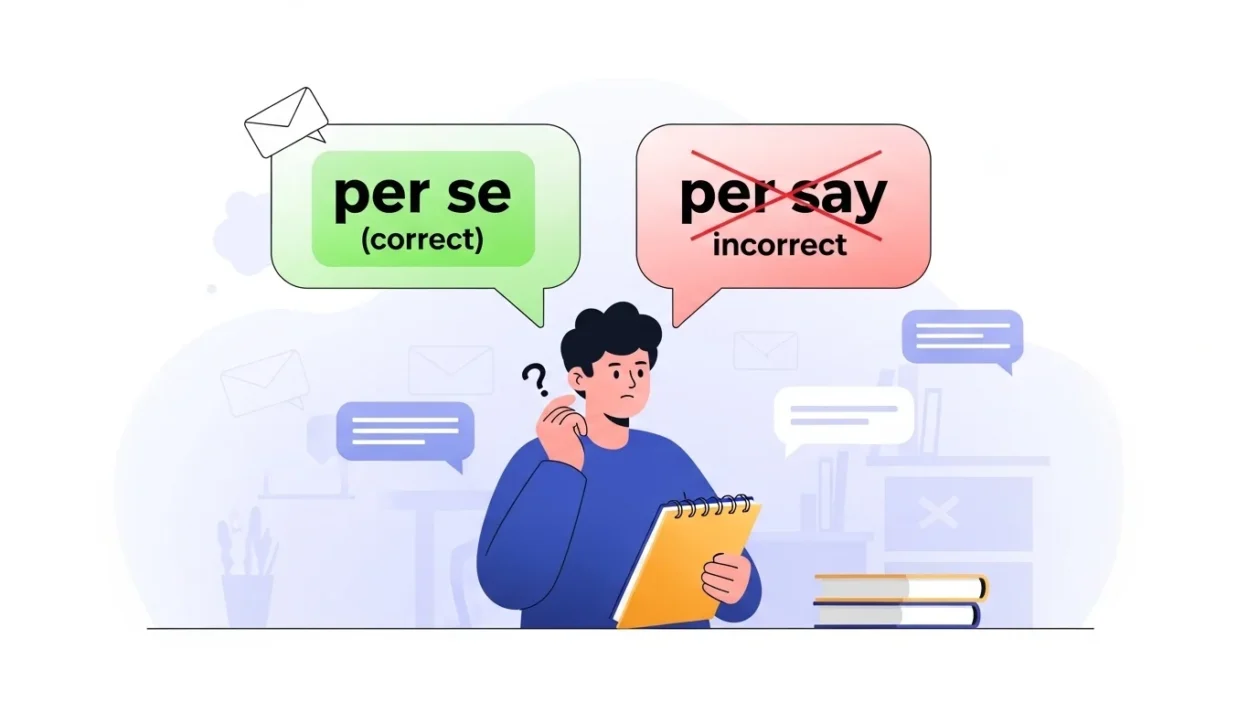
Have you ever written “per say” because it sounded correct in your head?
You are not alone.
Many students, learners, and even native speakers make this mistake. The words sound almost the same when spoken, so the spelling gets mixed up. Then it spreads through chats, social media, and school writing.
But here is the simple truth:
One of these is correct English. The other is just a mistake.
Let’s clear it completely in the easiest way possible.
Quick Answer (No Confusion)
- Per se = correct phrase
- Per say = incorrect spelling
- Meaning of per se = “by itself” or “in itself”
- Simple idea = something alone, without other factors
Example:
- “The idea is not bad per se.”
The Real Reason People Get Confused
This confusion happens for one main reason:
They sound almost identical.
When you hear someone say “per se,” it can easily sound like:
- “per say”
So your brain automatically tries to match it with a familiar English word: “say.”
That is where the mistake starts.
But in reality:
- “se” is not “say”
- it comes from Latin, not modern English spelling rules
What Does “Per Se” Really Mean?
The meaning of per se is very simple:
- by itself
- in itself
- on its own
Easy way to understand it:
You are talking about ONE thing alone, without mixing other details.
Example:
- “The movie is not bad per se.”
👉 Meaning:
The movie itself is not bad, but other things might be.
Simple Per Se Definition
Here is a clean per se definition:
A Latin phrase used in English meaning “by itself” or “in itself.”
It does not change form. It always stays the same:
- per se ✔️
Why “Per Say” is Always Wrong
Let’s make this very clear.
“Per say meaning” does not exist.
Why?
- “Per se” is a fixed Latin phrase
- “say” is just a normal English word
- they do NOT belong together
So:
- ❌ per say = incorrect
- ❌ per say meaning = nothing in English grammar
- ❌ per say in English grammar = invalid usage
Important rule:
If you write “per say,” it is always a spelling mistake.
Per Se vs Per Say Difference
| Point | Per se | Per say |
| Correct spelling | Yes | No |
| Meaning | In itself / by itself | No meaning |
| Language origin | Latin | Not valid |
| Used in English | Yes | No |
| Common mistake | No | Yes |
Why “Per Se” Exists in English
You may wonder:
Why do we even use a Latin phrase?
English has many borrowed phrases from Latin because:
- they help express precise meaning
- they are widely used in formal writing
- they stay unchanged over time
So “per se” survived because it is useful, not because it is modern English.
How to Use “Per Se” in Real Life
Now let’s learn how to use per se naturally.
You use it when you want to say something is true “by itself,” but with extra context.
1. When something is not exactly what it seems
- “He is not rude per se, just very direct.”
2. When softening an opinion
- “The plan is not bad per se, but it needs improvement.”
3. When separating one factor from others
- “The job is not difficult per se, but it is time consuming.”
Real Life Examples You Can Actually Relate To
Chat message
- “This update is not bad per se, but it feels slow.”
School writing
- “The topic is not hard per se, but it requires practice.”
- “I am not refusing the request per se, but more details are needed.”
Daily speech
- “It’s not expensive per se, just not worth it.”
Common Mistakes Students Make
Let’s fix real errors learners often write:
❌ Wrong:
- “It is not bad per say.”
✔️ Correct:
- “It is not bad per se.”
❌ Wrong:
- “I don’t like it per say.”
✔️ Correct:
- “I don’t like it per se.”
❌ Wrong thinking:
- “per say = another form of per se”
✔️ Truth:
- It is only a spelling mistake, not a variation.
Simple Memory Trick (Very Important)
If you always forget, use this trick:
Trick 1: Replace it
Replace “per se” with:
- “by itself”
If the sentence still makes sense → it is correct.
Trick 2: Final spelling rule
- Always ends with se
- NEVER “say”
Beginner Learning Section (Super Simple)
If you are just learning English, remember:
- “per se” = correct phrase
- it means “by itself”
- “per say” = always wrong
- use it only when you want to isolate meaning
Practice this mentally:
per se = by itself = correct thinking
Frequently Asked Questions
1. What is the meaning of per se?
It means “by itself” or “in itself.”
2. Is per say correct English?
No, it is always incorrect.
3. Why do people write per say?
Because it sounds like “per se” when spoken.
4. Can I replace per se with simple words?
Yes, use “by itself.”
5. Is per se formal or informal?
It is slightly formal but commonly used.
6. What is the difference between per se and per say?
“Per se” is correct; “per say” is a spelling mistake.
7. Do native speakers use per se?
Yes, especially in writing and clear explanations.
8. Can I avoid using per se completely?
Yes, you can use simpler English instead.
Conclusion: One Simple Rule to Remember
The confusion between per se vs per say is very common, but the answer is extremely simple.
- Per se = correct phrase meaning “by itself”
- Per say = incorrect spelling with no meaning
If you remember only one thing:
👉 It is always PER SE, never “per say.”
Once you understand this small rule, you will never make this mistake again in writing, exams, or daily English conversations.