Many learners mix up who’s vs whose because they look almost identical. One has an apostrophe, the other does not. That tiny mark changes the meaning completely.
The confusion usually happens because both words come from “who.” Also, when we speak, they sound the same. So in writing, students often guess instead of understanding.
This guide will fix that problem in a very simple way. You will learn the rule, see real examples, avoid common mistakes, and test yourself with quick practice. After this, you will not need to guess again.
Quick Answer (No Confusion Rule)
Here is the simplest way to remember:
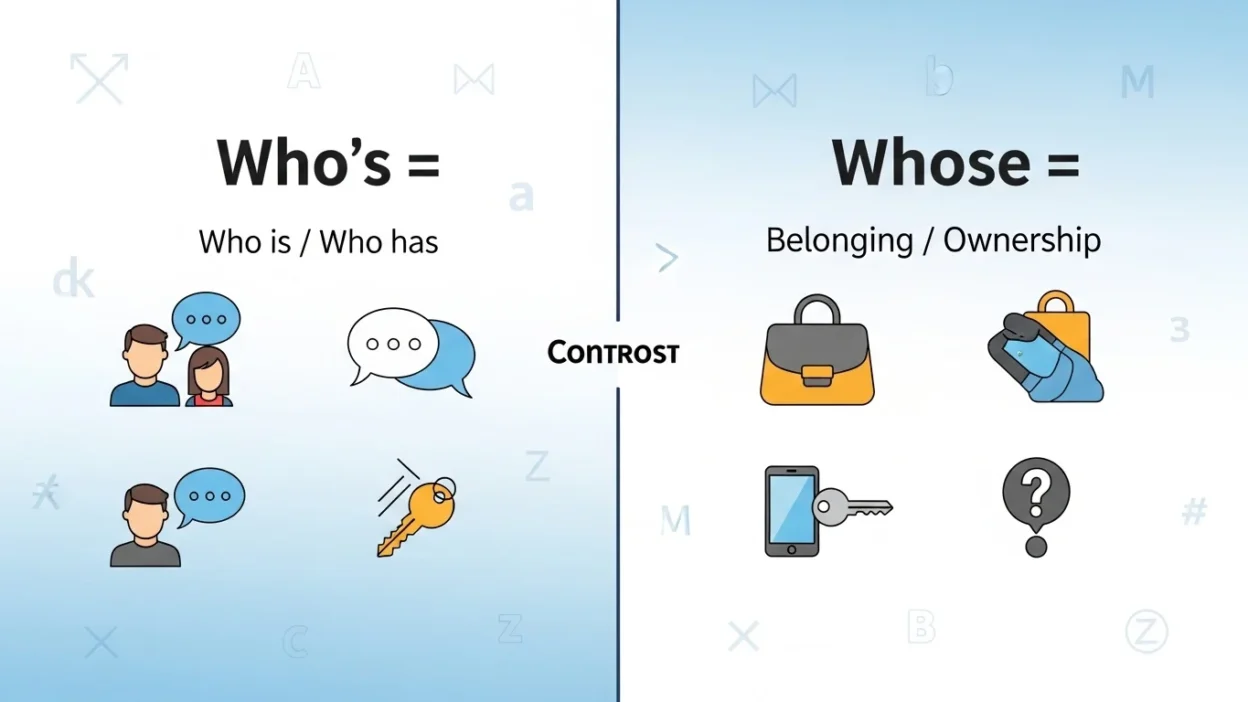
- Who’s = who is / who has
- Whose = belongs to someone (possession)
One line memory trick:
- If you can say “who is,” use who’s
- If you are talking about ownership, use whose
First, Understand the Core Idea (Very Important)
Before rules, understand this idea:
- Who’s is a short form
- Whose is a question of ownership
That’s it.
Now let’s go deeper in the easiest way.
What Does Who’s Mean?
Who’s = Who is / Who has
“Who’s” is a shortened form. The apostrophe shows something is missing.
Think of it like this:
- Who’s = Who is (missing “i” and “s”)
- Who’s = Who has (missing “ha”)
Examples:
- Who’s at the door?
- Who’s coming with us?
- Who’s finished the homework?
- Who’s taken my notebook?
Easy check:
Replace it:
- Who is at the door? ✔
- Who has finished the homework? ✔
If it works, then who’s is correct.
What Does Whose Mean?
Whose = ownership (belonging to someone)
“Whose” is NOT a short form. It is a full word used for possession.
It answers:
👉 “This belongs to who?”
Examples:
- Whose bag is this?
- Whose phone is ringing?
- Whose keys are on the table?
- The girl whose book is missing is sad.
Easy check:
If you are asking:
👉 “Who does this belong to?”
Then use whose.
Who’s vs Whose Difference
| Word | Meaning | Type | Easy Test | Example |
| Who’s | Who is / Who has | Contraction | Replace with “who is” | Who’s calling you? |
| Whose | Belonging/ownership | Possessive | Means “of who” | Whose jacket is this? |
The Fastest Way to Never Make Mistakes
Use this 3 step mental check:
Step 1: Try “who is”
- If sentence works → use who’s
Step 2: If not, ask:
- Is it about ownership?
Step 3:
- Yes → use whose
Real Life English Examples
1. Classroom English
- Who’s absent today?
- Whose notebook is on my desk?
2. Family conversations
- Who’s cooking dinner?
- Whose turn is it to clean?
3. Social media / texting
- Who’s online right now?
- Whose post got so many likes?
4. Everyday situations
- Who’s knocking?
- Whose umbrella is this?
Common Mistakes (And Easy Fixes)
Mistake 1: Using who’s for ownership
❌ Who’s bag is this?
✔ Whose bag is this?
👉 Rule: possession = whose
Mistake 2: Using whose for “who is”
❌ Whose coming with us?
✔ Who’s coming with us?
👉 Rule: action = who’s
Mistake 3: Thinking both are the same
They are NOT the same.
- Who’s = action or identity
- Whose = ownership
Mini Practice (Quick Test)
Choose the correct word:
- ___ coming to the party?
- ___ phone is ringing?
- ___ finished the assignment?
- ___ shoes are outside?
Answers:
- Who’s
- Whose
- Who’s
- Whose
Trick to Remember (Very Powerful)
- Who’s has an apostrophe → something is missing
- Whose has no apostrophe → complete idea of ownership
Simple image in your mind:
- Who’s = “who is” hiding inside
- Whose = “belongs to who”
Frequently Asked Questions
1. What is the main difference between who’s and whose?
Who’s = who is/has, whose = possession.
2. Is who’s always a contraction?
Yes, always.
3. Can whose be used for objects?
Yes, like books, phones, bags.
4. Why do people confuse them?
Because they sound the same.
5. Is who’s formal or informal?
Both. It is normal in spoken and written English.
6. Can whose be used in sentences, not questions?
Yes. Example: The boy whose bike is missing.
7. Does apostrophe matter?
Yes, it completely changes meaning.
8. What is the fastest learning method?
Replace “who’s” with “who is” and check meaning.
Final Summary (Very Simple)
If you remember only this:
- Who’s = who is / who has (action)
- Whose = belonging (ownership)
Then you will never confuse them again.
Just pause for one second before writing, and check:
👉 action or ownership?
That one question is enough to guide you correctly every time.

Mitcheel Satrac is a passionate visionary dedicated to creativity, innovation, and meaningful success. His work reflects authenticity, purpose, and a drive to make a real impact.