If you are confused between past vs passed, you are not alone. Many students, learners, and even fluent speakers make mistakes with these two words.
The reason is simple: they sound almost the same when spoken, but their meanings are completely different in writing.
This confusion often causes mistakes in exams, assignments, and daily English writing. Some learners use past vs passed meaning incorrectly, while others struggle with how to use past and passed correctly in sentences.
But here is the good news: once you understand the simple rule behind them, you will never mix them again.
Quick Answer
If you want a fast understanding of the difference between past and passed, remember this:
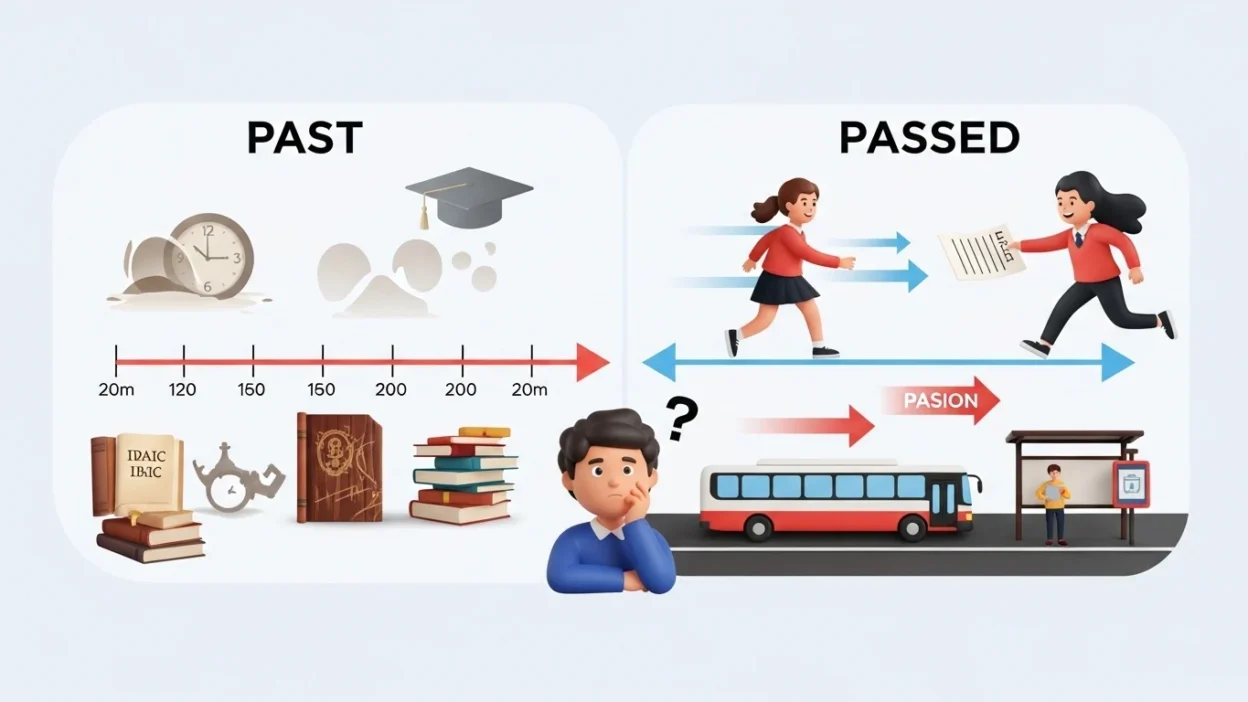
- Past = time or position (NO action)
- Passed = action (something happens)
That’s it. This one rule solves almost every confusion.
Why These Two Words Feel So Confusing
The confusion in past vs passed meaning happens because:
- They sound the same in spoken English
- They are spelled very similarly
- Both are used in daily conversation
- Students are not taught the “logic difference” clearly
But the truth is simple:
👉 One word talks about time or location
👉 The other word shows movement or action
Pronunciation Tip (Very Important for Learners)
Understanding sound helps reduce confusion:
- Past → /pɑːst/ (no “d” sound)
- Passed → /pæst/ + soft “d” at the end
Even though they sound close, passed has a slight ending sound of “d”, which shows it is an action verb.
Meaning of “Past” (Simple Explanation)
The past meaning in English refers to:
- Time before now
- Something that already happened
- A position or direction
Easy examples:
- We learn from the past.
- She walked past the shop.
- In the past, people used letters instead of phones.
Key idea:
👉 “Past” does NOT show action. It shows time or position only.
Meaning of “Passed” (Simple Explanation)
The passed meaning in English comes from the verb “pass.” It always shows action.
It can mean:
- Moving by something
- Successfully completing something
- Giving something to someone
Easy examples:
- He passed the school gate.
- She passed her exam easily.
- The bus passed us quickly.
- Please pass the water bottle.
Key idea:
👉 “Passed” always shows something happening or being done.
Past vs Passed Difference (Very Clear )
| Feature | Past | Passed |
| Type | Noun / adjective / preposition | Verb |
| Meaning | Time or position | Action |
| Shows action | No | Yes |
| Example | In the past, life was simple | He passed the exam |
| Usage focus | History, time, direction | Movement, success, transfer |
How to Use Past and Passed Correctly (Simple Trick)
Use this mental question:
👉 Ask yourself:
- Is it about time or place? → Use past
- Is it about action or movement? → Use passed
This trick works in almost every sentence.
When to Use “Past” (With Clear Examples)
Use past in these situations:
1. Talking about time
- My childhood is in the past.
- Don’t think too much about the past.
2. Talking about direction
- He walked past me without saying anything.
- The car went past the station.
3. Talking about history
- In the past, people traveled by horse.
- Life in the past was very different.
When to Use “Passed” (With Clear Examples)
Use passed when something happens:
1. Movement
- The train passed the tunnel.
- She passed me on the road.
2. Exams and success
- I passed all my exams.
- He passed the driving test.
3. Giving something
- Please pass the book.
- She passed the message to her friend.
Past vs Passed Examples in Real Life (Very Important)
Daily life
- I remember my school days in the past.
- The bus passed my stop quickly.
- She passed me a notebook in class.
Social media style
- “Thinking about the past today 😌”
- “Finally passed my exam 🎉”
- “That moment passed so fast!”
Conversation style
- Don’t worry about the past.
- The car just passed us.
- He passed the interview successfully.
Common Mistakes Students Make
❌ Mistake 1:
He past the exam.
✔ He passed the exam.
❌ Mistake 2:
In the passed, life was simple.
✔ In the past, life was simple.
❌ Mistake 3:
The dog past me quickly.
✔ The dog passed me quickly.
❌ Mistake 4:
I don’t think about passed mistakes.
✔ I don’t think about past mistakes.
Memory Trick (Very Easy for Beginners)
Use this simple memory system:
- Past = “time” (no action)
- Passed = “did something” (action)
Extra trick:
👉 Words ending in “-ed” often show action → passed
👉 No “-ed” often means state/time → past
Mini Practice (Learn by Doing)
Fill in the blanks:
- I finally ______ my exam.
- In the ______, people used letters.
- The bus ______ us very fast.
- Don’t think about the ______.
Answers:
- passed
- past
- passed
- past
Short Student Learning Guide
If you still feel confused about past vs passed, just remember:
- Past = before now
- Passed = action happened
Say it a few times. It builds automatic understanding.
FAQs (Clear and Student-Focused)
1. What is the main difference between past vs passed?
Past is about time or position, while passed is about action.
2. Why do people confuse past and passed?
Because they sound almost identical in speech.
3. Is past a verb?
No, past is not a verb.
4. Is passed always an action word?
Yes, it always comes from the verb “pass.”
5. Can past show movement?
Yes, but only as direction (walked past).
6. What is the easiest way to remember them?
Past = time, Passed = action.
7. Can both be used in one sentence?
Yes. Example: He passed the shop in the past.
8. Are these words common in exams?
Yes, very common in grammar and writing tests.
Conclusion
But the rule is very simple:
- Past = time or position
- Passed = action or movement
Once you understand this and practice a few past vs passed examples, you will never mix them again.

Mitcheel Satrac is a passionate visionary dedicated to creativity, innovation, and meaningful success. His work reflects authenticity, purpose, and a drive to make a real impact.