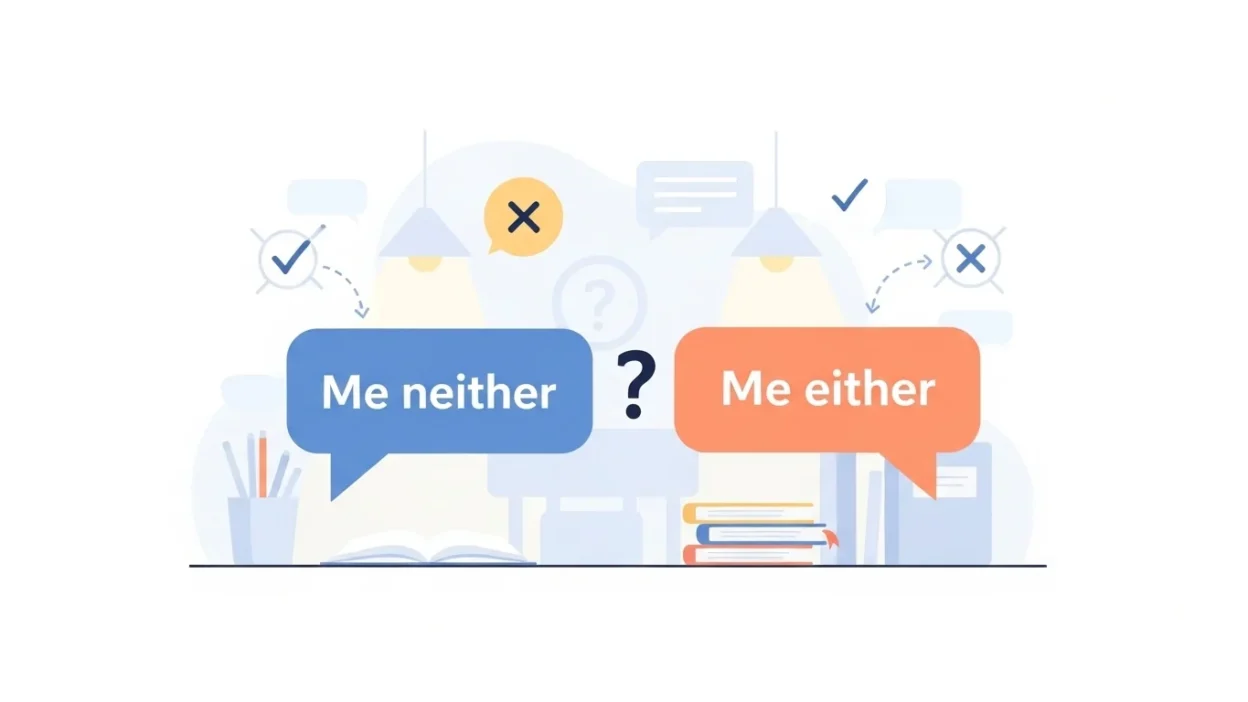
Many English learners get confused about me either vs me neither. Both phrases are short, both appear in everyday conversations, and both seem to mean the same thing.
Because of this, students often ask a simple question: Which one should I use me either or me neither?
You might hear a friend say “Me neither!” after a negative sentence. But another person might say “Me either!” in the same situation. This can make learners feel unsure about the difference between me either and me neither.
The truth is that the rule is quite simple once you understand how these expressions work.
This guide explains the me either meaning, the me neither meaning, when to use each phrase, and how they appear in real conversations.
Quick Rule
If you want a fast explanation of me either vs me neither, remember these points:
- Me neither is the grammatically correct response to a negative sentence.
- Me either is informal but very common in everyday conversation.
- Both phrases mean “I also don’t.”
Example:
Person A: I don’t like cold weather.
Person B: Me neither.
Person B means: I also don’t like cold weather.
Many people may also say:
Person B: Me either.
In daily speech, both responses are understood.
Basic Background
To understand the difference between me either and me neither, we first need to see how people agree with someone in English.
When a sentence is positive, we use responses like:
- Me too
- So do I
- I do too
Example:
Person A: I like chocolate.
Person B: Me too.
But when a sentence is negative, the response changes.
Example:
Person A: I don’t like chocolate.
Person B: Me neither.
This pattern is important for learners who are studying me either vs me neither ESL usage.
Grammar Structure Behind These Expressions
Understanding the grammar helps make the rule clearer.
In English, when someone says a negative sentence, another person can agree using several patterns.
Negative statement → Agreement
Example:
I don’t like coffee.
Possible responses:
- Me neither
- Neither do I
- I don’t either
All three responses show agreement.
This grammar pattern explains the me neither meaning, which is essentially “I also do not.”
The phrase me either developed later in informal speech, which is why people often discuss me either vs me neither grammar.
Me Either vs Me Neither: The Main Difference
The difference between me either and me neither mainly comes down to formality and grammar.
Me neither
- traditional grammar form
- accepted in writing and speaking
- taught in classrooms
Me either
- informal spoken variation
- common in casual conversation
- used frequently in American English
This is why many learners ask: me either or me neither which is correct?
Technically, me neither is the safer choice, but me either is widely understood.
Comparison
Here is a clear comparison of me either vs me neither.
| Phrase | Meaning | Grammar Status | Typical Use |
| Me neither | I also do not | Standard grammar | Spoken and written English |
| Me either | I also do not | Informal usage | Casual conversation |
Example:
Person A: I didn’t watch the game.
Response: Me neither.
Response: Me either.
Both responses show agreement with the negative statement.
When to Use Me Neither
Knowing when to use me neither helps you sound more confident in English.
Use me neither when:
- responding to a negative sentence
- speaking in class
- writing dialogue
- using careful grammar
Examples of me neither examples in English:
Friend: I don’t understand this question.
You: Me neither.
Classmate: I didn’t finish the assignment.
You: Me neither.
Teacher: I don’t have the answer yet.
Student: Me neither.
These examples show how to use me neither in a sentence naturally.
When to Use Me Either
Now let’s explore when to use me either.
This expression appears mostly in informal spoken English. You will hear it often in:
- casual conversations
- text messages
- social media comments
- group chats
Example conversation:
Friend: I can’t find my phone.
You: Me either.
Text message example:
Friend: I didn’t study today.
You: Me either.
These are common me either examples in conversation.
Spoken English vs Written English
Another helpful way to understand me either vs me neither is to look at speaking and writing.
In writing or formal situations
Use:
- Me neither
- Neither do I
Example:
Email:
“I didn’t understand the instructions.”
“Me neither.”
In casual speaking
People often say:
- Me either
Example:
Friend: I’m not going out tonight.
You: Me either.
Similar Expressions
English also has other ways to agree with negative statements.
Common alternatives include:
- Neither do I
- I don’t either
Example:
Person A: I don’t like loud music.
Person B: Neither do I.
Another example:
Person A: I can’t swim.
Person B: I don’t either.
Because of this, learners often compare neither do I vs me neither.
Both are correct, but neither do I sounds slightly more formal.
Real Life Examples
Here are more me either vs me neither examples in everyday situations.
Daily Conversation
Friend: I don’t remember his name.
You: Me neither.
Friend: I can’t solve this puzzle.
You: Me either.
Workplace Example
Coworker: I didn’t receive the meeting email.
You: Me neither.
Social Media Example
Post:
“I don’t enjoy studying late at night.”
Comment:
“Me neither!”
Another comment:
“Me either 😄”
Classroom Example
Student: I don’t understand the homework.
Another student: Me neither.
These examples show how to use me either in a sentence in natural situations.
Common Mistakes
When learning me either vs me neither, beginners often make a few mistakes.
Using “Me Neither” After Positive Sentences
Incorrect:
Person A: I like pizza.
Person B: Me neither.
Correct response:
Me too.
Using “Me Too” After Negative Sentences
Incorrect:
Person A: I don’t like coffee.
Person B: Me too.
Correct response:
Me neither.
Combining Both Words
Incorrect:
Me neither either.
Choose only one phrase.
Beginner Learning Tip
For learners studying me either vs me neither for beginners, this simple rule helps.
Positive sentence → Me too
Negative sentence → Me neither
Examples:
I enjoy music. → Me too
I don’t enjoy music. → Me neither
Remembering this pattern makes it easier to understand me either vs me neither conversations.
Quick Practice
Try these practice questions.
Fill the blank with the correct response.
- I don’t like waking up early. → ______
- I didn’t finish the book. → ______
- I can’t solve this problem. → ______
Possible answers:
- Me neither
- Me either
Both work in conversation, but me neither is the standard grammar form.
FAQs
What is the difference between me either and me neither?
Both phrases agree with negative statements. However, me neither is the grammatically standard form.
What is the me neither meaning?
The me neither meaning is “I also do not” or “I feel the same way about this negative statement.”
What is the me either meaning?
The me either meaning is also “I also don’t,” but it is usually used in casual speech.
Me either or me neither which is correct?
Traditionally, me neither is correct grammar, but me either is widely used in conversation.
How to use me neither in a sentence?
Example:
Friend: I didn’t watch the movie.
You: Me neither.
How to use me either in a sentence?
Example:
Friend: I can’t find my notebook.
You: Me either.
What is the difference between neither do I vs me neither?
Both agree with negative statements. Neither do I sounds slightly more formal.
Is “I don’t either vs me neither” the same?
Yes. Both phrases express the same idea, though me neither is shorter and more common.
Conclusion
Understanding me either vs me neither is much easier than it first seems.
Both phrases are used to agree with negative statements. The main difference is style.
- Me neither follows traditional grammar and works well in almost every situation.
- Me either appears often in relaxed conversation.
The easiest rule to remember is this:
Positive sentence → Me too
Negative sentence → Me neither
Once you practice with real conversations and examples, these expressions will become natural.
Soon you will hear them everywhere in daily speech, messages, and social media and you will know exactly how to use them correctly.

Mitcheel Satrac is a passionate visionary dedicated to creativity, innovation, and meaningful success. His work reflects authenticity, purpose, and a drive to make a real impact.