Many English learners feel confused when they see any time and anytime. These two expressions look almost identical, but they are not used in exactly the same way. Because of this, students often search questions like anytime or any time, is anytime one word or two, or what is the difference between any time and anytime.
This confusion is very common for beginners, learners and even some native speakers. The reason is simple: both forms sound the same when spoken. However, in writing, the small spelling difference changes how the word works in a sentence.
In this guide, you will learn the any time vs anytime difference in very clear and simple English. We will look at easy rules, examples, common mistakes, and quick practice so you can understand the topic completely.
Quick Rule to Remember
If you only remember one thing about any time vs anytime, remember this rule:
Simple Rule
- Use any time (two words) after “at.”
- Use anytime (one word) when it means “whenever.”
Examples:
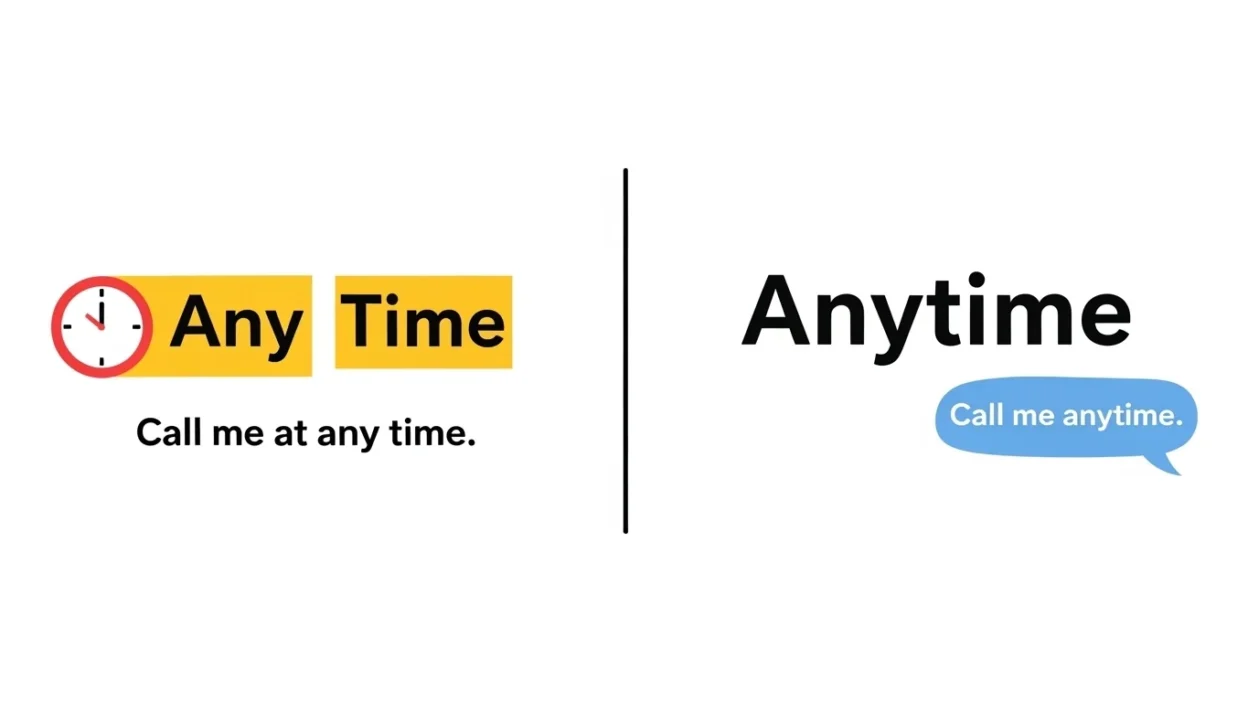
- Call me at any time.
- Call me anytime.
This rule helps solve most questions about any time vs anytime grammar.
Quick Answer
Here is a short explanation of the difference between any time and anytime:
- Any time (two words) is a noun phrase that refers to time itself.
- Anytime (one word) is an adverb that means whenever.
- Any time is often used in more formal writing.
- Anytime is more common in casual speech and texting.
Understanding these points will help you recognize when to use any time and when to use anytime.
Is Anytime One Word or Two?
Many learners ask: is anytime one word or two?
The answer is that both forms exist, but they are used differently.
- Any time → two words
- Anytime → one word
The difference depends on grammar and sentence structure. Learning this small detail helps you avoid mistakes and understand anytime vs any time explained clearly.
The Difference Between Any Time and Anytime
Let’s look closely at the difference between any time and anytime.
Any Time (Two Words)
The phrase any time refers to time itself. It usually appears when the sentence talks about a possible moment or period.
Examples:
- You can call me at any time.
- The teacher is available at any time today.
- Visitors may arrive at any time during the afternoon.
In these sentences, “time” acts like a noun. It is something that can be chosen or mentioned directly.
Anytime (One Word)
The word anytime acts as an adverb. It means whenever or at any moment.
Examples showing how to use anytime in a sentence:
- You can visit anytime.
- Message me anytime you need help.
- I’m free anytime this weekend.
Here, “anytime” replaces the word whenever.
Understanding this idea makes the any time vs anytime simple explanation much easier.
Simple Comparison
| Feature | Any Time | Anytime |
| Word form | Two words | One word |
| Grammar role | Noun phrase | Adverb |
| Meaning | Refers to a time | Means whenever |
| Writing style | More formal | Informal or casual |
| Example | Call me at any time | Call me anytime |
This comparison helps learners quickly understand any time vs anytime examples.
When to Use “Any Time”
Use any time when your sentence talks about a specific or possible time.
This often happens after the word at.
Examples:
- You may contact the office at any time.
- The doctor can see patients at any time today.
- The library is open at any time during school hours.
These examples clearly show when to use any time.
More Correct Examples
Correct:
- Please call us at any time.
Correct:
- Students can ask questions at any time.
Incorrect:
- Please call us at anytime.
When to Use “Anytime”
Use anytime when the meaning is similar to whenever.
This is common in casual conversation and friendly messages.
Examples of anytime meaning and examples:
- Come visit anytime.
- You can text me anytime.
- I’m ready anytime after lunch.
These examples show when to use anytime in everyday situations.
More Correct Examples
Correct:
- Call me anytime you need help.
Correct:
- I’m available anytime tomorrow.
Incorrect:
- Call me any time you need help (in casual conversation this sounds less natural).
Common Mistakes Learners Make
Many learners confuse any time vs anytime because the words sound the same. Let’s look at common mistakes.
Mistake 1: Using “anytime” after “at”
Wrong
❌ I will call you at anytime.
Correct
✔ I will call you at any time.
Mistake 2: Thinking only one form is correct
Some learners think anytime is wrong. Others think any time is outdated. In reality, both are correct depending on the sentence.
Mistake 3: Forgetting the meaning “whenever”
If the meaning is whenever, the correct choice is usually anytime.
Example:
Wrong
❌ Visit me any time you want.
Correct
✔ Visit me anytime you want.
Understanding these examples helps learners follow any time vs anytime grammar rules explained earlier.
Real Life Examples
Here are some everyday situations where you might use these expressions.
Email Example
Hello,
You may contact our office at any time during working hours.
Thank you.
Friendly Message
Hey! You can come over anytime today.
Social Media Post
Need help with homework? Message me anytime.
Conversation Example
Person A: When should I visit?
Person B: Anytime works for me.
School Example
Students may ask questions at any time during the lesson.
These examples make the anytime vs any time guide easier to understand.
Quick Practice for Beginners
Try this short exercise.
Choose the correct form.
- You can call me ____ tomorrow.
- The office is open at ____ during the day.
- Come visit me ____ this weekend.
Answers:
- anytime
- any time
- anytime
Practice like this helps beginners remember the any time vs anytime simple explanation.
Easy Trick to Remember
Here is a simple memory trick.
- at any time → two words
- anytime = whenever
Example:
Call me anytime.
Meaning: Call me whenever.
Call me at any time.
Meaning: Call me at a time you choose.
This small trick helps many learners remember any time vs anytime easily.
FAQs
What is the difference between any time and anytime?
The difference between any time and anytime is grammatical. “Any time” is a noun phrase, while “anytime” is an adverb meaning “whenever.”
Is anytime one word or two?
Both forms exist. Any time is two words, while anytime is written as one word.
When should you use anytime or any time?
Use anytime when you mean “whenever.” Use any time when referring to time itself, especially after “at.”
Is “at anytime” correct?
No. The correct phrase is at any time.
Which form is more common in conversation?
In casual speech, anytime is very common.
Do native speakers mix them up?
Yes, sometimes. Because both words sound the same, even native speakers occasionally confuse them.
Is this rule important for students?
Yes. Learning any time vs anytime for beginners helps improve writing accuracy and grammar skills.
Conclusion
The difference between any time vs anytime is small, but learning it makes your English clearer and more correct.
Remember the key rule:
- Use any time when referring to time, especially after “at.”
- Use anytime when you mean whenever.
With this simple rule, examples, and practice, the confusion about anytime vs any time should now be completely clear.
Once you start noticing these forms in everyday writing and conversation, choosing the correct one will become easy and natural.

Kaliyan Martan is a passionate dreamer and creative thinker who believes in turning ideas into meaningful action. With vision and dedication, he strives to make a lasting impact through innovation and authenticity.