If you keep mixing up ensure vs insure, you are not alone. Many English learners face the same problem.
These two words look almost identical, and they even sound very similar. Because of that, students often use the wrong one in writing, exams, emails, and daily English.
The good news is this: the difference is actually very simple. Once you understand it clearly, you will never confuse them again.
Quick Answer
Here is the fastest way to understand:
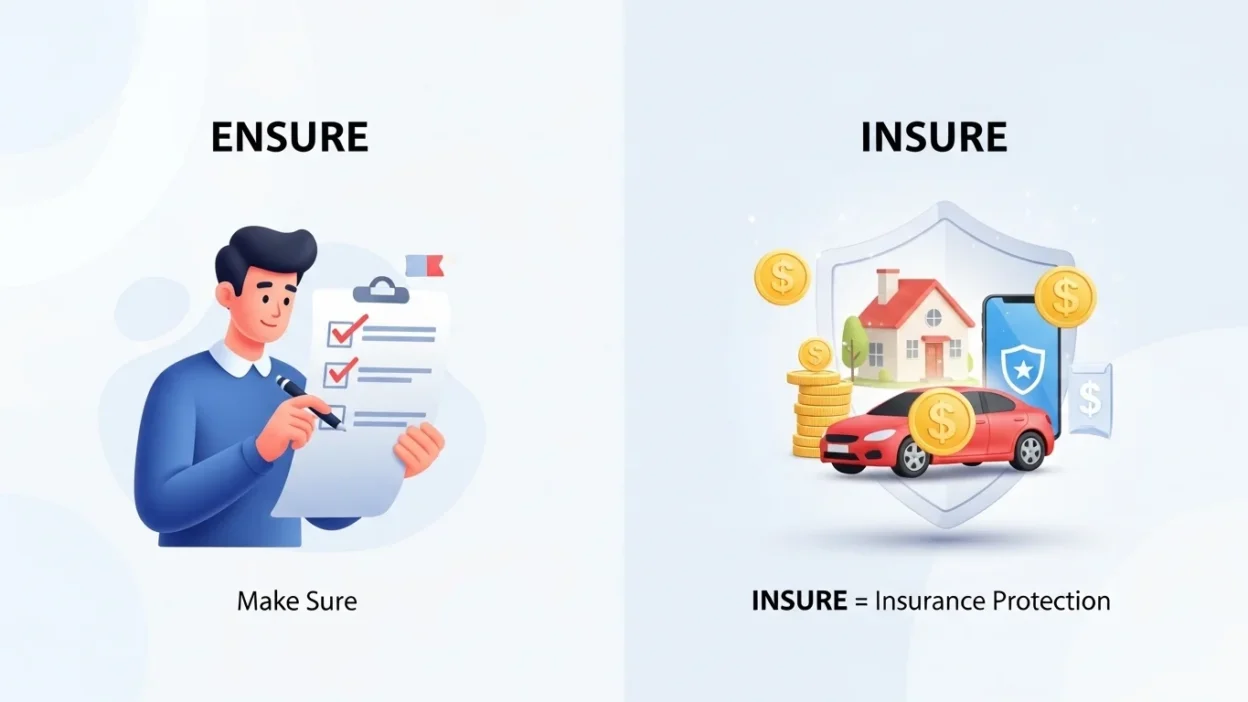
- Ensure = make something certain / make sure
- Insure = protect something with insurance (money protection)
That’s it.
No complicated grammar. Just two different ideas.
One Line Meaning
Before anything else, remember this:
- Ensure = I want to make sure it happens
- Insure = I want financial protection if something goes wrong
If you remember only this, you will already be ahead of most learners.
Why Students Confuse Ensure and Insure
Most confusion happens because:
- The spelling is almost the same
- Only one letter is different
- Both words feel like they are about “safety”
- In speaking, they sound very similar
- People guess instead of learning the real meaning
So when students search “difference between ensure and insure in English”, they are usually already confused in real life situations like writing, exams, or speaking.
Let’s fix that confusion completely.
Ensure Meaning (Very Simple Explanation)
Ensure means:
To make sure something happens or to guarantee a result.
Think of it like this:
👉 You are controlling or checking something so it becomes correct.
Key idea:
No money. No insurance. Only certainty.
Easy examples:
- Please ensure you bring your ID card.
- I will ensure the door is locked.
- She studied hard to ensure success.
- We ensure students are safe in school.
Real life situation:
Imagine you are leaving home. You check the door twice. That action is ensure.
Insure Meaning (Very Simple Explanation)
Insure means:
To protect something with insurance in case something bad happens.
Think of it like this:
👉 You are paying money to reduce risk.
Key idea:
Money + protection + risk.
Easy examples:
- I will insure my car.
- They insured their house against fire.
- She insured her phone before traveling.
- The company insures all employees.
Real life situation:
If your phone breaks and a company pays for it because you insured it, that is insure.
Ensure vs Insure (Very Clear Comparison)
| Feature | Ensure | Insure |
| Meaning | Make sure something happens | Protect with insurance |
| Focus | Certainty | Financial safety |
| Money involved | No | Yes |
| Use in life | Actions, tasks, results | Insurance policies |
| Example | Ensure safety | Insure car |
Super Easy Memory Trick (Never Forget Again)
Here is the simplest trick:
- Ensure = Sure (make sure)
- Insure = Insurance (money protection)
Another way to remember:
- Ensure = “I control it”
- Insure = “I pay for protection”
If you remember this, you will rarely make mistakes again.
Common Real Mistakes (And Fixes)
Let’s fix confusion the way students actually make mistakes.
❌ Wrong: I will insure you arrive safely.
✔️ Correct: I will ensure you arrive safely.
❌ Wrong: I will ensure my car.
✔️ Correct: I will insure my car.
❌ Wrong: Please insure the door is closed.
✔️ Correct: Please ensure the door is closed.
Real Life Conversations (Very Important for Learning)
At School
Teacher: Please ensure you complete your homework.
At Travel
I will insure my luggage before the trip.
We must ensure we reach the airport early.
At Work
Manager: Ensure all reports are submitted today.
Company: We insure all office equipment.
Daily Life Chat
Friend: Make sure you come early.
You: Don’t worry, I will ensure it.
Simple Learning Method (For Beginners)
Try this 3 step method:
Step 1: Think “make sure”
If your sentence means “make sure,” use ensure
Step 2: Think “insurance”
If your sentence is about protection or money safety, use insure
Step 3: Ask yourself
- Am I checking something? → Ensure
- Am I paying for protection? → Insure
Mini Practice (Fix Your Brain Instantly)
Fill in the blanks:
- I want to ______ my phone.
- Please ______ you study daily.
- We will ______ the house.
- Teachers ______ students are safe.
Answers:
- insure
- ensure
- insure
- ensure
Common Confusion Traps (Very Important)
Be careful with these:
⚠️ Trap 1: Both sound like “safety”
Only ensure = general safety
Only insure = financial safety
⚠️ Trap 2: Guessing spelling
Never guess. Meaning decides the word, not spelling similarity.
⚠️ Trap 3: Thinking they are interchangeable
They are NEVER interchangeable.
Quick Revision (Final Clarity)
- Ensure → make sure → action word
- Insure → insurance → money protection word
FAQs
1. What is the main difference between ensure and insure?
Ensure means to make something certain. Insure means to protect with insurance.
2. Can I use insure instead of ensure?
No, they have different meanings.
3. Which word is more common?
Ensure is more common in everyday English.
4. Is insure only used in banking or finance?
Mostly yes, especially insurance services.
5. Why do people confuse them?
Because they look and sound very similar.
6. What is the easiest way to remember?
Ensure = make sure, Insure = insurance.
7. Can ensure mean protection?
Only general safety, not financial protection.
8. Are both formal words?
Yes, both are standard English verbs.
Conclusion
The confusion between ensure vs insure is common, but it is very easy to fix.
Just remember:
- Ensure = make sure something happens
- Insure = protect something with insurance
One is about controlling results. The other is about paying for protection.
If you use the memory trick and practice a few sentences, you will never mix them up again in writing, speaking, or exams.

Mitcheel Satrac is a passionate visionary dedicated to creativity, innovation, and meaningful success. His work reflects authenticity, purpose, and a drive to make a real impact.