Many English learners get stuck when they see relieving vs reliving. At first glance, the words look almost identical. Even the sound is very close. Only one small letter changes everything.
Because of this, students often pause while writing sentences. They are unsure which word fits the situation.
Some people say one word when they actually mean the other. For example, they may use a word about memory when they actually want to talk about stress or pain.
This guide will clear the confusion in a very simple way, using easy English, real examples, and clear thinking patterns.
Quick understanding (before details)
If you remember only this, you are already halfway there:
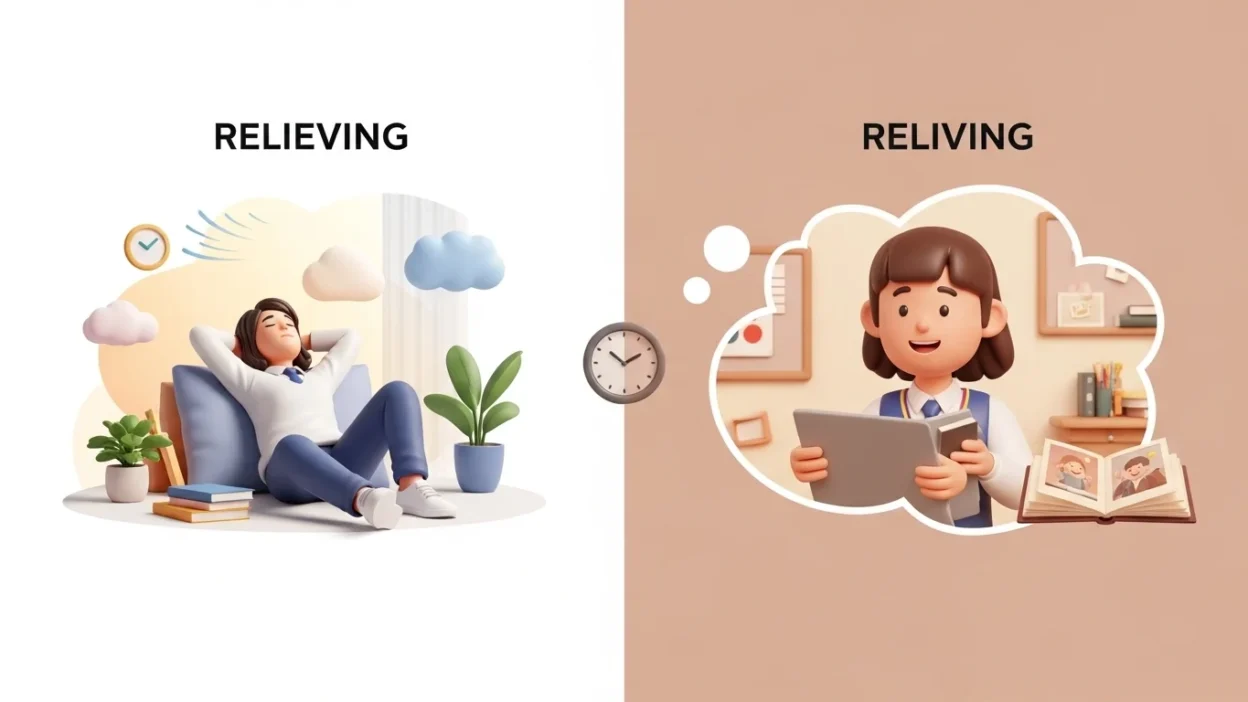
- Relieving = making something better right now (less stress, pain, pressure)
- Reliving = experiencing something again in your mind (a memory replay)
One is about present comfort.
The other is about past memories.
Why these words are often confused
The confusion happens for three simple reasons:
- They look almost the same in spelling
- They sound very similar when spoken
- Both are connected to emotions and feelings
But the real difference is not in sound. It is in time and meaning.
- Relieving belongs to the present moment
- Reliving belongs to the past memory
Once you see this time difference, everything becomes clear.
The meaning of “relieving” in simple English
Relieving means reducing something uncomfortable. It can be pain, stress, fear, or pressure.
Think of it like this:
When something heavy is lifted off you, you feel lighter. That feeling is relieving.
Simple idea:
Relieving = making life easier right now
Everyday examples:
- This medicine is relieving my headache
- Talking to a friend is relieving my stress
- A cool breeze is relieving the heat
- Finishing homework early is relieving pressure
In all these cases, something bad becomes less strong in the present moment.
The meaning of “reliving” in simple English
Reliving means thinking about a past moment so clearly that it feels like happening again.
It is not real time travel. It is your brain replaying memories.
Simple idea:
Reliving = replaying a memory in your mind
Everyday examples:
- I am reliving my school days while looking at old photos
- She is reliving her wedding day in her thoughts
- He keeps reliving his first football goal
- They are reliving the trip while watching videos
Here, nothing is being fixed or improved. It is only memory replay.
The core difference (very easy explanation)
Let’s make it extremely simple:
- Relieving = fixing or reducing a problem now
- Reliving = replaying something from the past
Another way to think:
- Relieving helps your body or mind feel better today
- Reliving takes your mind back to yesterday or any past moment
This is the real heart of the difference.
Relieving vs reliving comparison
| Point | Relieving | Reliving |
| Time | Present | Past |
| Main idea | Reducing discomfort | Replaying memory |
| Feeling | Relief, comfort | Emotion, nostalgia |
| Action type | Practical improvement | Mental experience |
| Example focus | Stress, pain, pressure | Memories, events, moments |
Relieving vs reliving in real life situations
Let’s understand how these words appear in daily life.
1. Student life
- Relieving stress after exams feels amazing
- Reliving exam day in your mind is common later
2. Daily routine
- Drinking water is relieving thirst
- Thinking about a fun party is reliving the moment
3. Social media
- Watching funny videos is relieving boredom
- Looking at old pictures is reliving memories
4. Emotional moments
- A kind message can be relieving anxiety
- A sad memory can make someone relive past pain
This shows how both words are part of normal life, but in very different ways.
Common mistakes learners make
Many students confuse these two words in similar situations.
Mistake 1: Using “reliving” for pain
Wrong:
- I am reliving my headache
Correct:
- I am relieving my headache
Mistake 2: Using “relieving” for memories
Wrong:
- I am relieving my childhood
Correct:
- I am reliving my childhood
Mistake 3: Mixing emotional meaning
Students sometimes think both words are about feelings.
But only one is about memory, the other is about comfort.
How to remember the difference easily
Here is a very simple trick:
- Relieving = leave pain behind
- Reliving = live the past again
Break it like this:
- Relieve → remove pressure
- Relive → experience again
This mental shortcut works very well for beginners.
Real conversation examples
Example 1: Friend talk
- “I feel so tired after work.”
- “Take a break, it will be relieving your stress.”
Example 2: Memory talk
- “Do you remember our school trip?”
- “Yes, I am reliving it right now!”
Example 3: Daily life
- “This music is really relieving my tension.”
- “That song is making me relive old memories.”
These examples show natural usage in real English conversations.
Small learning section for beginners
Try to decide which word fits:
- I am ___ my stress after a walk.
- She is ___ her childhood memories.
- This break is ___ my pressure.
- He is ___ the moment in his mind again.
Answers:
- relieving
- reliving
- relieving
- reliving
Why understanding this difference is useful
Learning this difference helps you:
- Speak more clearly in English
- Avoid common grammar mistakes
- Understand emotional expressions better
- Improve writing accuracy in school or exams
Even small word differences can change meaning completely.
Frequently Asked Questions
1. What is the simple meaning of relieving?
It means reducing stress, pain, or pressure in the present moment.
2. What is the simple meaning of reliving?
It means experiencing a past memory again in your mind.
3. Are relieving and reliving related?
They look similar but have different meanings and uses.
4. Can reliving be positive or negative?
Yes, it can be happy memories or sad memories.
5. Is relieving only for physical pain?
No, it is also used for stress, worry, and emotions.
6. Why do people confuse these words?
Because they look and sound very similar.
7. What is the easiest way to remember them?
Relieving = reduce pain, reliving = replay memory.
8. Can both be used in daily English?
Yes, both are common in everyday speaking and writing.
Conclusion: A very simple way to never forget
The difference between these two words is actually very easy once you understand the idea of time.
- Relieving belongs to the present. It makes you feel better now.
- Reliving belongs to the past. It brings memories back in your mind.
One word helps your body and mind feel lighter today.
The other takes your thoughts back to moments you have already lived.
If you remember “present relief vs past replay,” you will never confuse them again.

Kaliyan Martan is a passionate dreamer and creative thinker who believes in turning ideas into meaningful action. With vision and dedication, he strives to make a lasting impact through innovation and authenticity.