If you mix up elude vs allude, you are not alone. Many English learners face the same problem. The words look similar, sound similar, and both feel “slightly formal.” Because of this, students often use the wrong one without even realizing it.
But here is the good news: the meaning difference is actually very simple. Once you see it in real life situations, your brain will stop confusing them.
Before we go deeper, here is a super quick fix:
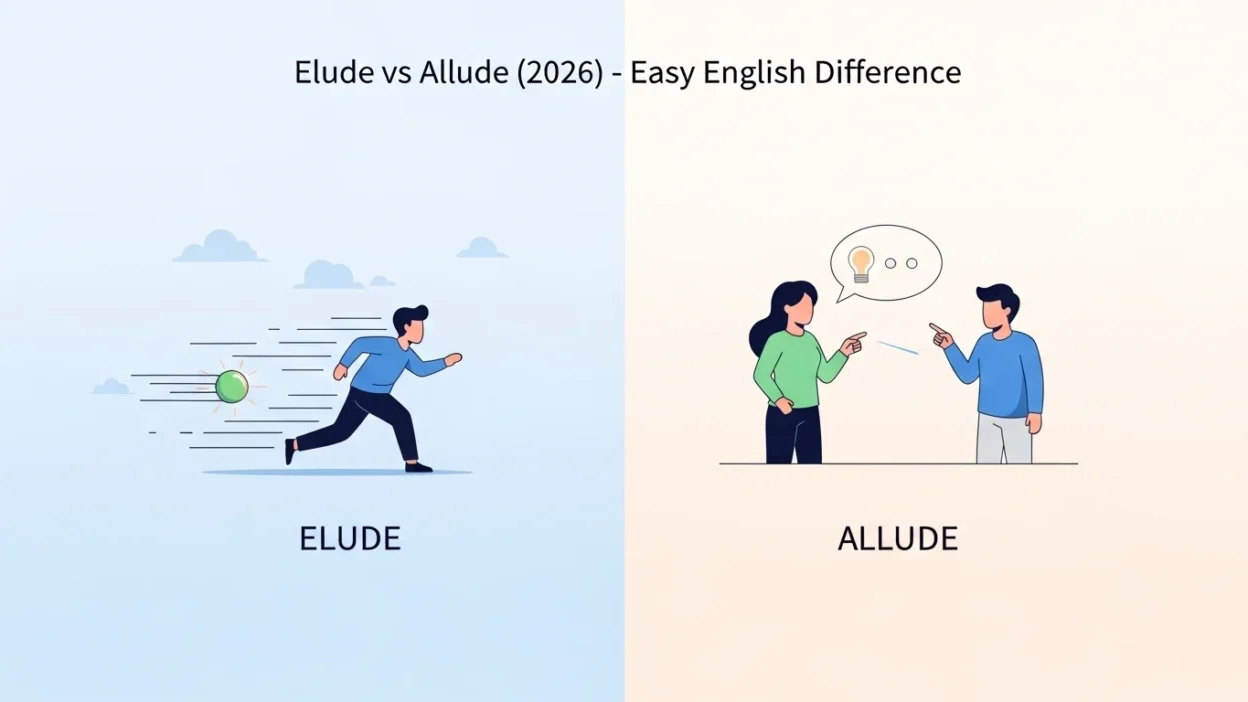
- Elude = escape / avoid / cannot catch
- Allude = hint / indirect mention
Now let’s understand it in a way that truly sticks.
Quick Meaning
- Elude means something is slipping away from you. You cannot catch it, reach it, or understand it easily.
- Allude means you are talking about something without saying it directly.
Think like this:
- Elude → It runs away from you
- Allude → You talk around it, not directly
Why These Two Words Feel So Confusing
Most learners struggle because:
- The spelling is almost similar
- Both are not common in everyday conversation
- Both are used in slightly formal English
- Neither word has a “simple daily life feel” at first
But the real difference becomes clear when you see them in action, not just definitions.
Elude Meaning
Basic idea of elude
Elude = to escape, avoid, or remain out of reach
It can be:
- physical (a person escaping)
- mental (an idea you cannot understand)
- emotional (something you cannot achieve)
Real life situations
Imagine these moments:
- A thief runs fast and escapes the police → The thief eludes the police
- You study hard but still cannot solve a question → The answer eludes you
- You try to remember a name but it doesn’t come → The name eludes you
Easy emotional picture
Think of something always “slipping away” from your hand. That is elude.
Allude Meaning
Basic idea of allude
Allude = to refer to something indirectly without naming it
It is about communication, not escape.
Real life situations
Imagine these moments:
- A friend says, “You know what happened yesterday…” but doesn’t explain → They are alluding to something
- A speaker talks about a “famous incident” without naming it → They are alluding
- Someone hints at a problem but avoids details → They are alluding
Easy emotional picture
Think of someone pointing gently without saying the full story. That is allude.
Elude vs Allude: The Clear Difference
Let’s make it crystal clear.
| Feature | Elude | Allude |
| Core meaning | Escape / avoid | Indirect mention |
| Action type | Something happens to you | Something you do while speaking |
| Focus | Difficulty, failure to catch | Hinting, subtle reference |
| Real world | crime, memory, success | speech, writing, conversation |
| Key idea | “I cannot catch it” | “I am not saying it directly” |
The Easiest Memory Trick (Never Forget Again)
Here is a strong mental trick used by many learners:
ELUDE = EXIT
- Imagine something escaping through an exit
- It is gone, you cannot catch it
ALLUDE = A HINT
- Think of “A” as “about”
- You are talking about something without saying it clearly
Super simple line:
- Elude → escapes from you
- Allude → you hint at it
Side by Side Real Life Comparison
1. Crime situation
- The criminal eludes the police → escapes capture
- (Not used for allude here)
2. Conversation situation
- She alludes to her breakup → hints without saying it directly
- (Not used for elude here)
3. Memory situation
- The answer eludes me → I cannot remember or find it
4. Storytelling situation
- The writer alludes to history → indirect reference
Common Mistakes Learners Make (And Why)
Mistake 1: Using “elude” with speech
❌ He eluded to the problem
✔ He alluded to the problem
👉 Reason: elude is NOT about speaking
Mistake 2: Using “allude” for escaping
❌ The thief alluded the police
✔ The thief eluded the police
👉 Reason: allude is NOT about running or escaping
Mistake 3: Thinking both mean “avoid”
Only elude means avoid.
Allude never means escape.
Mistake 4: Confusing meaning in writing
Many students mix them because both feel “formal.”
But their actions are completely different.
Real Life English You Will Actually Hear
In a WhatsApp chat
- “I won’t say it directly, but I’m alluding to what happened yesterday.”
In school
- “The answer still eludes me in math.”
In a workplace email
- “He alluded to a delay in the project without giving details.”
In news
- “The suspect continues to elude authorities.”
Mini Learning Story (Easy to Remember Forever)
Imagine two scenes:
Scene 1: Elude
You are chasing a flying balloon. It keeps going higher and higher. You cannot catch it.
👉 That is elude
Scene 2: Allude
A friend says:
“I know something interesting happened yesterday… but I won’t say it.”
👉 That is allude
Quick Practice Test
Fill in the blanks:
- The truth still ______ me.
- He ______ to the incident during his speech.
- The prisoner managed to ______ the guards.
- She ______ to her childhood memories.
Answers:
- eludes
- alluded
- elude
- alluded
Frequently Asked Questions (Real Search Style)
1. What is the simplest difference between elude and allude?
Elude means escape. Allude means hint.
2. Is elude used in daily English?
Not often, but it is common in writing and formal speech.
3. Can allude be used in conversation?
Yes, especially when speaking indirectly or politely.
4. Why do people confuse elude and allude?
Because they look and sound similar, but their meanings are completely different.
5. Is elude used for emotions?
Yes. Example: “Happiness eludes him.”
6. What is the opposite idea of allude?
Directly state or clearly mention.
7. Can elude and allude ever be interchangeable?
No. They are never interchangeable.
8. What is the fastest way to remember both?
Elude = escape
Allude = hint
Conclusion
The confusion between elude vs allude disappears when you focus on meaning instead of spelling.
- Elude is about something escaping or staying out of reach
- Allude is about indirectly mentioning something
If you remember one simple idea:
👉 Elude = it runs away
👉 Allude = you hint at it
You will never confuse them again, even in exams, writing, or real conversation.

Kaliyan Martan is a passionate dreamer and creative thinker who believes in turning ideas into meaningful action. With vision and dedication, he strives to make a lasting impact through innovation and authenticity.