If you are here just to decide fast, this is the simple truth:
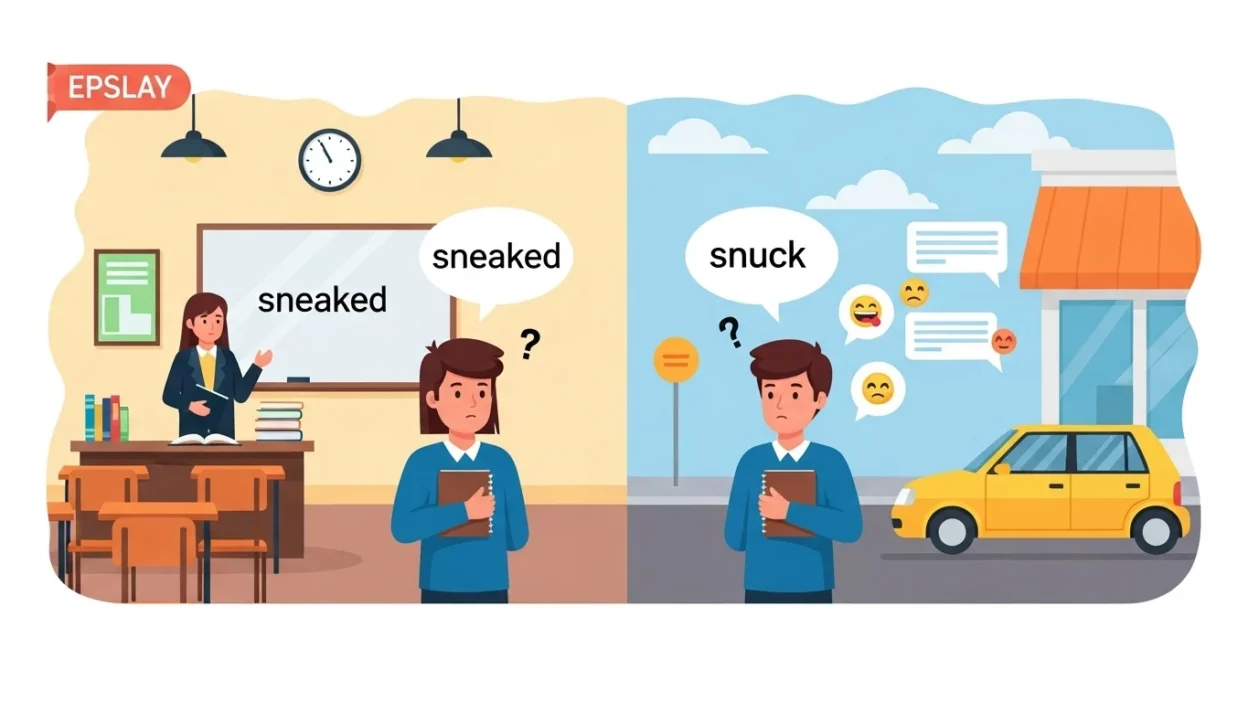
- Sneaked = correct, traditional, safe for writing and exams
- Snuck = correct in informal English, mostly spoken (especially American English)
- Meaning is exactly the same
- Choose based on situation, not meaning
👉 If you are unsure: use “sneaked” every time. It is always safe.
Why People Get Confused About Sneaked vs Snuck
The confusion comes from one simple problem: English does not always follow one fixed pattern.
The verb “sneak” means:
- to move quietly
- to do something secretly
- to avoid being seen
Example:
- She sneaks into the room quietly.
But when we change it to past tense, English gives us two accepted forms:
- sneaked
- snuck
That is why learners ask:
- “Is snuck correct English?”
- “Sneaked or snuck which is correct?”
- “What is the real past tense of sneak?”
The answer is: both are correct, but used differently.
The Real Meaning (No Difference at All)
Let’s make this very clear:
Sneaked meaning
- Past form of “sneak”
- Used in formal English and writing
Snuck meaning
- Same meaning as sneaked
- Used in casual speech
👉 Important point:
There is no meaning difference between sneaked and snuck.
Both describe:
- secret movement
- quiet action
- avoiding attention
Sneaked vs Snuck: Simple Comparison
| Feature | Sneaked | Snuck |
| Meaning | Same | Same |
| Grammar style | Traditional | Modern informal |
| Best for | Exams, writing, formal English | Speaking, casual chats |
| Tone | Clean and correct | Natural and relaxed |
| Safety level | Always safe | Safe in speech, not formal writing |
When to Use Sneaked (Safe Choice Rule)
Use sneaked when you want your English to sound correct and formal.
Use it in:
- school essays
- IELTS or exams
- emails to teachers or offices
- formal writing
- professional communication
Examples:
- She sneaked into the library to study quietly.
- The cat sneaked under the table without noise.
- He sneaked past the security guard.
👉 Think: Sneaked = Safe English
When to Use Snuck (Natural Speech Rule)
Use snuck when you want natural, everyday English.
Use it in:
- talking with friends
- texting or chatting
- storytelling
- movies and dialogue
- social media posts
Examples:
- I snuck into the kitchen last night 😄
- We snuck out to buy snacks.
- He snuck behind the door to scare me.
👉 Think: Snuck = Spoken English
Why “Snuck” Exists (Simple Explanation)
Many learners think “snuck” is a mistake. It is not.
Here is why it exists:
- English changes over time
- People prefer shorter, easier sounds in speech
- “Snuck” became popular in everyday American English
- Movies and conversations made it common worldwide
So now both forms live together:
- sneaked = traditional grammar
- snuck = natural spoken version
Important Grammar Truth (Very Important)
Let’s remove the biggest confusion:
❌ Wrong idea:
“Snuck is incorrect grammar.”
✅ Correct idea:
“Snuck is informal but widely accepted.”
👉 Native speakers use both naturally without thinking.
Real Life Examples (Very Natural Usage)
1. Formal writing
The student sneaked into the computer lab after hours.
2. Casual chat
Bro, I snuck into the fridge at midnight 😂
3. Storytelling
He sneaked through the dark hallway without making a sound.
4. Social media
We snuck into the cinema without tickets. Don’t try this!
👉 Notice:
Same meaning, different tone.
Sneaked or Snuck: Which Should YOU Use?
Here is the simplest decision rule:
Use SNEAKED if:
- you are writing anything important
- you are unsure
- you want correct English
Use SNUCK if:
- you are speaking casually
- you are chatting with friends
- you want natural tone
👉 Golden rule:
Sneaked is always safe. Snuck is optional.
Common Mistakes Learners Make
1. Thinking one is wrong
Both are correct. This is the biggest misunderstanding.
2. Mixing tense incorrectly
❌ Yesterday he sneaks into the room
✔ Yesterday he sneaked into the room
✔ Yesterday he snuck into the room
3. Using snuck in formal writing
❌ She snuck into the exam hall (essay)
✔ She sneaked into the exam hall
4. Overthinking grammar rules
English speakers don’t always follow strict patterns in speech. Natural usage matters more.
Mini Learning Trick (Very Easy Memory Rule)
Remember this:
- Sneaked = School English
- Snuck = Street English (casual speech)
Or even simpler:
- Sneaked = safe + formal
- Snuck = relaxed + spoken
Quick Practice (Check Yourself)
Fill in the blanks:
- She ______ into the room quietly.
- They ______ out at night to meet friends.
- The cat ______ behind the sofa.
Answers:
All can be:
- sneaked OR snuck (depending on tone)
But:
- sneaked = formal writing choice
- snuck = casual speech choice
FAQs
1. Is snuck correct English?
Yes. It is correct in informal English and spoken conversation.
2. Is sneaked more correct than snuck?
Sneaked is more formal, but both are correct.
3. What is the past tense of sneak?
Both sneaked and snuck are accepted past tense forms.
4. Why do Americans say snuck?
Because it became popular in spoken American English over time.
5. Can I use snuck in IELTS or exams?
No. Use sneaked in formal exams.
6. Which one do native speakers use more?
In writing: sneaked
In speech: snuck
7. Are both words in dictionaries?
Yes, both are accepted in modern English dictionaries.
8. Will I be wrong if I use snuck?
No, but it depends on context. It is informal, not academic.
Conclusion
The confusion between sneaked vs snuck is actually not a grammar problem. It is a style problem.
Both words:
- mean the same thing
- are used in real English
- are widely understood
The only difference is situation:
- Use sneaked when you want correct, formal, safe English
- Use snuck when you want natural, casual speech
👉 If you remember only one thing:
Sneaked is always safe. Snuck is optional.

Kaliyan Martan is a passionate dreamer and creative thinker who believes in turning ideas into meaningful action. With vision and dedication, he strives to make a lasting impact through innovation and authenticity.