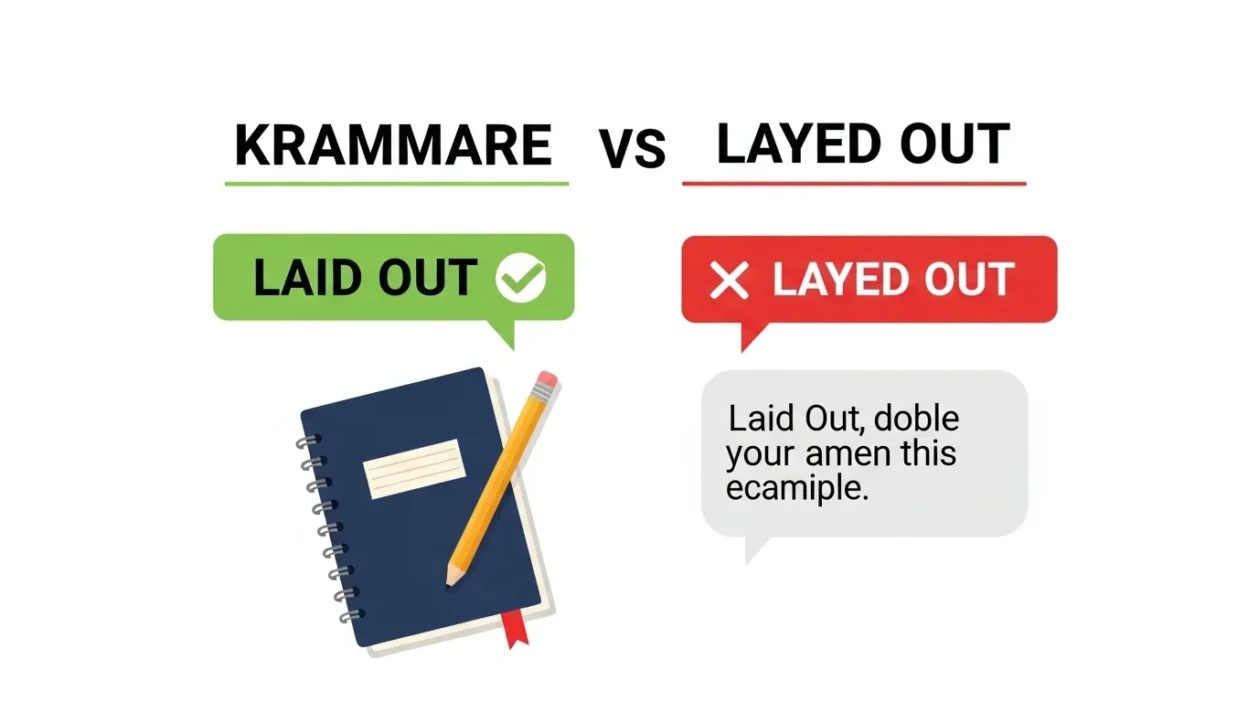
Many students and English learners get confused when they see “laid out” and “layed out.” Both spellings look similar, and when you say them aloud, they sound almost the same. Because of this, people often wonder which one is correct.
This confusion happens frequently in emails, assignments, text messages, and social media posts. Some people write “layed out the plan,” while others write “laid out the plan.” So which one should you use?
The simple answer is that only one of these forms is correct in standard English. In this guide, you will learn the correct spelling, the grammar rule behind it, and how to use the phrase properly in real life situations.
Quick Answer
If you are deciding between laid out vs layed out, remember this:
- Laid out is correct
- Layed out is incorrect
- The verb lay is irregular
- The correct forms are lay → laid → laid
- “Layed” is not a proper verb form in English
So whenever you need the past tense of lay out, always use laid out.
Why People Confuse “Laid Out” and “Layed Out”
The confusion comes from how many English verbs form their past tense. Most verbs simply add -ed.
Examples:
- play → played
- stay → stayed
- clean → cleaned
Because of this pattern, many people think the verb lay follows the same rule. They assume the past tense should be layed.
However, lay is an irregular verb. Irregular verbs do not follow the normal -ed rule. Instead, the correct past tense of lay is laid.
That is why layed out appears logical but is actually a spelling mistake.
Verb Forms: Lay : Laid : Laid
To understand this clearly, it helps to look at the verb forms.
| Verb Form | Word |
| Present | lay |
| Past | laid |
| Past participle | laid |
Example sentences:
- I lay the book on the table every night.
- Yesterday I laid the book on the table.
- I have laid the book there before.
Notice that “layed” never appears in the verb forms.
What Does “Laid Out” Mean?
The phrase laid out comes from the phrasal verb lay out.
A phrasal verb is a verb combined with another word that creates a new meaning.
Lay out can mean:
- to arrange things neatly
- to explain something clearly
- to plan or design something
- to prepare something in advance
Examples
- She laid out the clothes for tomorrow.
- The teacher laid out the lesson plan clearly.
- He laid out his ideas during the meeting.
- They laid out the city design carefully.
In each example, something is being organized, explained, or prepared.
Why “Layed Out” Is Incorrect
Now let’s answer a common question: Is layed out correct?
The answer is no.
The word layed is not accepted in standard English grammar. It appears because people apply the regular -ed rule to the verb lay.
Correct:
- She laid out the plan.
- He laid out the documents.
Incorrect:
- She layed out the plan.
- He layed out the documents.
Even in casual writing, layed out is considered a spelling error.
Clear Comparison: Laid Out vs Layed Out
Here is a simple comparison to make the difference clear.
| Feature | Laid Out | Layed Out |
| Grammar status | Correct | Incorrect |
| Verb form | Past tense of lay | Not a real verb form |
| Usage | Standard English | Spelling mistake |
| Meaning | Arrange or explain clearly | No valid meaning |
| Example | She laid out the plan | ✘ She layed out the plan |
The table shows that only “laid out” is correct.
When to Use “Laid Out”
You should use laid out whenever you talk about arranging, organizing, or explaining something.
1. Arranging Objects
Examples:
- She laid out the plates on the table.
- He laid out the tools before fixing the car.
- They laid out the decorations for the party.
2. Explaining Ideas
Examples:
- The manager laid out the rules for the team.
- The teacher laid out the instructions step by step.
- She laid out her argument clearly.
3. Planning or Designing
Examples:
- The architect laid out the building plan.
- The designer laid out the page design.
- They laid out the travel schedule.
Lay vs Lie: Another Common Confusion
Many learners also confuse lay and lie.
These verbs look similar but have different meanings.
| Verb | Meaning | Past |
| Lay | Put something down | Laid |
| Lie | Rest or recline | Lay |
Examples:
- She laid the book on the table.
- He lay on the couch all afternoon.
This difference causes confusion because the past tense of lie is lay, which looks like the present tense of lay.
Understanding this helps avoid grammar mistakes.
Lay Out vs Layout
Another related confusion is lay out and layout.
They look similar but function differently.
| Word | Type | Meaning |
| Lay out | Verb phrase | To arrange or organize |
| Layout | Noun | The design or arrangement |
Examples:
- She laid out the plan carefully.
- The layout of the website looks clean.
This small space changes the word’s function.
Real Life Examples
Here are some everyday situations where laid out is used.
Email Example
Hello Team,
I have laid out the meeting agenda below so everyone can review the topics before tomorrow.
Thank you.
Social Media Example
“Just laid out my study plan for the week. Time to stay focused!”
Daily Conversation
- “She laid out the snacks for the guests.”
- “He laid out the travel plan yesterday.”
- “The coach laid out the strategy before the game.”
These examples show how naturally the phrase appears in everyday communication.
Common Mistakes Learners Make
Here are some frequent mistakes.
1. Writing “layed” instead of “laid”
This is the most common error.
2. Assuming every verb adds “-ed”
Irregular verbs do not follow the normal pattern.
3. Mixing up lay and lie
These verbs have different meanings and forms.
4. Confusing “layout” with “lay out”
One is a noun, while the other is a verb phrase.
Simple Memory Trick
Here is an easy way to remember the rule:
Think of the verb pattern:
Lay → Laid → Laid
Never write:
Lay → Layed
If you remember this simple pattern, you will always choose the correct form.
Quick Practice
Choose the correct sentence.
- She laid / layed out the books on the desk.
- He laid / layed out the meeting plan.
- They laid / layed out the picnic blanket.
Correct answers:
- laid
- laid
- laid
FAQs
1. What is the difference between laid out and layed out?
Laid out is correct. Layed out is a spelling mistake.
2. Is layed out ever correct?
No. The word layed is not accepted in standard English grammar.
3. What is the past tense of lay out?
The correct past tense is laid out.
4. What does laid out mean?
It means to arrange, organize, explain, or prepare something clearly.
5. Why do people write layed out?
People mistakenly apply the regular -ed rule to the verb lay.
6. Can I use laid out in formal writing?
Yes. It is correct in both formal and informal writing.
7. Is this a common English mistake?
Yes. Many learners and even native speakers occasionally write it incorrectly.
8. How can I remember the correct form?
Remember the verb pattern lay → laid → laid.
Conclusion
The difference between laid out vs layed out is simple once you understand the grammar rule. The correct form is laid out, which comes from the irregular verb lay.
The spelling layed out may look logical, but it is not correct English. By remembering the verb pattern lay → laid → laid, you can avoid this common mistake.
With a little practice, using laid out will feel natural in emails, conversations, and everyday writing.

Kaliyan Martan is a passionate dreamer and creative thinker who believes in turning ideas into meaningful action. With vision and dedication, he strives to make a lasting impact through innovation and authenticity.