Many English learners mix up either vs whether because both words appear in sentences about choices, decisions, and thinking. At first, they look similar. But their meaning is very different.
The confusion is normal. Even intermediate students make mistakes with them. The good news is that you only need a few simple rules to understand them forever.
In this guide, you will learn the difference in a very clear way using short sentences, real examples, and easy memory tricks.
Quick Answer
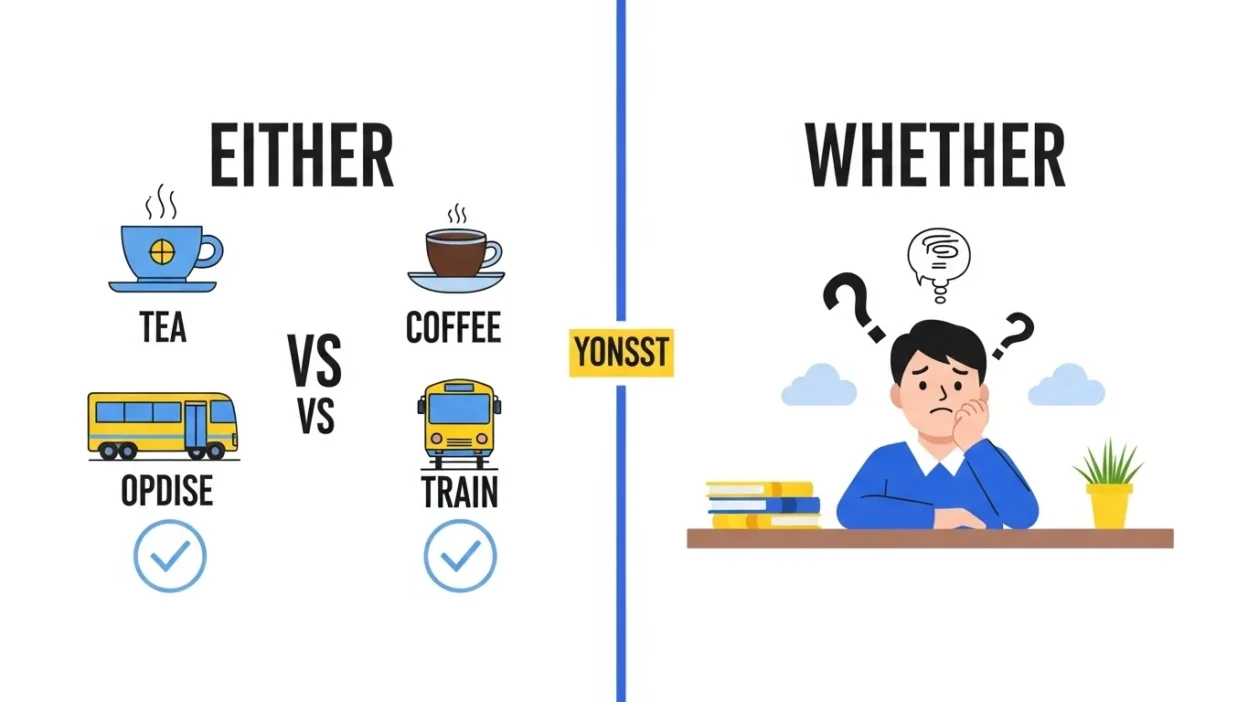
- Either = choice between two things (A or B)
- Whether = uncertainty or decision not confirmed
👉 Easy shortcut:
- Either = OR
- Whether = NOT SURE
Why Students Confuse Either vs Whether
The confusion happens because both words are used in decision related sentences.
For example:
- I don’t know whether I should go.
- You can choose either tea or coffee.
Both talk about decisions, but:
- One is about choosing
- The other is about thinking or doubt
What “Either” Means (Very Simple)
Either is used when you are choosing between two options.
Core idea:
👉 One of two choices (not both)
Simple pattern:
👉 either A or B
Easy examples:
- You can sit either here or there.
- I will take either rice or noodles.
- Call me either today or tomorrow.
Negative form:
- I don’t like either option.
What “Whether” Means (Very Simple)
Whether is used when you are not sure about something.
Core idea:
👉 Maybe yes, maybe no
Simple pattern:
👉 whether + situation
Easy examples:
- I don’t know whether he will come.
- She asked whether I was free.
- I’m thinking about whether to study abroad.
Important idea:
It shows thinking, doubt, or decision making
Fast Difference (Easy to Remember)
| Word | Meaning | Simple Signal |
| Either | Choice between two things | OR |
| Whether | Not sure / thinking | MAYBE |
Simple Rule Test (Very Powerful Trick)
Try this test:
Step 1:
Can you replace it with “A or B”?
- Yes → use either
- No → go next step
Step 2:
Is the sentence about uncertainty or thinking?
- Yes → use whether
When to Use Either (Clear Cases)
Use either in these situations:
1. Choosing between two things
- You can choose either tea or coffee.
2. Giving options
- We will meet on either Monday or Tuesday.
3. Negative meaning
- I don’t like either dress.
4. Daily decisions
- You can either study now or later.
👉 Key point:
Always two clear options.
When to Use Whether (Clear Cases)
Use whether in these situations:
1. You are not sure
- I don’t know whether it will rain.
2. Decision is not final
- She is deciding whether to join the class.
3. Indirect questions
- He asked me whether I was ready.
4. Two possible outcomes
- I will go whether you come or not.
👉 Key point:
No fixed choice yet.
Very Common Mistakes
❌ Mistake 1:
I don’t know either he is coming.
✔ I don’t know whether he is coming.
❌ Mistake 2:
You can choose whether tea or coffee.
✔ You can choose either tea or coffee.
❌ Mistake 3:
Either I should go.
✔ I don’t know whether I should go.
❌ Mistake 4:
Whether tea coffee
✔ Either tea or coffee
Real Life English Examples
Conversation:
- You can take either seat.
School:
- The teacher asked whether we finished homework.
Email:
- Please confirm whether you will attend.
Social media:
- I can’t decide whether to post this.
Daily life:
- I will choose either sleep or study.
Super Easy Memory Tricks
Trick 1:
👉 Either = OR (choice word)
Trick 2:
👉 Whether = WAITING (not decided yet)
Trick 3:
Imagine:
- Either = menu with two items
- Whether = thinking before ordering
Mini Practice (Quick Test)
Fill in the blanks:
- I don’t know ___ he is coming.
- You can take ___ bus or taxi.
- She asked ___ I was ready.
- I will choose ___ tea or coffee.
- He is unsure ___ to go or stay.
Answers:
- whether
- either
- whether
- either
- whether
FAQs
1. What is the main difference between either and whether?
Either is for choice. Whether is for uncertainty.
2. Can either be used for more than two options?
No, only two options.
3. Is whether the same as if?
Sometimes yes, but “whether” is more formal and clearer.
4. Why do learners confuse them?
Because both appear in decision related sentences.
5. Which is more common in English exams?
Whether is very common in formal writing.
6. Can either and whether appear in one sentence?
Yes, if they serve different roles.
7. What is the easiest way to remember?
Either = OR, Whether = MAYBE.
8. Which one is easier to use in daily English?
Either is easier because it is simple choice based.
Conclusion
The difference between either vs whether is actually very simple:
- Use either when you are choosing between two things.
- Use whether when you are not sure or still deciding.
If you remember just two ideas:
👉 Either = OR
👉 Whether = unsure
You will never confuse them again.
Practice a few sentences daily, and both words will become natural in your speaking and writing.

Robert Kalian is a passionate visionary dedicated to creativity, leadership, and meaningful innovation. He believes in turning ideas into action and inspiring others to achieve their highest potential.