Many English learners get stuck on one small problem: “specs vs specks.” These two words look almost the same, and when spoken quickly, they also sound very similar. Because of this, students often write the wrong word without noticing.
The confusion is normal. It happens to beginners, learners and even fluent speakers when they are not paying attention.
But once you understand the idea behind each word, the problem disappears quickly.
Let’s make it very simple and clear.
Quick Answer
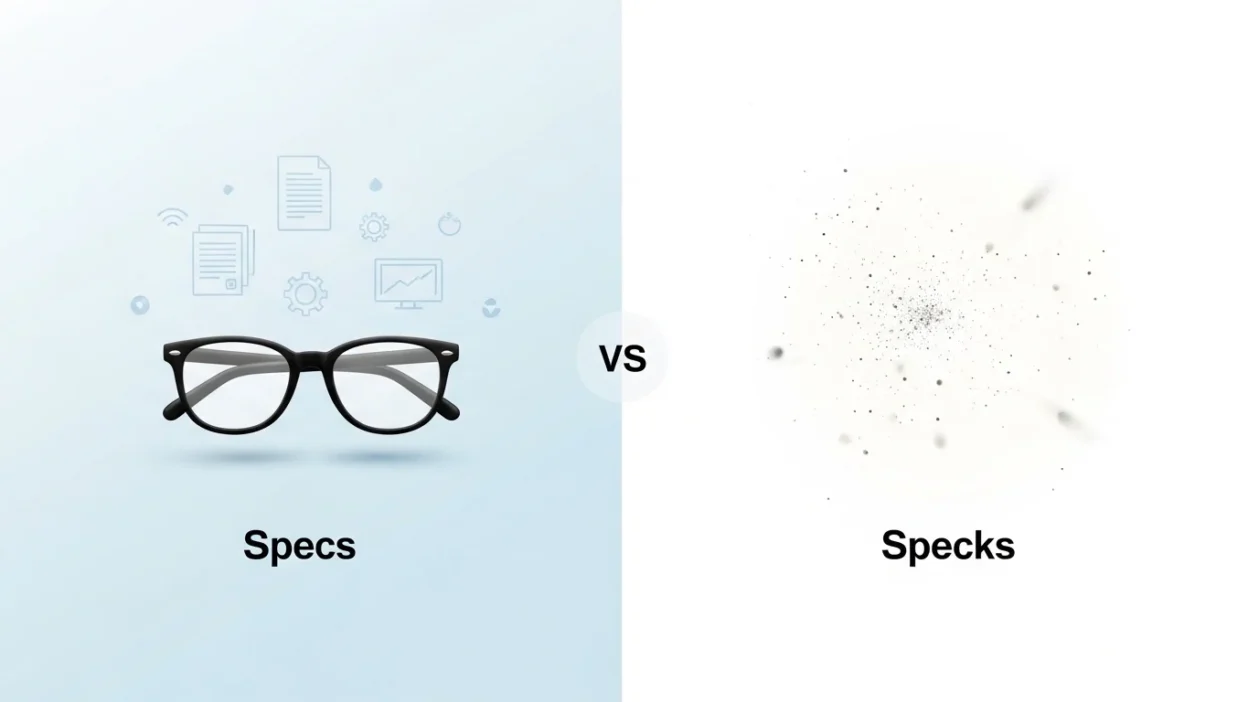
- Specs = glasses OR technical details of something
- Specks = tiny small spots, dust, or particles
- Specs = useful information or vision support
- Specks = very small things you can see but ignore
That is the full idea in one simple view.
Why These Two Words Sound So Similar
The confusion between specs vs specks happens for a few natural reasons:
- Both words start with “spec”
- Both are short and simple
- In fast speech, the ending sound becomes unclear
- The brain focuses on sound, not spelling
So when someone hears them instead of reading them, they easily mix them up.
This is a classic case of English words that confuse learners because of sound similarity.
Meaning of “Specs”
The word “specs” has two common meanings.
1. Specs = Glasses
In daily English, “specs” is a friendly word for glasses.
Examples:
- “He put on his specs before reading the book.”
- “I forgot my specs at home today.”
Here, specs help you see clearly.
2. Specs = Technical Details
“Specs” also means the features or details of something like a phone, laptop, or machine.
Examples:
- “This phone has amazing specs for gaming.”
- “Check the specs before you buy a laptop.”
Here, specs help you understand a product.
Simple idea for specs:
👉 Specs = “seeing clearly” OR “understanding details”
Meaning of “Specks” (Very Simple)
The word “specks” means tiny small dots or particles.
It is always used for things that are very small.
Examples:
- “There are specks of dust on the table.”
- “I saw specks of paint on my shirt.”
- “Specks of sand were stuck to my shoes.”
These are small things you can see, but they are not important.
Simple idea for specks:
👉 Specks = tiny dirt, dots, or particles
The Real Difference
The specs vs specks difference is very simple:
- Specs = useful (glasses or information)
- Specks = tiny and physical (dust or small particles)
Think like this:
- Specs help you see or understand
- Specks are small things you notice but don’t care about
Comparison (Clear Understanding)
| Feature | Specs | Specks |
| Meaning | Glasses or product details | Tiny spots or particles |
| Type | Useful information / object | Physical small things |
| Size | Not about size | Extremely small |
| Usage | Technology, daily life | Dust, dirt, marks |
| Example | “Check phone specs” | “Specks of dust on desk” |
| Importance | Useful | Usually unimportant |
Real Life Examples (Easy Situations)
1. At School
- “I forgot my specs, so I cannot see the board clearly.”
- “There are specks of chalk dust in the air.”
2. At Home
- “Clean your specs before wearing them.”
- “I noticed specks of dust on the window.”
3. Technology Talk
- “This laptop has strong specs for editing.”
- (We don’t use specks here because it is not about dust)
4. Daily Life
- “Your specs look nice on you.”
- “Specks of dirt are on your shoes.”
Pronunciation Trick (Very Important)
This is where most confusion actually happens.
- Specs → sounds short and sharp: “speks”
- Specks → sounds almost the same: “speks”
👉 They sound nearly identical, which is why spelling becomes the only way to tell them apart.
So the safest rule is:
Always focus on meaning, not sound.
Common Mistakes Students Make
Mistake 1: Using “specks” for phone details
❌ “Check the specks of this phone”
✔ “Check the specs of this phone”
Mistake 2: Using “specs” for dust
❌ “There are specs of dust on the table”
✔ “There are specks of dust on the table”
Mistake 3: Guessing by sound only
Many learners write what they hear, not what they understand.
Simple Memory Trick (Very Effective)
Remember this:
- Specs = See + System
- Glasses help you see
- Specs show system details
- Specks = Small particles
- Think dust, sand, tiny dots
👉 Quick rule:
- If it helps you or gives information → specs
- If it is tiny and physical → specks
Mini Practice (For Beginners)
Try choosing the correct word:
- I need my ___ to read the board.
- There are ___ of dust on the table.
- Check the laptop ___ before buying it.
- I saw ___ of paint on the wall.
(Answers: specs, specks, specs, specks)
Common FAQs
1. What is the main difference between specs and specks?
Specs are glasses or details, specks are tiny particles.
2. Why do people confuse specs and specks?
Because they sound almost the same and are spelled similarly.
3. Is specs singular or plural?
Specs is usually plural in meaning, even when used for glasses.
4. Can specks be used for anything big?
No, specks always refer to very small things.
5. Are specs and specks homophones?
Yes, they are nearly homophones in spoken English.
6. Is specs formal or informal?
It is informal for glasses, but normal for technical details.
7. Can I use specks in writing?
Yes, especially when describing dust, dirt, or tiny particles.
8. What is the easiest way to remember them?
Specs = useful (glasses/details), Specks = small (dust/particles)
Conclusion
The confusion between specs vs specks is completely normal, but now it should feel much easier.
- Specs help you see better or understand information
- Specks are tiny particles like dust or small dots
Even though they sound almost the same, their meanings are very different.
Once you connect each word with its simple idea, you will stop mixing them in writing or speaking. With a little practice, this becomes an easy part of your English learning journey.