Many English learners get confused when they see the words inpatient and impatient. They look almost the same, but their meanings are completely different.
Because of this small spelling difference, people often misunderstand sentences in hospitals, daily conversations, and even exams.
The confusion is normal. One word is related to medical care inside a hospital, while the other is related to human behavior when waiting.
Once you understand the real meaning with simple examples, the difference becomes very easy.
Quick and Simple Answer
Here is the fastest way to understand both words:
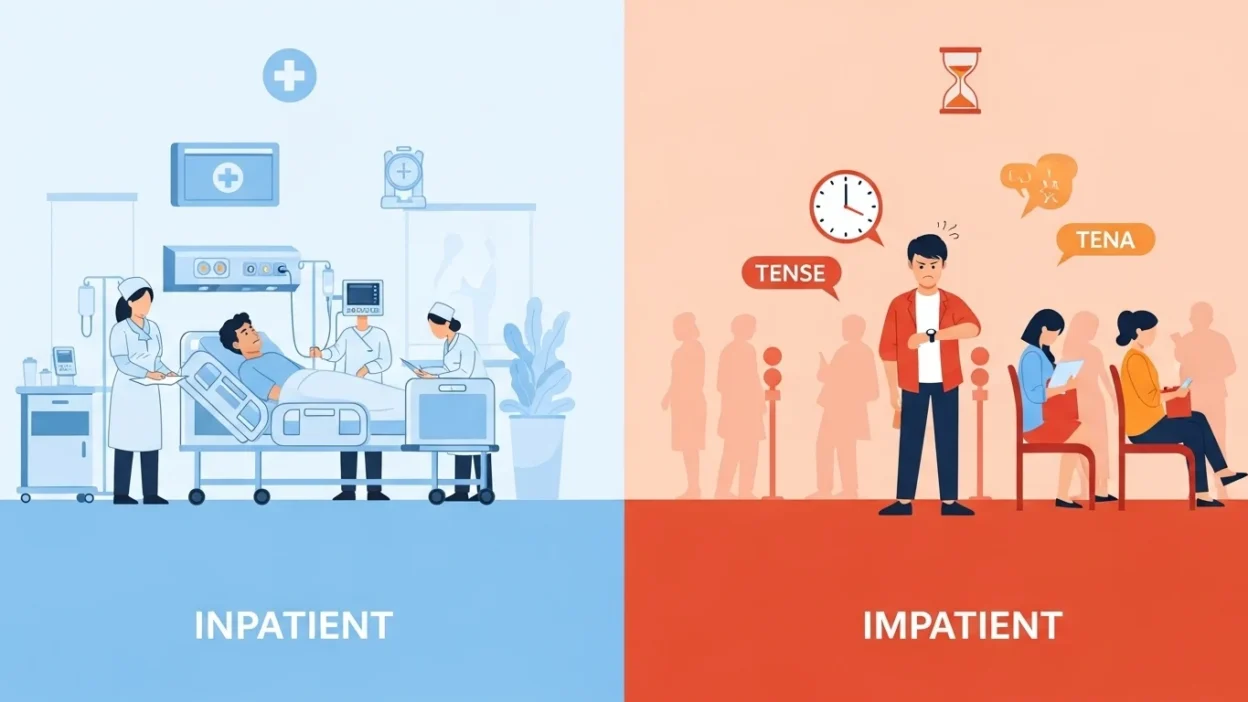
- Inpatient → A person staying inside a hospital for treatment
- Impatient → A person who cannot wait calmly
- One is medical (hospital use)
- The other is emotional (daily life use)
That’s the main difference in the simplest form.
What Does “Inpatient” Mean? (Hospital Meaning)
The word inpatient is used in hospitals and medical situations.
An inpatient is a person who is admitted to a hospital and stays there for treatment. This stay can be for one night or longer, depending on the condition.
Simple idea
If a patient sleeps and receives care inside a hospital → they are an inpatient.
Easy examples
- “The patient is still an inpatient after surgery.”
- “She will remain an inpatient for observation.”
- “The hospital has separate rooms for inpatients.”
Important point
This word is only used in medical contexts. It is not about feelings or behavior.
What Does “Impatient” Mean? (Daily Life Meaning)
The word impatient describes a feeling or behavior.
A person is impatient when they cannot wait calmly. They may feel annoyed, restless, or frustrated when something takes too long.
Simple idea
If you hate waiting → you feel impatient.
Easy examples
- “I get impatient when the bus is late.”
- “He is impatient while waiting for results.”
- “She became impatient in the long queue.”
Important point
This word is about emotions, not hospitals or medical care.
Inpatient vs Impatient: Clear Difference
Now let’s compare both words in a very simple way.
- Inpatient = A hospital patient receiving care inside a hospital
- Impatient = A person who cannot wait calmly
One belongs to healthcare, the other belongs to human behavior.
Even though the spelling is similar, the meanings are completely unrelated.
Easy Comparison
| Feature | Inpatient | Impatient |
| Meaning | Hospital patient staying for treatment | Unable to wait calmly |
| Area | Medical / healthcare | Daily life / emotions |
| Example place | Hospital ward | Bus stop, queue, home |
| Type | Noun (medical role) | Adjective (feeling) |
| Example sentence | “He is an inpatient in the hospital.” | “She is impatient in traffic.” |
When to Use Each Word (Simple Guide)
Use “Inpatient” when:
- Talking about hospitals
- Talking about surgery or treatment
- Talking about medical admission
Example:
- “The doctor admitted him as an inpatient.”
Use “Impatient” when:
- Talking about waiting
- Talking about frustration
- Talking about behavior or mood
Example:
- “I become impatient when things move slowly.”
Common Mistakes Learners Make
1. Mixing spelling in writing
Wrong: “I am inpatient in the queue.”
Correct: “I am impatient in the queue.”
2. Thinking both words are emotions
Only impatient is a feeling.
Inpatient is medical.
3. Using inpatient outside hospitals
You should not use “inpatient” in daily emotional sentences.
Real Life Examples (Very Clear Situations)
Hospital Situation
- “After the accident, he became an inpatient for two weeks.”
- “Inpatients are monitored 24 hours a day.”
Daily Life Situation
- “I feel impatient when my internet is slow.”
- “They were impatient during the long meeting.”
Simple Conversation
- A: “Why are you quiet?”
- B: “I’m just impatient for the results.”
Easy Memory Trick (Very Helpful)
You can remember it like this:
- Inpatient = IN the hospital
- Impatient = I don’t have patience
Another simple idea:
- “Inpatient” → inside medical care
- “Impatient” → emotional waiting problem
This trick helps you remember the difference instantly.
Mini Practice (Test Yourself)
Fill in the blanks:
- The doctor said he is an ______.
- I feel ______ when I wait too long.
- She is an ______ after surgery.
- Don’t be ______ in the queue.
Answers:
- inpatient
- impatient
- inpatient
- impatient
FAQs
1. What is the main difference between inpatient and impatient?
Inpatient is a hospital term, impatient is a feeling.
2. Is inpatient used in daily conversation?
Only when talking about hospitals or medical care.
3. What does impatient mean in simple English?
It means not being able to wait calmly.
4. Can inpatient describe a person’s mood?
No, it is not used for emotions.
5. Why do people confuse these words?
Because the spelling looks very similar.
6. What is the opposite of impatient?
Patient (someone who can wait calmly).
7. Is inpatient related to outpatient?
Yes, inpatient stays in hospital; outpatient does not stay overnight.
8. How can I remember both words easily?
Think: hospital = inpatient, waiting feeling = impatient.
Conclusion: Now You Will Never Mix Them Again
The confusion between inpatient and impatient happens only because the words look similar. But their meanings are completely different.
- Inpatient belongs to hospitals and medical care
- Impatient belongs to human emotions and daily life situations
Once you connect each word with its real situation, you will never confuse them again. Keep practicing with simple examples, and these words will become natural in your English vocabulary.