Many English learners search for farther vs further because the two words look almost identical. They both come from the word far, and both relate to distance. Because of this, many students and even native speakers mix them up.
Here is the simple rule that solves the confusion immediately:
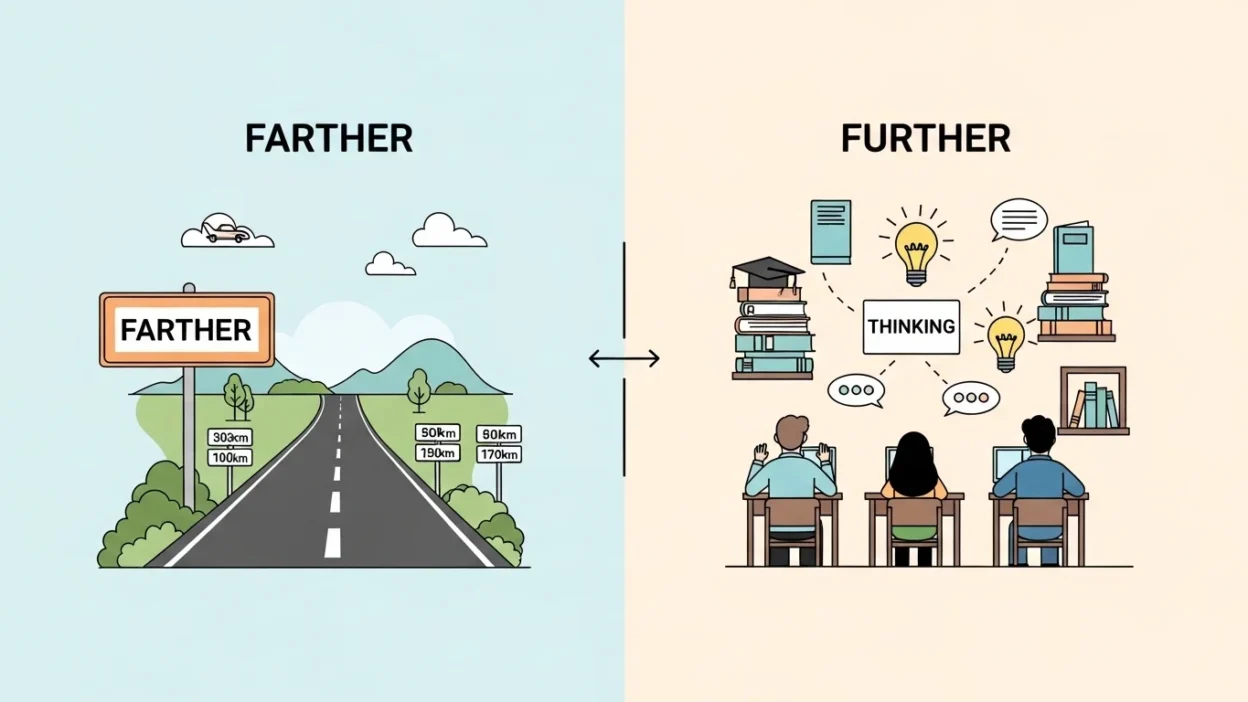
• Farther refers to physical distance you can measure.
• Further refers to figurative distance, progress, or additional information.
Example:
• The school is farther down the street.
• We need to discuss this further.
Once you understand this rule, the difference between farther and further becomes much easier to remember. This guide will explain the rule clearly, show many examples, and help students and learners feel confident when using these words.
Quick Answer: Farther vs Further
If you want the fastest explanation of farther vs further in English, remember this:
Farther
- Used for physical distance
- Distance you can measure in miles, meters, or steps
- Often used for locations and travel
Example:
The park is farther from my house.
Further
- Used for ideas, progress, or additional information
- Not related to physical distance
- Common in discussions and explanations
Example:
The teacher explained the lesson further.
This simple rule is the easiest way to understand when to use farther and further.
A Short Background
Both farther and further developed from the word far many centuries ago. In older English, the two words were often used in the same way. Over time, speakers began using them differently.
Today, most grammar guides explain the farther vs further grammar rule like this:
Farther = measurable distance
Further = additional or figurative distance
Even though some people still use further for physical distance, separating the two words helps make writing clearer.
The Difference Between Farther and Further
Understanding farther vs further becomes simple if you focus on the type of distance in the sentence.
Farther Meaning and Examples
The farther meaning relates to real distance in the physical world.
If you can measure the distance with miles, meters, or steps, farther is usually correct.
Examples:
• The gas station is farther down the highway.
• Her new office is farther from the city center.
• The hikers walked farther into the mountains.
• The second island is farther away.
• He threw the ball farther than anyone else.
These are clear farther vs further examples because the distance exists in the real world.
Further Meaning and Examples
The further meaning usually refers to additional progress, explanation, or development.
It is used when distance is not physical.
Examples:
• We need to talk further about the problem.
• The manager asked for further information.
• Scientists want to study the issue further.
• She continued her education further.
• The investigation will go further next week.
These sentences show how to use farther and further correctly.
Farther vs Further Comparison
| Word | Meaning | Type of Distance | Example |
| Farther | Greater distance in space | Physical | The beach is farther away |
| Further | More or additional | Figurative | We need further discussion |
| Farther | Measurable distance | Travel or movement | He ran farther today |
| Further | Greater degree | Ideas or progress | She researched further |
This comparison highlights the farther vs further grammar difference.
When to Use Farther
Use farther whenever the sentence talks about actual physical distance.
Common situations include:
• travel
• locations
• directions
• measurable distance
Examples:
• My office is farther from home now.
• The library is farther down the street.
• They sailed farther into the ocean.
• The dog ran farther than expected.
• Our new school is farther from the station.
If you could measure the distance on a map, farther is usually correct.
When to Use Further
Use further when the sentence refers to ideas, time, progress, or additional effort.
Common situations include:
• discussions
• explanations
• research
• development
Examples:
• Let’s discuss this further tomorrow.
• The report needs further review.
• She wants to improve her skills further.
• We will investigate the issue further.
• The teacher explained the topic further.
These examples help learners understand the farther vs further simple explanation.
American vs British Usage
Many learners wonder if farther vs further in English changes depending on location.
In American English, teachers often follow the rule strictly:
Farther → physical distance
Further → figurative distance
In British English, speakers sometimes use further for both meanings.
Example:
The shop is further down the road.
Even though this may appear in everyday speech, using farther for physical distance is still a clear and helpful rule for students.
Common Mistakes with Farther vs Further
Because the words are so similar, people often make the same mistakes.
Mistake 1: Using Further for Distance
Incorrect:
The bus stop is further down the street.
Better:
The bus stop is farther down the street.
The sentence describes a real location, so farther fits better.
Mistake 2: Using Farther for Ideas
Incorrect:
We should discuss this farther.
Correct:
We should discuss this further.
The sentence talks about continuing a discussion.
Understanding these mistakes helps learners master farther vs further for students.
Real Life Examples
Looking at everyday situations helps learners understand farther vs further sentence examples.
Email Example
Could you explain this further before the meeting?
Text Message Example
My new apartment is farther from downtown, but it’s quieter.
Workplace Example
The team will investigate the problem further.
Conversation Example
Friend: Is the restaurant close?
Friend: No, it’s farther down the road.
These examples show how the words appear in daily communication.
A Simple Memory Trick
A helpful trick for remembering how to use farther and further is to focus on the letter A in farther.
Farther → Actual distance
Examples:
• farther down the road
• farther away from home
• farther from the city
Think of further as meaning more or additional.
Examples:
• further explanation
• further research
• further discussion
This trick works well for beginners learning the farther vs further explanation.
Practice Quiz for Learners
Choose the correct word.
- The next town is ______ down the highway.
- We need to study the topic ______.
- The runners went ______ than expected.
- The teacher gave ______ instructions.
Answers:
- farther
- further
- farther
- further
Practice helps students remember the farther vs further grammar rule more easily.
Frequently Asked Questions
What is the difference between farther and further?
The difference between farther and further is simple. Farther describes physical distance, while further refers to additional progress or ideas.
Can further describe distance?
Yes, some speakers use further for distance, but many grammar guides recommend farther for measurable space.
Is farther becoming less common?
Not really. Farther is still widely used when discussing real physical distance.
Why do people confuse these words?
They sound similar, have the same root word, and historically were used in similar ways.
Which word appears more often?
Further appears more often because it can describe ideas, explanations, and additional information.
Should students learn both words?
Yes. Understanding farther vs further for students improves writing and speaking accuracy.
Can farther describe progress?
No. Farther normally refers only to physical distance.
What is the easiest way to remember the rule?
Remember this simple rule:
Farther = physical distance
Further = additional or figurative distance
Conclusion
The confusion between farther vs further becomes easy to solve once you focus on the type of distance in the sentence.
Use farther when the distance is physical and measurable.
Use further when the sentence talks about ideas, progress, or additional information.
Keeping this rule in mind will help you choose the correct word naturally.
With practice and real examples, the difference between farther and further becomes clear. Soon you will use both words confidently in conversations, writing, and everyday communication.

Mitcheel Satrac is a passionate visionary dedicated to creativity, innovation, and meaningful success. His work reflects authenticity, purpose, and a drive to make a real impact.