Many learners get confused when they see minuscule vs miniscule. The two words look nearly the same.
They also sound very similar. Because of this, people often use them as if they are equal. But they are not exactly the same in standard English.
The confusion becomes stronger because you may see miniscule online, in messages, or even in some published texts.
So the big question is: which one should you trust and use? This article will give you a clear, simple, and complete answer.
Quick Answer
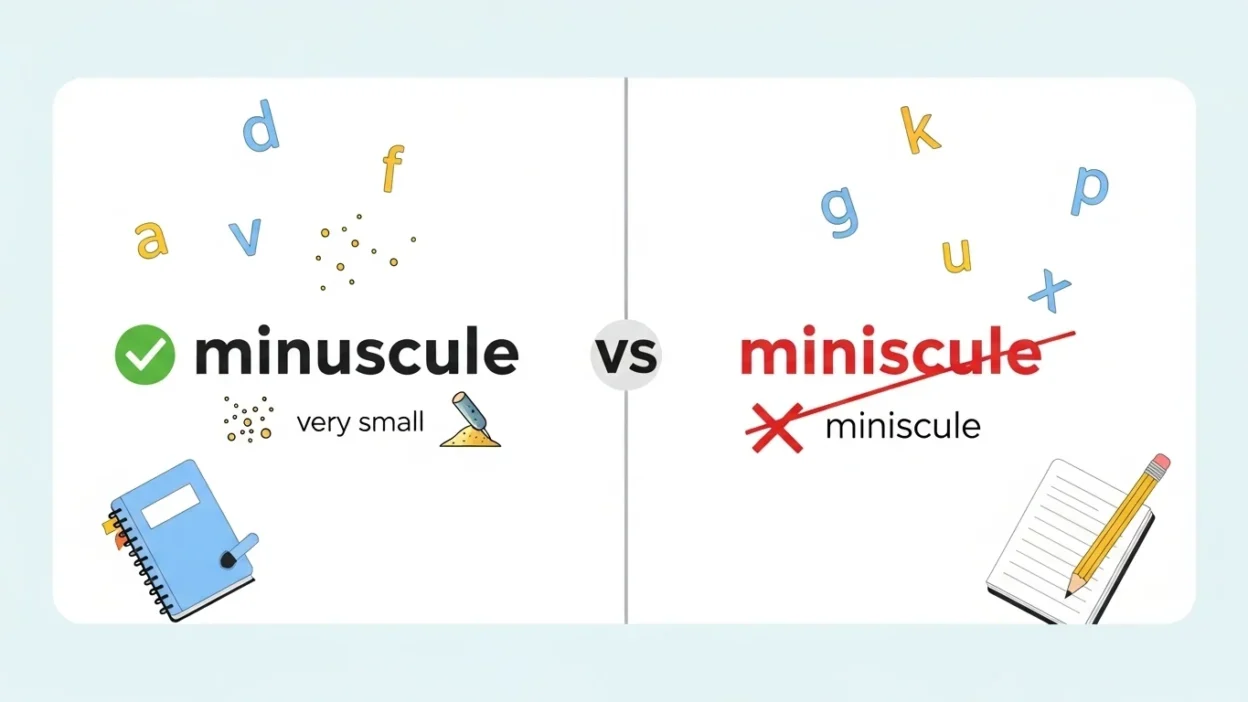
- Minuscule is the correct and standard spelling.
- Miniscule is a common variant spelling, but it is often treated as a mistake.
- Both are used to mean “very small.”
- In formal writing, exams, and professional work, always use minuscule.
- It is safer and more widely accepted everywhere.
Simple Background
The word minuscule comes from Latin. It was first used to describe small letters in writing. Over time, its meaning expanded. Now it describes anything very tiny in size, amount, or importance.
The spelling miniscule appeared later. People likely formed it because it looks similar to the word mini, which also means small. This connection makes it feel correct, even though it is not the standard form.
So the confusion comes from both spelling similarity and natural guessing.
What Is the Difference?
The difference between minuscule and miniscule is mainly about correctness and usage.
- Minuscule = standard, correct, and preferred
- Miniscule = non-standard, but widely used
Both forms are understood to mean “very small.” However, language experts and teachers strongly recommend using minuscule.
A More Accurate View
It is important to understand one key point:
- Miniscule is not completely unknown
- But it is still considered incorrect or careless in formal English
That means:
- You may see it
- People may understand it
- But you should avoid using it in serious writing
Minuscule Meaning
The minuscule meaning is simple:
- Extremely small
- Very tiny in size, amount, or importance
Examples:
- A minuscule drop of water
- A minuscule chance of success
Miniscule Meaning
The miniscule meaning is intended to be the same. However, it is not the accepted spelling in standard English. It is better seen as a spelling error or informal variant.
Comparison
| Feature | Minuscule | Miniscule |
| Spelling | Correct and standard | Non-standard / often incorrect |
| Meaning | Very small | Same intended meaning |
| Usage | Formal and informal | Informal only (not recommended) |
| Acceptance | Accepted everywhere | Often criticized |
| Best Practice | Always use | Avoid in writing |
Why Does This Mistake Happen?
1. Confusion with “mini”
People connect the word to mini, which means small. This leads to the wrong spelling miniscule.
2. Similar Pronunciation
The minuscule pronunciation sounds very close to “miniscule.” This makes it hard to notice the difference when listening.
3. Habit and Exposure
If learners see the wrong spelling often, they may think it is correct.
4. Online Writing
Social media and quick typing increase common spelling mistakes in English, including this one.
When to Use “Minuscule”
You should use minuscule in all types of writing.
1. Talking About Size
- The insect is minuscule.
- The text is written in minuscule letters.
2. Talking About Amount
- There is a minuscule amount of milk left.
- The change is minuscule.
3. Talking About Importance
- The error is minuscule and can be ignored.
- His role was minuscule.
Minuscule in a Sentence
Here are clear examples of minuscule in a sentence:
- The chances of winning are minuscule.
- She noticed a minuscule detail in the design.
- The difference between the two prices is minuscule.
When to Use “Miniscule”
For learners, the safest advice is simple:
👉 Do not use miniscule in writing.
Even though it appears in some places, it is not trusted in:
- exams
- academic work
- professional writing
Using the correct spelling of minuscule will always make your writing stronger.
Easy Trick to Remember
Here is a simple trick:
Think of the word minus (which means less).
Now connect it to small size → minuscule
Or remember:
- Not “mini scule”
- But minu scule
This helps you avoid one of the most easy English vocabulary mistakes.
Real Life Examples
1. In Emails
- Correct: The difference is minuscule.
- Wrong: The difference is miniscule.
2. On Social Media
- Better: My progress is small but not minuscule.
- Common mistake: My progress is small but not miniscule.
3. At School
- Correct: The teacher said the mistake was minuscule.
- Incorrect: The teacher said the mistake was miniscule.
4. Daily Writing
- Correct: The cost difference is minuscule.
- Incorrect: The cost difference is miniscule.
Common Mistakes to Avoid
1. Thinking Both Are Equal
They are not equal in standard English.
2. Using the Wrong Form in Exams
This can lower your marks.
3. Relying on What You See Online
Not everything online is correct.
4. Ignoring Small Differences
Even a small spelling change can affect meaning and quality.
Minuscule vs Small Difference
Another small point:
- Small = general
- Minuscule = extremely small
Example:
- A small house
- A minuscule grain of sand
Beginner Learning Section
If you are new to English, follow these steps:
Step 1: Learn One Correct Form
Focus only on minuscule.
Step 2: Practice Writing
Write it several times until it feels natural.
Step 3: Use in Daily Sentences
- The bug is minuscule.
- The change is minuscule.
Step 4: Read Carefully
Notice correct spelling when reading books or articles.
Step 5: Build Good Habits
Avoid copying common mistakes from others.
FAQs
1. What is the correct spelling: minuscule or miniscule?
The correct spelling is minuscule.
2. Is miniscule correct?
It is widely used, but still considered non-standard and often incorrect.
3. What is the minuscule meaning?
It means very small or tiny.
4. Why is miniscule wrong?
Because it is not the accepted standard spelling in English.
5. Why do people still use miniscule?
Because it looks like “mini” and is easy to guess.
6. What is the minuscule pronunciation?
It is pronounced like: mi-nuh-skyo͞ol.
7. Is this a common mistake?
Yes, it is one of the most common confusing English words problems.
8. How can I avoid this mistake?
Always remember and use the correct spelling of minuscule.
Conclusion
The confusion around minuscule vs miniscule is very common, but now it should be clear. Both forms may appear in real life, but only minuscule is correct and fully accepted.
Even though miniscule is widely used, it is still safer to avoid it, especially in formal writing. By understanding the difference, practicing the correct form, and staying consistent, you can improve your English with confidence.
Remember: when something is extremely small, the right word to use is minuscule.

Mitcheel Satrac is a passionate visionary dedicated to creativity, innovation, and meaningful success. His work reflects authenticity, purpose, and a drive to make a real impact.