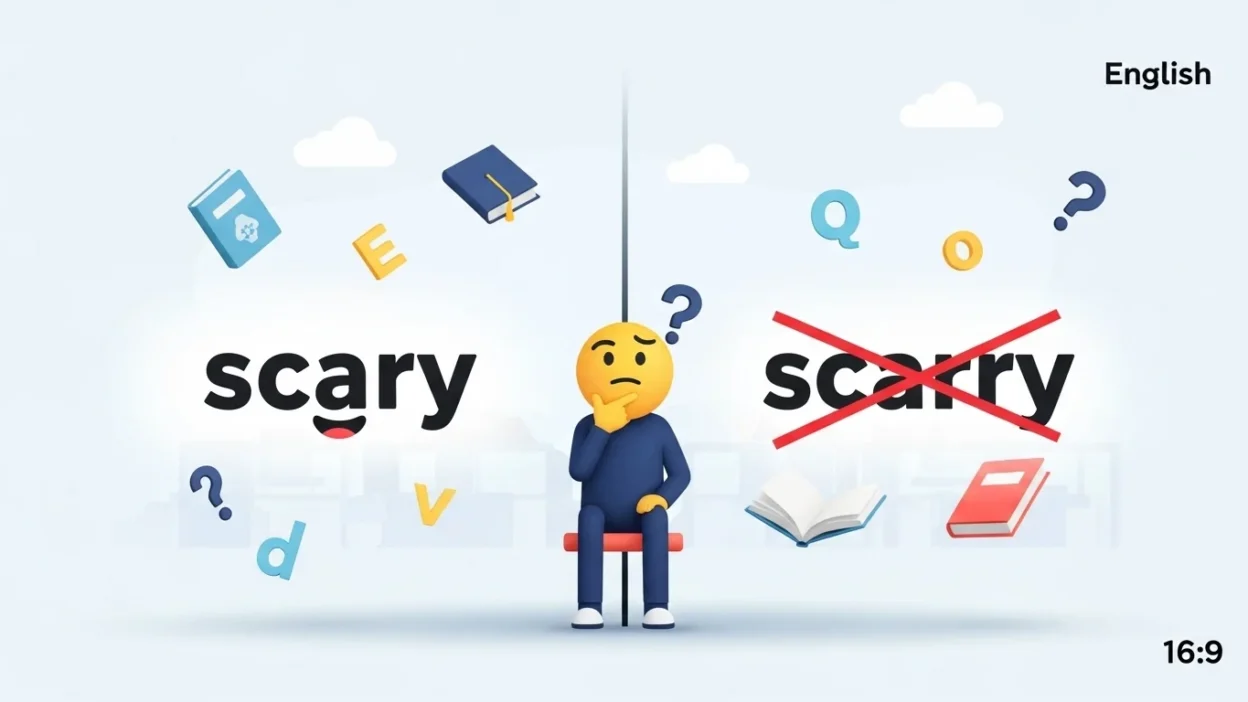
A lot of English learners get confused when two words look almost the same. “Scary vs scarry” is one of those common doubts.
At first glance, both spellings seem possible. But only one is correct in real English.
This confusion usually happens because English spelling does not always match how words sound.
Learners also see many double letter words in English, so it feels natural to guess a double “r” in “scary.”
In this simple guide, you will quickly understand the correct spelling, the real meaning, and how to never make this mistake again.
Quick Answer (Very Clear)
- The correct spelling is: scary
- Scarry is incorrect in standard English
- “Scary” means something that causes fear or nervous feelings
- Always use scary in writing, exams, and daily English
- The confusion happens because spelling and pronunciation don’t always match
What “Scary” Really Means
The word scary is an adjective. It describes something that makes people feel afraid, nervous, or uncomfortable.
Simple meaning:
- Scary = something frightening or fear inducing
Easy examples:
- A horror movie can be scary
- A dark room can feel scary
- Loud thunder can be scary for children
So when someone asks about scary meaning, it simply refers to anything that creates fear or anxiety.
Is “Scarry” a Real Word?
This is one of the most searched questions: is scarry correct word?
The answer is very simple: No.
“Scarry” is not an English word. It has:
- No dictionary meaning
- No grammar role
- No usage in formal or informal English
It only appears because of typing mistakes or confusion with similar words.
So:
- ❌ scarry = wrong spelling
- ✔️ scary = correct spelling
Why People Confuse Scary and Scarry
Understanding the confusion helps you avoid it.
Here are the real reasons:
1. Sound confusion
“Scary” sounds like it might have double letters when spoken quickly.
2. Similar English patterns
Words like:
- carry
- marry
- sorry
all have double letters, so learners guess “scarry.”
3. Fast typing mistakes
People often accidentally press “r” twice.
4. Online misinformation
Sometimes incorrect spelling spreads on social media.
That’s why the topic scary vs scarry difference is so important for learners.
Correct Spelling Rule (Very Easy Trick)
To remember the correct spelling:
Think like this:
scare + y = scary
There is no extra “r” needed.
So the correct spelling of scary is always:
👉 S C A R Y
This simple rule removes most confusion instantly.
Scary vs Scarry Difference (Simple Comparison)
| Feature | Scary | Scarry |
| Spelling | Correct | Incorrect |
| English status | Real word | Not a word |
| Meaning | Something frightening | No meaning |
| Usage | Everyday English | Never used |
| Example | That movie is scary | ❌ Wrong spelling |
This table clearly shows the scary vs scarry difference in the easiest way.
Scary Usage in English (Real Life)
The word scary is very common in daily conversations.
Talking about experiences
- The storm last night was scary
- That accident looked scary
Talking about movies or stories
- This horror film is scary
- The ghost story was really scary
Talking about feelings
- It is scary to speak in public
- Heights can feel scary
This is the normal scary usage in English you will hear everywhere.
Scary Examples in Sentences
Here are simple scary examples in sentences:
- The noise in the dark was scary
- That abandoned house looks scary
- The roller coaster was scary but fun
- The thunder sound is scary for kids
- It was scary walking alone at night
These examples show how natural the word feels in everyday English.
Common English Spelling Mistakes with “Scary”
Many learners make small spelling errors like:
- writing scarry instead of scary
- adding extra letters like “scaryy”
- copying incorrect social media spelling
- mixing pronunciation with spelling rules
These are part of common English spelling mistakes that improve with practice.
Easy Memory Tricks for Beginners
Here are simple ways to never forget:
Trick 1: Word breakdown
- scare + y = scary
Trick 2: Short vs long idea
- scary = simple and short
- scarry = looks wrong and unnecessary
Trick 3: One rule only
- English has no double “r” in “scary”
These tricks are helpful for beginners learning how to spell scary correctly.
Quick Practice (Check Your Understanding)
Fill in the blanks:
- That haunted house looks very ______
- The loud sound was ______
- Horror movies are often ______
Answers:
- scary
- scary
- scary
If you got all correct, you already understand the rule well.
Real Life Communication Examples
Chat messages
- “That game was so scary 😂”
- “Don’t send scary videos at night!”
Social media posts
- “This place looks scary!”
- “That story is scary!”
Daily speaking
- “I find horror movies scary”
- “That situation was scary”
These show natural English usage in real communication.
FAQs About Scary vs Scarry
1. What is the correct spelling: scary or scarry?
The correct spelling is scary.
2. Is scarry a real English word?
No, it is not a real word in English.
3. What does scary mean?
It means something that causes fear or nervous feelings.
4. Why do people write scarry?
Because of spelling confusion and typing mistakes.
5. What is the easiest way to remember scary spelling?
Think: scare + y = scary
6. Can I use scary in formal writing?
Yes, it is completely correct in all situations.
7. Is scary a noun or adjective?
It is an adjective.
8. What is the main scary vs scarry difference?
“Scary” is correct, “scarry” is incorrect.
Conclusion
The confusion between scary vs scarry is very common, but the answer is simple. Only “scary” is correct English. “Scarry” is just a spelling mistake that appears because of pronunciation confusion and typing errors.
Once you understand the basic rule scare + y = scary you will never get confused again. With practice and real examples, using “scary” becomes natural in speaking and writing.
Now you can confidently avoid this mistake in exams, chats, and daily English communication.

Robert Kalian is a passionate visionary dedicated to creativity, leadership, and meaningful innovation. He believes in turning ideas into action and inspiring others to achieve their highest potential.