Have you ever written “occuring” and felt unsure if it was right? You are not alone. Many students lose marks or look unprofessional in emails because of this small spelling mistake.
The confusion is simple: one extra letter changes everything. In this guide, you will clearly understand occurring vs occuring, learn the correct spelling, and master the rule so you never make this mistake again.
Quick Answer
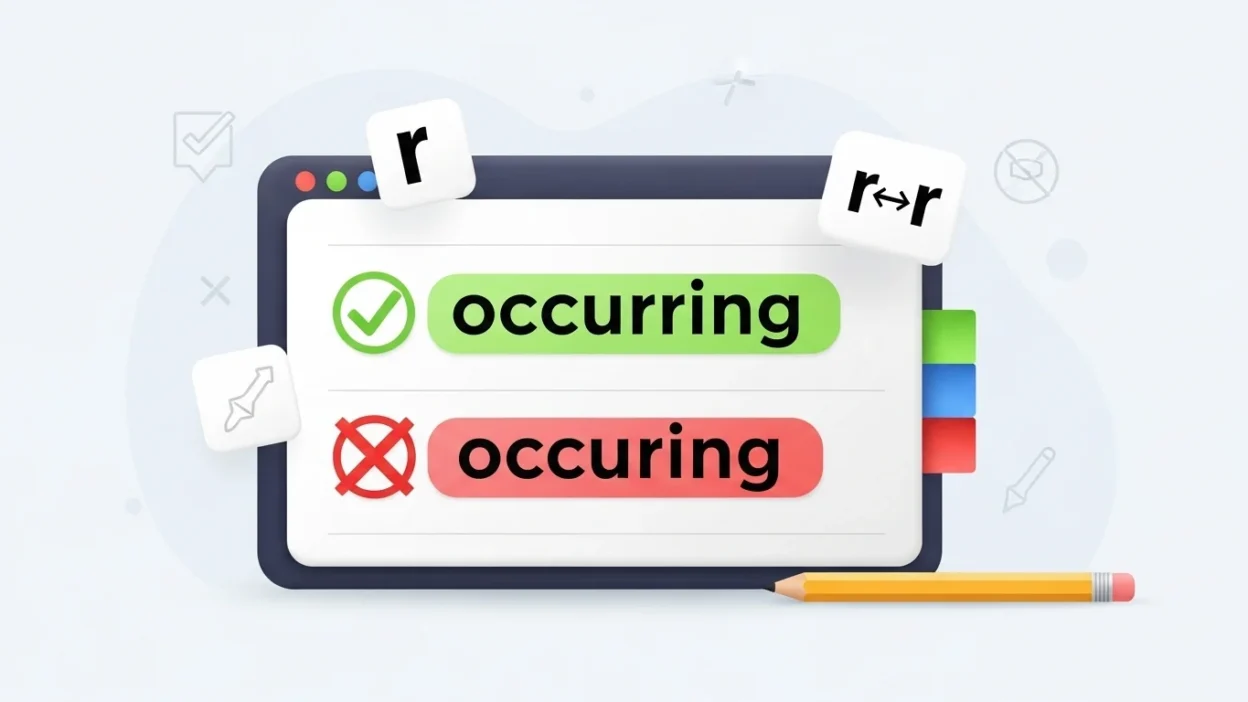
- ✅ Correct spelling: occurring
- ❌ Incorrect spelling: occuring
- The correct form follows a double consonant spelling rule
- Use occurring when something is happening now
Simple Background
To understand occurring spelling, start with the base word: occur.
“Occur” means to happen or to take place.
Examples:
- The event will occur tomorrow.
- A mistake occurred yesterday.
When we add ing, many learners get confused between occuring or occurring.
Why “Occurring” Has Two R’s (Simple Rule)
Many learners ask: why is occurring spelled with two r?
Here is the easy rule:
If a word ends with:
- a short vowel + one consonant
You double the last letter before adding “ ing.”
So:
- occur → occurring ✅
This is part of basic English grammar rules and helps avoid common spelling mistakes in English.
More Examples of This Rule
- begin → beginning
- admit → admitting
- refer → referring
These examples help you see the pattern clearly.
The Real Difference (Occurring vs Occuring)
There is no real choice here:
- Occurring → correct spelling
- Occuring → spelling mistake
“Occuring” breaks the rule and is not accepted in correct English.
Comparison Table
| Feature | Occurring | Occuring |
| Correct spelling of occurring | Yes | No |
| Follows spelling rules | Yes | No |
| Meaning | Happening | No meaning |
| Used in exams and writing | Yes | No |
| Professional use | Yes | No |
Occur vs Occurring (Easy Understanding)
Many learners also mix occur vs occurring.
- Occur → base form
- Occurring → action happening now
Examples:
- Problems occur often.
- Problems are occurring right now.
Occurring vs Occurred Difference
Another confusion is occurring vs occurred difference.
- Occurred → past (already happened)
- Occurring → present (happening now)
Examples:
- The error occurred yesterday.
- The error is occurring now.
When to Use “Occurring”
Use occurring when something is happening in the present or over time.
Examples of occurring in sentences:
- A problem is occurring in the system.
- Changes are occurring in the environment.
- Something strange is occurring here.
- Growth is occurring quickly.
Why “Occuring” Is Always Wrong
“Occuring” is missing one “r.”
It does not follow the spelling rules for occurring, so it is incorrect in:
- Exams
- Emails
- Assignments
- Job applications
This is one of the most common ESL spelling mistakes.
Real Life Examples
In Emails
❌ An error is occuring in the system.
✅ An error is occurring in the system.
In School Writing
❌ Pollution is occuring in cities.
✅ Pollution is occurring in cities.
On Social Media
❌ Something weird is occuring 😂
✅ Something weird is occurring 😂
At Work
❌ A delay is occuring due to updates.
✅ A delay is occurring due to updates.
Similar Words That Follow This Rule
Learning similar words helps you master the pattern:
- stop → stopping
- plan → planning
- run → running
- sit → sitting
These follow the same double consonant spelling rule.
Important Exception (So You Don’t Get Confused)
Not all words double the last letter.
Example:
- open → opening (NOT openning)
Why?
Because “open” does not have the same stress pattern.
This helps you understand deeper English grammar basics.
Common Mistakes Learners Make
1. Forgetting to double the letter
❌ occuring
✅ occurring
2. Writing too fast
Mistakes happen when typing quickly.
3. Mixing patterns
Learners confuse words that follow different rules.
4. Not practicing enough
Understanding is good, but practice builds confidence.
Mini Practice: Spot the Mistake
Find the wrong word:
- The issue is occuring again.
- A change is occurring in the system.
- Something is occuring here.
Answers:
- ❌ occuring → ✅ occurring
- ✅ correct
- ❌ occuring → ✅ occurring
Easy Learning Section for Beginners
Step by Step Trick
- Start with: occur
- Add “ ing”
- Double the “r”
Final word: occurring
Memory Trick
“Occur needs a pair of R’s.”
This simple idea helps you remember the correct spelling every time.
FAQs
1. What is the correct spelling of occurring?
The correct spelling is occurring with two “r’s.”
2. Is “occuring or occurring” correct?
Only occurring is correct.
3. What does occurring mean?
It means something is happening.
4. Why is occurring spelled with two r?
Because of the double consonant spelling rule.
5. What is the difference between occur vs occurring?
“Occur” is base form, “occurring” shows ongoing action.
6. What is occurring vs occurred difference?
“Occurred” is past, “occurring” is present.
7. Why doesn’t “open” become “openning”?
Because it follows a different stress pattern.
8. Is this mistake common?
Yes, it is one of the most common spelling mistakes for learners.
Conclusion
The confusion between occurring vs occuring is very common, but the solution is simple. The correct spelling is always occurring with two “r’s.” This happens because of a basic spelling rule where the final consonant is doubled before adding “ ing.”
By understanding this rule, practicing real examples, and using the memory trick, you can avoid this mistake easily. With time, your writing will become clearer, more accurate, and more confident.

Mitcheel Satrac is a passionate visionary dedicated to creativity, innovation, and meaningful success. His work reflects authenticity, purpose, and a drive to make a real impact.